


An oral health education video game for high caries risk children: study protocol for a randomized controlled trial
- PMID: 26016586
- PMCID: PMC4451717
- DOI: 10.1186/s13063-015-0754-6
An oral health education video game for high caries risk children: study protocol for a randomized controlled trial
Abstract
Background: Tooth decay is the most common chronic disease of childhood in the world. Many children develop caries early in their lives, and go on to develop further caries and sepsis as they grow up, indicating failure in prevention. As a result, many end up requiring general anaesthesia to undergo treatment for a disease that is completely preventable. Previous studies have suggested that the families of these children need better oral health education as well as better support in implementing healthy practices at home, as they feel impeded by broader life challenges. Parents of these children have suggested utilizing modern technologies, such as the internet, DVDs and video games as methods of delivery of education that might fit in with their busy lifestyles. The aim of this investigation is to assess the acceptability and efficiency of an oral health education video game directed at these children and their families.
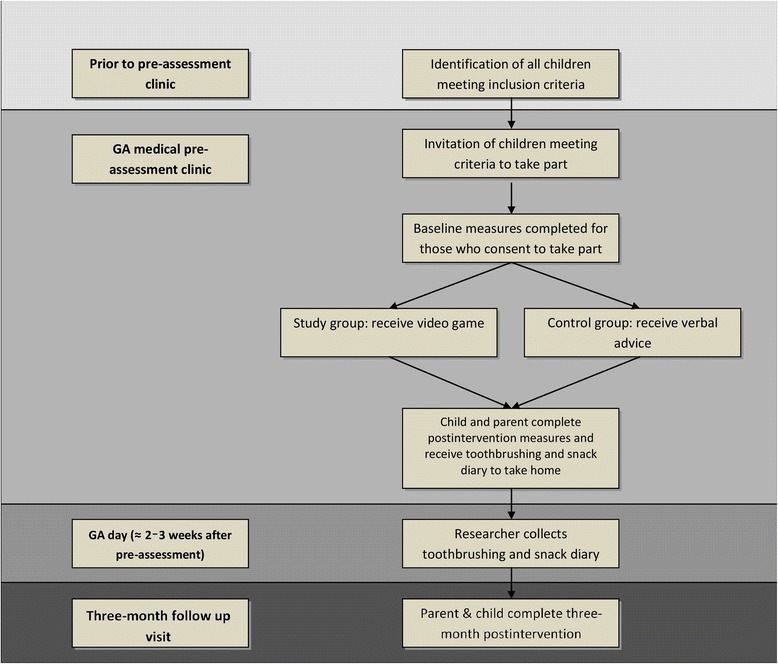
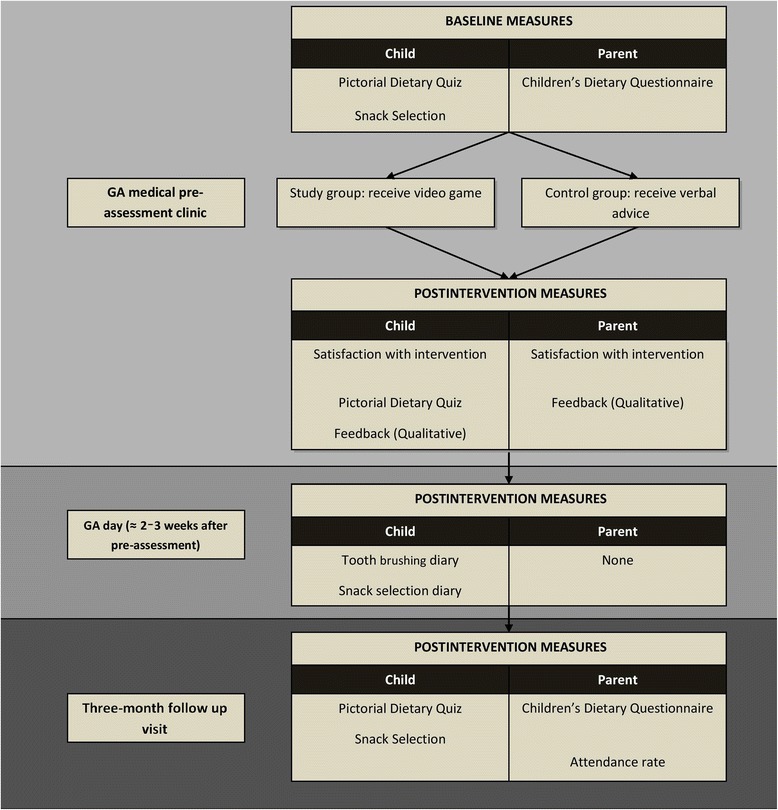
Methods/design: A two-armed phase-II randomized controlled trial will assess a children's oral health education video game in comparison with verbal oral health education in terms of: family satisfaction, effect on oral health knowledge, and effect on dietary and oral hygiene habits. Up to 110 four- to ten-year-old children, referred for tooth extraction under general anaesthesia due to caries, will be recruited. A sample of 45 participants in each group will be needed to provide 80% statistical power. The primary outcome measures for this study are: (1) parent and child satisfaction with the intervention, as indicated using a visual analogue scale; (2) improvement in the child's dietary knowledge measured by a pictorial dietary quiz; and (3) changes in the child's diet and oral hygiene habits, measured using a children's dietary questionnaire completed by the parent, and snacking and toothbrushing diaries completed by the child. Measures will be taken at baseline, directly after the intervention, and three months later.
Discussion: This study is a phase-II randomized controlled trial of an oral health education video game for high caries risk children and their families. Few protocols such as this are available in this much-needed research area.
Trial registration: ISRCTN94617251.
Figures
References
-
- Puska P, Porter D, Petersen PE. Dental diseases and oral health. World Health Organisation. 2003. http://www.who.int/oral_health/publications/en/orh_fact_sheet.pdf.
-
- American Academy of Pediatric Dentistry. Definition of Early Childhood Caries (ECC). 2008. http://www.aapd.org/assets/1/7/D_ECC.pdf.
-
- Public Health England. Oral health survey of three-year-old children 2013: a report on the prevalence and severity of dental decay. 2014. http://www.nwph.net/dentalhealth/reports/DPHEP%20for%20England%20OH%20Su... [Accessed 28 May 2015] for England OH Survey 3yr 2013 Report.pdf.
-
- Davies GM, Neville JS, Rooney E, Robinson M, Jones A, Perkins C. National Dental Epidemiology Programme for England: oral health survey of five-year-old children 2012: a report on the prevalence and severity of dental decay. 2013. http://www.nwph.net/dentalhealth/Oral%20Health%205yr%20old%20children%20... [Accessed 28 May 2015].
Publication types
MeSH terms
Associated data
LinkOut - more resources
Full Text Sources
Other Literature Sources
Medical
Research Materials
