


Evaluation of two novel ⁶⁴Cu-labeled RGD peptide radiotracers for enhanced PET imaging of tumor integrin αvβ₃
- PMID: 26016906
- PMCID: PMC4591102
- DOI: 10.1007/s00259-015-3085-7
Evaluation of two novel ⁶⁴Cu-labeled RGD peptide radiotracers for enhanced PET imaging of tumor integrin αvβ₃
Abstract
Purpose: Our goal was to demonstrate that suitably derivatized monomeric RGD peptide-based PET tracers, targeting integrin αvβ3, may offer advantages in image contrast, time for imaging, and low uptake in nontarget tissues.
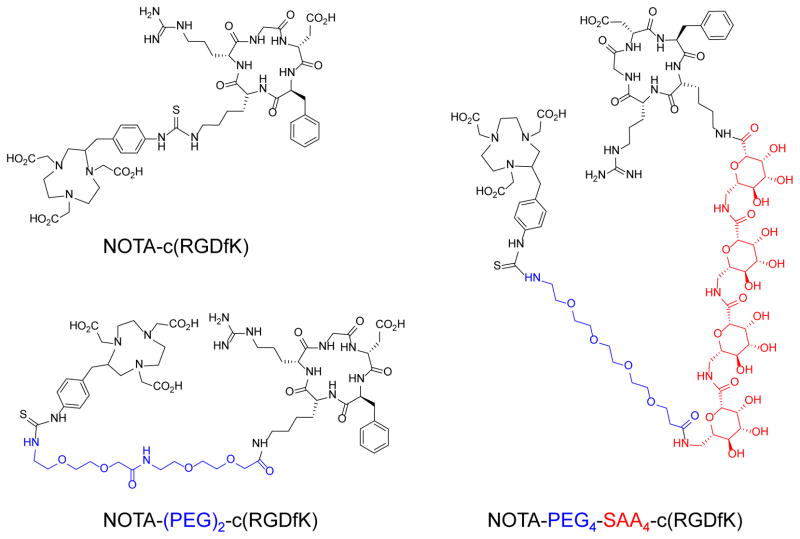
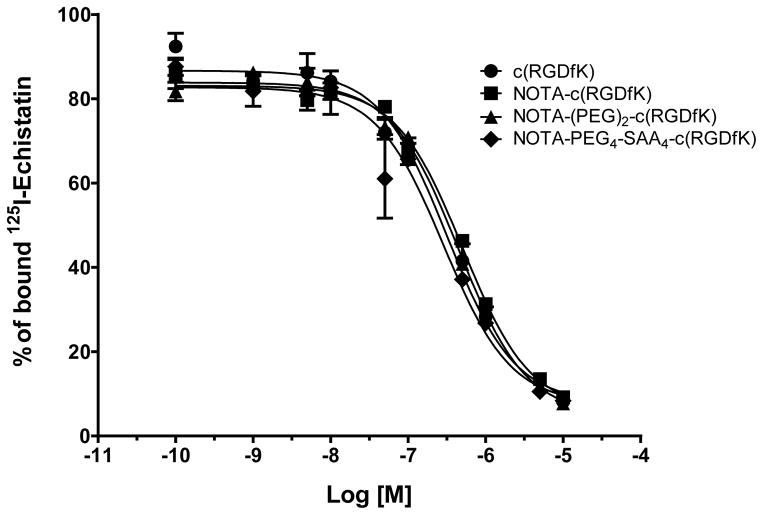
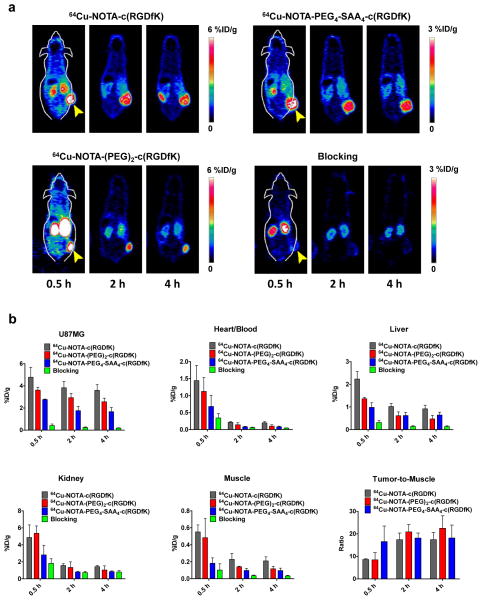
Methods: Two cyclic RGDfK derivatives, (PEG)2-c(RGDfK) and PEG4-SAA4-c(RGDfK), were constructed and conjugated to NOTA for (64)Cu labeling. Their integrin αvβ3-binding properties were determined via a competitive cell binding assay. Mice bearing U87MG tumors were intravenously injected with each of the (64)Cu-labeled peptides, and PET scans were acquired during the first 30 min, and 2 and 4 h after injection. Blocking and ex vivo biodistribution studies were carried out to validate the PET data and confirm the specificity of the tracers.
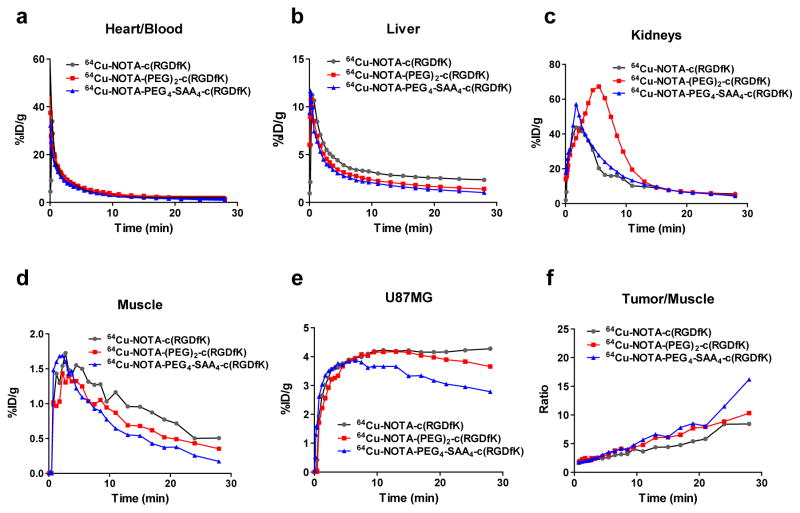
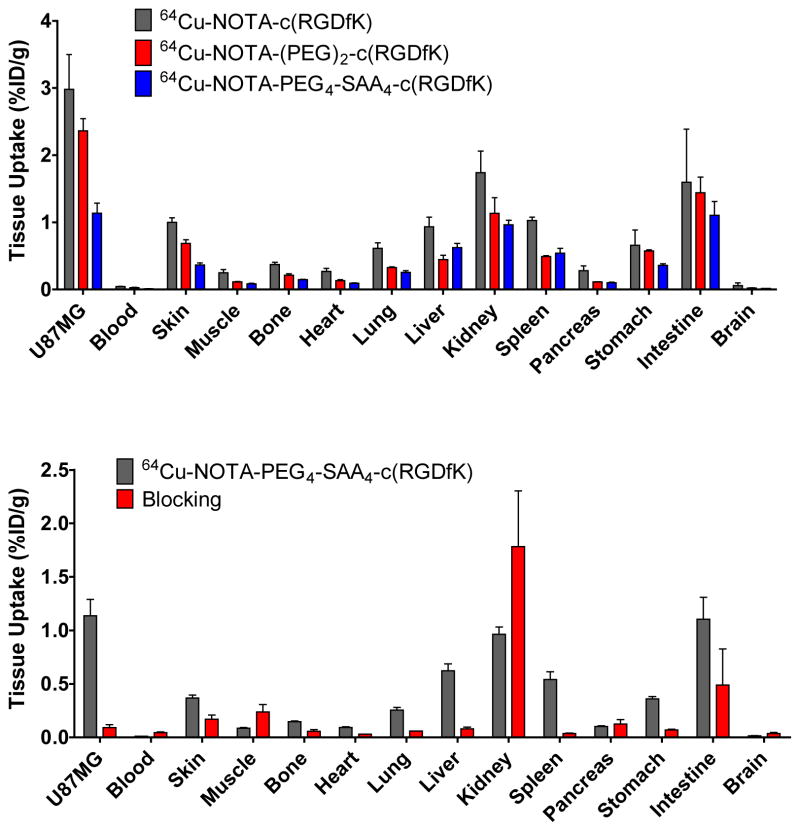
Results: The IC50 values of NOTA-(PEG)2-c(RGDfK) and NOTA-PEG4-SAA4-c(RGDfK) were 444 ± 41 nM and 288 ± 66 nM, respectively. Dynamic PET data of (64)Cu-NOTA-(PEG)2-c(RGDfK) and (64)Cu-NOTA-PEG4-SAA4-c(RGDfK) showed similar circulation t 1/2 and peak tumor uptake of about 4 %ID/g for both tracers. Due to its marked hydrophilicity, (64)Cu-NOTA-PEG4-SAA4-c(RGDfK) provided faster clearance from tumor and normal tissues yet maintained excellent tumor-to-background ratios. Static PET scans at later time-points corroborated the enhanced excretion of the tracer, especially from abdominal organs. Ex vivo biodistribution and receptor blocking studies confirmed the accuracy of the PET data and the integrin αvβ3-specificity of the peptides.
Conclusion: Our two novel RGD-based radiotracers with optimized pharmacokinetic properties allowed fast, high-contrast PET imaging of tumor-associated integrin αvβ3. These tracers may facilitate the imaging of abdominal malignancies, normally precluded by high background uptake.
Keywords: Angiogenesis; Copper-64 (64Cu); Integrin αvβ3; Molecular imaging; Positron emission tomography (PET); RGD peptide.
Conflict of interest statement
Figures
References
-
- Hwang R, Varner J. The role of integrins in tumor angiogenesis. Hematol Oncol Clin North Am. 2004;18:991–1006. vii. - PubMed
-
- Robinson SD, Hodivala-Dilke KM. The role of beta3-integrins in tumor angiogenesis: context is everything. Curr Opin Cell Biol. 2011;23:630–7. - PubMed
-
- Puduvalli VK. Inhibition of angiogenesis as a therapeutic strategy against brain tumors. Cancer Treat Res. 2004;117:307–36. - PubMed
-
- Sengupta S, Chattopadhyay N, Mitra A, Ray S, Dasgupta S, Chatterjee A. Role of alphavbeta3 integrin receptors in breast tumor. J Exp Clin Cancer Res. 2001;20:585–90. - PubMed
-
- Felding-Habermann B, Fransvea E, O’Toole TE, Manzuk L, Faha B, Hensler M. Involvement of tumor cell integrin alpha v beta 3 in hematogenous metastasis of human melanoma cells. Clin Exp Metastasis. 2002;19:427–36. - PubMed
Publication types
MeSH terms
Substances
Grants and funding
LinkOut - more resources
Full Text Sources
Other Literature Sources
Miscellaneous
