


Intervals to Plasmodium falciparum recurrence after anti-malarial treatment in pregnancy: a longitudinal prospective cohort
- PMID: 26017553
- PMCID: PMC4449611
- DOI: 10.1186/s12936-015-0745-9
Intervals to Plasmodium falciparum recurrence after anti-malarial treatment in pregnancy: a longitudinal prospective cohort
Abstract
Background: Plasmodium falciparum infections adversely affect pregnancy. Anti-malarial treatment failure is common. The objective of this study was to examine the duration of persistent parasite carriage following anti-malarial treatment in pregnancy.
Methods: The data presented here are a collation from previous studies carried out since 1994 in the Shoklo Malaria Research Unit (SMRU) on the Thailand-Myanmar border and performed using the same unique methodology detailed in the Materials and Methods section. Screening for malaria by microscopy is a routine part of weekly antenatal care (ANC) visits and therapeutic responses to anti-malarials were assessed in P. falciparum malaria cases. Women with microscopy confirmed P. falciparum malaria had a PCR blood spot from a finger-prick sample collected. Parasite DNA was extracted from the blood-spot samples using saponin lysis/Chelex extraction method and genotyped using polymorphic segments of MSP1, MSP2 and GLURP. Recurrent infections were classified by genotyping as novel, recrudescent or indeterminate. Factors associated with time to microscopy-detected recrudescence were analysed using multivariable regression techniques.
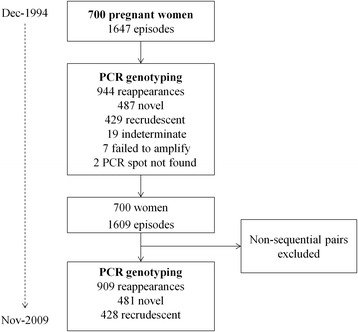
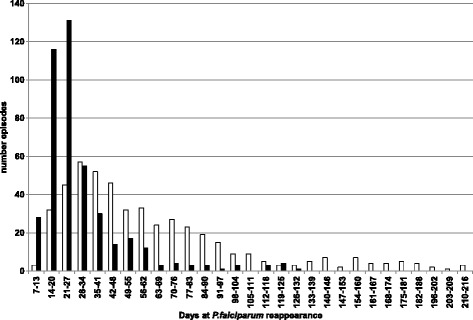
Results: From December 1994 to November 2009, 700 women were treated for P. falciparum and there were 909 recurrent episodes (481 novel and 428 recrudescent) confirmed by PCR genotyping. Most of the recurrences, 85% (770/909), occurred after treatment with quinine monotherapy, artesunate monotherapy or artesunate-clindamycin. The geometric mean number of days to recurrence was significantly shorter in women with recrudescent infection, 24.5 (95%: 23.4-25.8), compared to re-infection, 49.7 (95%: 46.9-52.7), P<0.001. The proportion of recrudescent P. falciparum infections that occurred after days 28, 42 and 63 from the start of treatment was 29.1% (124/428), 13.3% (57/428) and 5.6% (24/428). Recrudescent infections≥100 days after treatment occurred with quinine and mefloquine monotherapy, and quinine+clindamycin and artesunate+atovaquone-proguanil combination therapy. Treatments containing an artemisinin derivative or an intercalated Plasmodium vivax infection increased the geometric mean interval to recrudescence by 1.28-fold (95% CI: 1.09-1.51) and 2.19-fold (1.77-2.72), respectively. Intervals to recrudescence were decreased 0.83-fold (0.73-0.95) if treatment was not fully supervised (suggesting incomplete adherence) and 0.98-fold (0.96-0.99) for each doubling in baseline parasitaemia.
Conclusions: Prolonged time to recrudescence may occur in pregnancy, regardless of anti-malarial treatment. Long intervals to recrudescence are more likely with the use of artemisinin-containing treatments and also observed with intercalated P. vivax infections treated with chloroquine. Accurate determination of drug efficacy in pregnancy requires longer duration of follow-up, preferably until delivery or day 63, whichever occurs last.
Figures
References
-
- Brockman A, Paul RE, Anderson TJ, Hackford I, Phaiphun L, Looareesuwan S, et al. Application of genetic markers to the identification of recrudescent Plasmodium falciparum infections on the northwestern border of Thailand. Am J Trop MedHyg. 1999;60:14–21. - PubMed
Publication types
MeSH terms
Substances
Grants and funding
LinkOut - more resources
Full Text Sources
Other Literature Sources
