


Mass-based condition measures and their relationship with fitness: in what condition is condition?
- PMID: 26019406
- PMCID: PMC4442632
- DOI: 10.1111/jzo.12213
Mass-based condition measures and their relationship with fitness: in what condition is condition?
Abstract
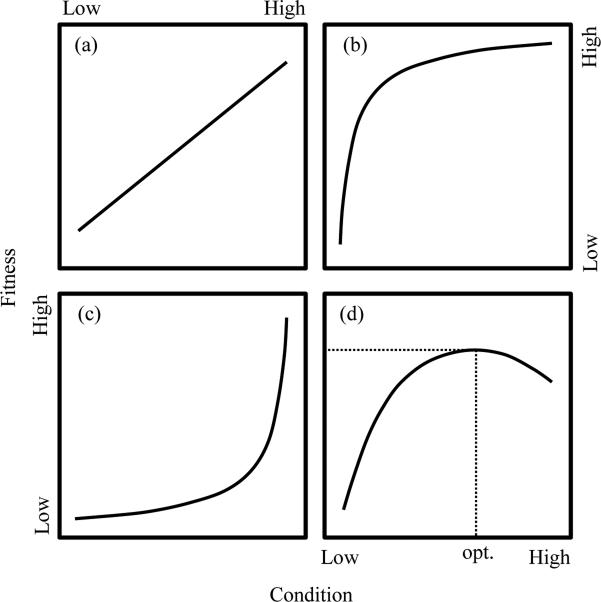
Mass or body-size measures of 'condition' are of central importance to the study of ecology and evolution, and it is often assumed that differences in condition measures are positively and linearly related to fitness. Using examples drawn from ecological studies, we show that indices of condition frequently are unlikely to be related to fitness in a linear fashion. Researchers need to be more explicit in acknowledging the limitations of mass-based condition measures and accept that, under some circumstances, they may not relate to fitness as traditionally assumed. Any relationship between a particular condition measure and fitness should first be empirically validated before condition is used as a proxy for fitness. In the absence of such evidence, researchers should explicitly acknowledge that assuming such a relationship may be unrealistic.
Keywords: birds; condition; fat reserves; fitness; individual phenotypic quality; insects; mammals; mass reserves.
Figures
References
-
- Adamo SA, Roberts JL, Easy RH, Ross NW. Competition between immune function and lipid transport for the protein apolipophorin III leads to stress-induced immunosuppression in crickets. J. Exp. Biol. 2008;211:531–538. - PubMed
-
- Andersson M. The evolution of condition-dependent sex ornaments and mating preferences: sexual selection based on viability differences. Evolution. 1986;40:804–816. - PubMed
-
- Barclay RMR. Constraints on reproduction by flying vertebrates: energy and calcium. Am. Nat. 1994;144:1021–1031.
-
- Bergeron P, Baeta R, Pelletier F, Réale D, Garant D. Individual quality: tautology or biological reality? J. Anim. Ecol. 2011;80:361–364. - PubMed
Grants and funding
LinkOut - more resources
Full Text Sources
Other Literature Sources