Meta-Analysis
. 2015 May 25:21:612-20.
eCollection 2015.

Aqueous humor TGF-β2 levels in patients with open-angle glaucoma: A meta-analysis

Affiliations
Meta-Analysis

Aqueous humor TGF-β2 levels in patients with open-angle glaucoma: A meta-analysis

Puneet Agarwal et al. Mol Vis. .

Abstract

Introduction: Elevated intraocular pressure (IOP) in glaucomatous eyes is often due to increased resistance to aqueous outflow. Previous studies have shown that increased extracellular material deposition in outflow pathways leads to increased resistance to aqueous outflow, and transforming growth factor (TGF)-β seems to play a role in the deposition of extracellular material. TGF-β2 is the predominant isoform in ocular tissue. Hence, comparison of the aqueous humor TGF-β2 level between patients with open-angle glaucoma (OAG) and controls would provide direct evidence for the role of TGF-β2 in the etiology of OAG. Hence, we performed this meta-analysis to develop an accurate estimate of the changes in aqueous humor TGF-β2 levels among OAG patients.

Methods: We undertook the meta-analysis of data from all available studies that had a case-control design and investigated the aqueous humor levels of TGF-β2 (total, active, or both) in OAG patients. OAG included primary OAG (POAG), secondary glaucoma, pseudoexfoliation syndrome, and exfoliation glaucoma (EXG).

Results: We selected a total of eight studies that measured TGF-β2 levels in the aqueous humor of glaucomatous eyes. The studies included in this meta-analysis clearly demonstrated that in OAG eyes, total TGF-β2 levels are significantly elevated, whereas in POAG eyes, both the total and active TGF-β2 levels are significantly higher than in controls.

Conclusions: The analysis of pooled data showed that aqueous humor TGF-β2 levels are elevated in patients with OAG and POAG.


Figures
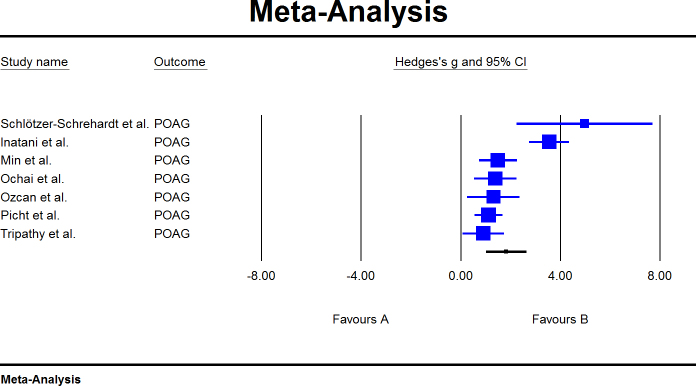
Figure 1
Figure 1
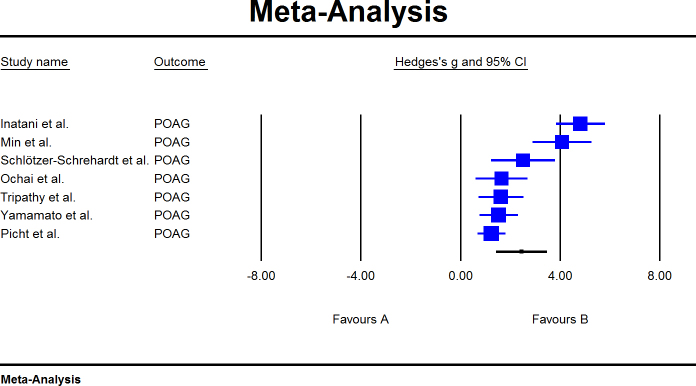
Forest plot of the standardized mean difference and 95% CIs of the active TGF-β2 levels in aqueous humor between the patients with POAG and the control subjects. The blue squares represent individual studies, and the size of the square represents the weight given to each study in the meta-analysis. The black square represents the pooled estimate. The horizontal lines represent 95% confidence interval (CI). The pooled results showed that patients with primary open angle glaucoma had higher active transforming growth factor (TGF)-β2 levels than the controls.
Figure 2
Figure 2
Forest plot of the standardized mean difference and 95% CIs of the total TGF-β2 levels in aqueous humor between the patients with POAG and the control subjects. The blue squares represent individual studies, and the size of the square represents the weight given to each study in the meta-analysis. The black square represents the pooled estimate. The horizontal lines represent the 95% confidence interval (CI). The pooled results showed that patients with primary open angle glaucoma had higher total transforming growth factor (TGF)-β2 levels than the controls.
Figure 3
Figure 3
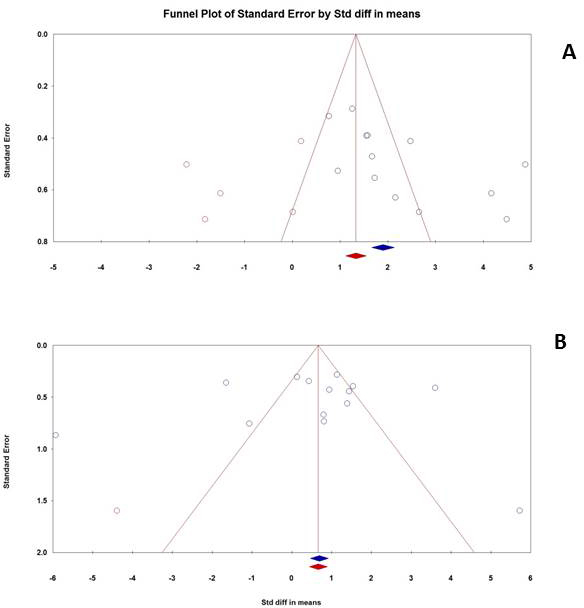
Begg’s funnel plot with the Egger’s test for publication bias for association of TGF-β levels in aqueous humor with risks of OAG. The vertical line in the funnel plot indicates the fixed-effects summary estimate, whereas the diagonal lines represent the pseudo-95% confidence interval (CI) limits concerning the effect estimate. In the absence of publication bias, studies are distributed symmetrically to the right and left of the vertical line. The blue symbols refer to the observed studies, while the red is the imputed studies, that is, expected if larger numbers of studies with negative results have been included in the analysis. A: Total transforming growth factor (TGF)-β2 levels in open-angle glaucoma (OAG), PEgger’s test=0.02 B: Active TGF-β levels in OAG, PEgger’s test=0.82.
Figure 4
Figure 4
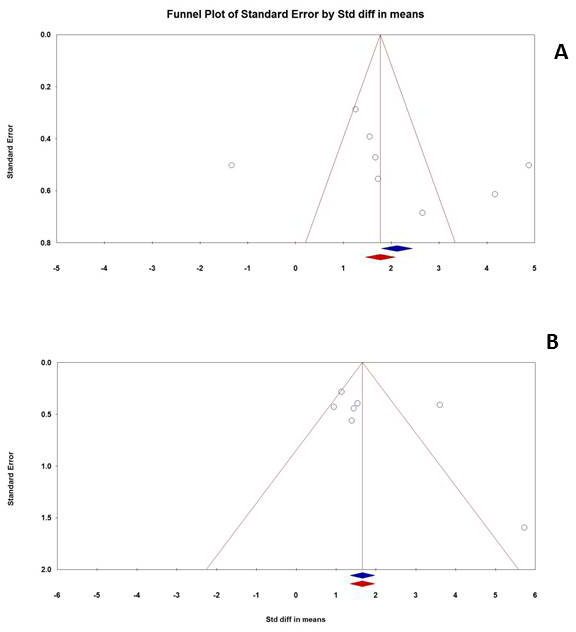
Begg’s funnel plot with the Egger’s test for publication bias for association of TGF-β levels in aqueous humor with risks of POAG. The vertical line in the funnel plot indicates the fixed-effects summary estimate, whereas the diagonal lines represent pseudo-95% confidence interval (CI) limits concerning the effect estimate. In the absence of publication bias, studies are distributed symmetrically to the right and left of the vertical line. The blue symbols refer to the observed studies, while the red is the imputed studies, that is, expected if larger numbers of studies with negative results have been included in the analysis. A: Total transforming growth factor (TGF)-β levels in primary open-angle glaucoma (POAG), PEgger’s test=0.13 B: Active TGF-β levels in POAG, PEgger’s test=0.30.

References

    1. Distelhorst JS, Hughes GM. Open-angle glaucoma. Am Fam Physician. 2003;67:1937–44. - PubMed
    1. Hynes RO. The extracellular matrix: not just pretty fibrils. Science. 2009;326:1216–9. - PMC - PubMed
    1. Lütjen-Drecoll E, Shimizu T, Rohrbach M, Rohen JW. Quantitative analysis of “plaque material” between ciliary muscle tips in normal and glaucomatous eyes. Exp Eye Res. 1986;42:457–65. - PubMed
    1. Rohen JW, Lütjen-Drecoll E, Flügel C, Meyer M, Grierson I. Ultrastructure of the trabecular meshwork in untreated cases of primary open-angle glaucoma (POAG). Exp Eye Res. 1993;56:683–92. - PubMed
    1. Gottanka J, Johnson DH, Martus P, Lütjen-Drecoll E. Severity of optic nerve damage in eyes with POAG is correlated with changes in the trabecular meshwork. J Glaucoma. 1997;6:123–32. - PubMed

Publication types

MeSH terms

Substances

LinkOut - more resources