


High prevalence of hypertension and of risk factors for non-communicable diseases (NCDs): a population based cross-sectional survey of NCDS and HIV infection in Northwestern Tanzania and Southern Uganda
- PMID: 26021319
- PMCID: PMC4476208
- DOI: 10.1186/s12916-015-0357-9
High prevalence of hypertension and of risk factors for non-communicable diseases (NCDs): a population based cross-sectional survey of NCDS and HIV infection in Northwestern Tanzania and Southern Uganda
Abstract
Background: The burden of non-communicable diseases (NCDs) is increasing in sub-Saharan Africa, but data available for intervention planning are inadequate. We determined the prevalence of selected NCDs and HIV infection, and NCD risk factors in northwestern Tanzania and southern Uganda.
Methods: A population-based cross-sectional survey was conducted, enrolling households using multistage sampling with five strata per country (one municipality, two towns, two rural areas). Consenting adults (≥18 years) were interviewed using the WHO STEPS survey instrument, examined, and tested for HIV and diabetes mellitus (DM). Adjusting for survey design, we estimated population prevalences of hypertension, DM, obstructive pulmonary disease, cardiac failure, epilepsy and HIV, and investigated factors associated with hypertension using logistic regression.
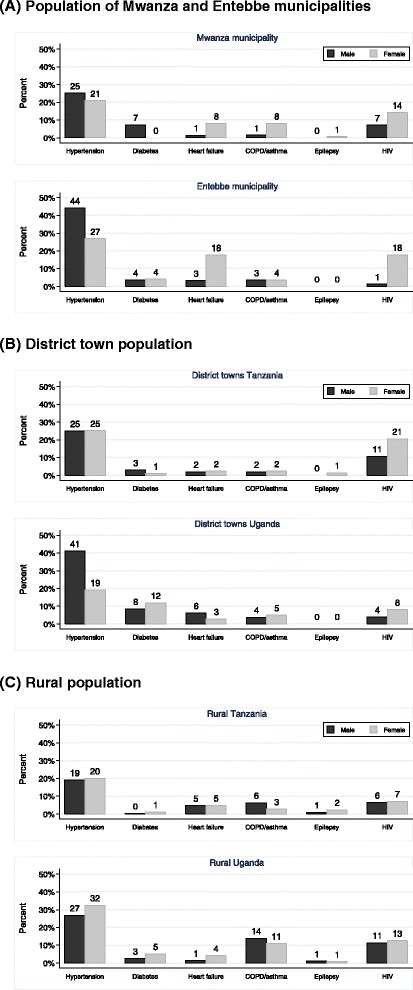
Results: Across strata, hypertension prevalence ranged from 16 % (95 % confidence interval (CI): 12 % to 22 %) to 17 % (CI: 14 % to 22 %) in Tanzania, and from 19 % (CI: 14 % to 26 %) to 26 % (CI: 23 % to 30 %) in Uganda. It was high in both urban and rural areas, affecting many young participants. The prevalence of DM (1 % to 4 %) and other NCDs was generally low. HIV prevalence ranged from 6 % to 10 % in Tanzania, and 6 % to 12 % in Uganda. Current smoking was reported by 12 % to 23 % of men in different strata, and 1 % to 3 % of women. Problem drinking (defined by Alcohol Use Disorder Identification Test criteria) affected 6 % to 15 % men and 1 % to 6 % women. Up to 46 % of participants were overweight, affecting women more than men and urban more than rural areas. Most patients with hypertension and other NCDs were unaware of their condition, and hypertension in treated patients was mostly uncontrolled. Hypertension was associated with older age, male sex, being divorced/widowed, lower education, higher BMI and, inversely, with smoking.
Conclusions: The high prevalence of NCD risk factors and unrecognized and untreated hypertension represent major problems. The low prevalence of DM and other preventable NCDs provides an opportunity for prevention. HIV prevalence was in line with national data. In Tanzania, Uganda and probably elsewhere in Africa, major efforts are needed to strengthen health services for the PREVENTION, early detection and treatment of chronic diseases.
Figures


References
-
- The World Bank Human Development Network. The growing danger of non-communicable diseases. Acting now to reverse course. 2011. http://www-wds.worldbank.org/external/default/WDSContentServer/WDSP/IB/2.... Accessed 18 Aug 2014.
-
- Twagirumukiza M, De Bacquer D, Kips JG, de Backer G, Stichele RV, Van Bortel LM. Current and projected prevalence of arterial hypertension in sub-Saharan Africa by sex, age and habitat: an estimate from population studies. J Hypertens. 2011;29:1243–52. doi: 10.1097/HJH.0b013e328346995d. - DOI - PubMed
-
- International Diabetes Federation. Diabetes atlas 2012. http://www.idf.org/diabetesatlas/5e/regional-overviews. Accessed 24 Sept 2013.
Publication types
MeSH terms
Grants and funding
LinkOut - more resources
Full Text Sources
Other Literature Sources
Medical
