. 2015 May 29:5:10342.
doi: 10.1038/srep10342.

Targeted mutagenesis in soybean using the CRISPR-Cas9 system

Affiliations

Targeted mutagenesis in soybean using the CRISPR-Cas9 system

Xianjun Sun et al. Sci Rep. .

Abstract

Genome editing is a valuable technique for gene function analysis and crop improvement. Over the past two years, the CRISPR-Cas9 system has emerged as a powerful tool for precisely targeted gene editing. In this study, we predicted 11 U6 genes in soybean (Glycine max L.). We then constructed two vectors (pCas9-GmU6-sgRNA and pCas9-AtU6-sgRNA) using the soybean U6-10 and Arabidopsis U6-26 promoters, respectively, to produce synthetic guide RNAs (sgRNAs) for targeted gene mutagenesis. Three genes, Glyma06g14180, Glyma08g02290 and Glyma12g37050, were selected as targets. Mutations of these three genes were detected in soybean protoplasts. The vectors were then transformed into soybean hairy roots by Agrobacterium rhizogenes infection, resulting in efficient target gene editing. Mutation efficiencies ranged from 3.2-9.7% using the pCas9-AtU6-sgRNA vector and 14.7-20.2% with the pCas9-GmU6-sgRNA vector. Biallelic mutations in Glyma06g14180 and Glyma08g02290 were detected in transgenic hairy roots. Off-target activities associated with Glyma06g14180 and Glyma12g37050 were also detected. Off-target activity would improve mutation efficiency for the construction of a saturated gene mutation library in soybean. Targeted mutagenesis using the CRISPR-Cas9 system should advance soybean functional genomic research, especially that of genes involved in the roots and nodules.


Figures
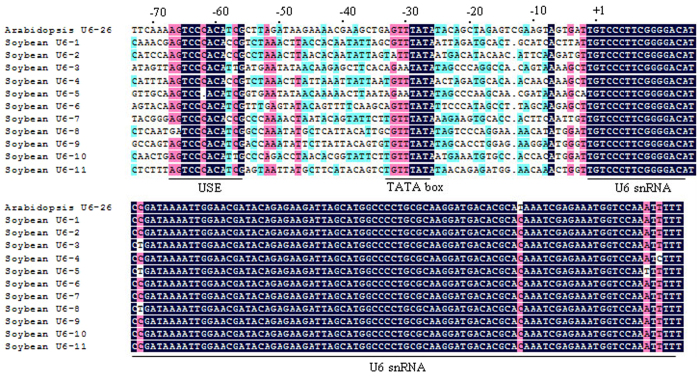
Figure 1
Figure 1
Alignment of 11 soybean U6 and Arabidopsis U6-26 genes. Soybean U6 and Arabidopsis U6-26 genes are highly conserved. Upstream sequence element (USE), TATA-box and U6 small nuclear RNA (snRNA) sequence regions are underlined.
Figure 2
Figure 2
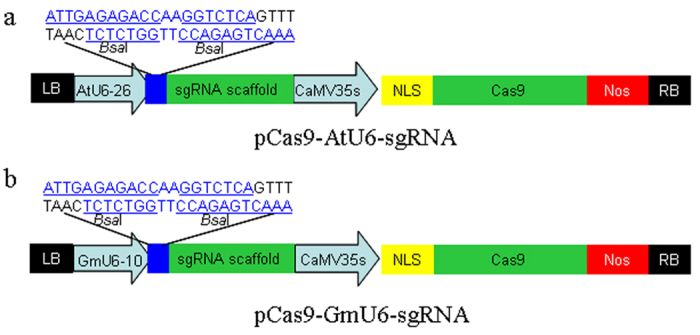
Construction of binary vectors for genome editing in soybean. Cas9 fused with a single nuclear localization signal (NLS) is expressed with a Cauliflower mosaic virus 35s (CaMV 35s) promoter. Synthetic guide RNA (sgRNA) is derived using U6 promoters. (a) Arabidopsis thaliana U6-26 promoter (b) Glycine max U6-10 promoter. Sequences containing two BsaI sites are located between the U6 promoter and the sgRNA scaffold. These sequences can be easily replaced with a gene-specific sgRNA seed. LB: left border; RB: right border.
Figure 3
Figure 3
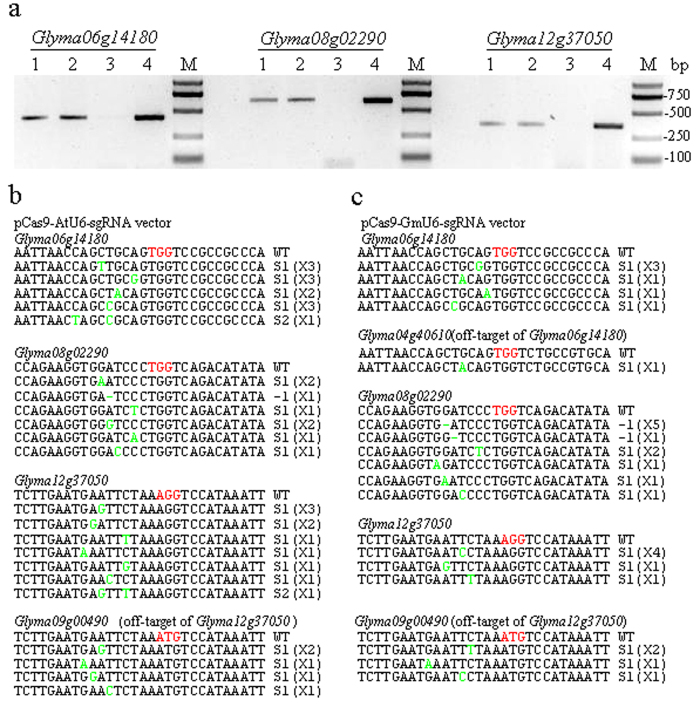
Targeted mutagenesis in soybean protoplasts. (a) Detection of mutations using restriction enzyme-PCR (RE-PCR). Lanes 1 and 2: PCR products of digested genomic DNA from protoplasts treated with pCas9-AtU6-sgRNA and pCas9-GmU6-sgRNA, respectively; Lanes 3 and 4: PCR products of digested and undigested genomic DNA, respectively, from wild-type controls. (b) and (c) Sequence-based detection of mutations induced by pCas9-AtU6-sgRNA and pCas9-GmU6-sgRNA vectors, respectively. Wild-type sequences of the target genes and off-target genes are shown with the protospacer-adjacent motif sequence highlighted in red. The change in the number of nucleotides is shown to the right of each sequence. D: deletion; S: substitution. Nucleotide substitutions are shown in green. The number of clones for each mutant is given in brackets.
Figure 4
Figure 4
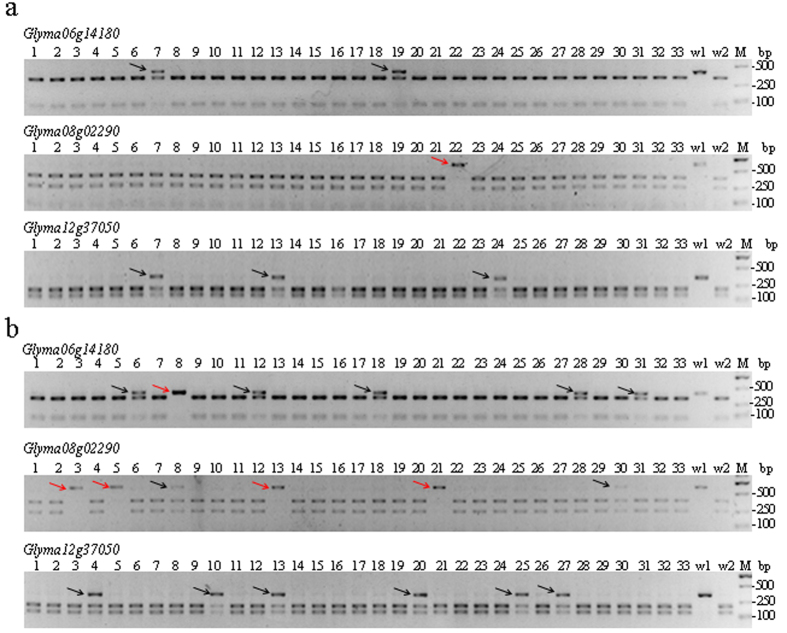
Detection of mutants using the PCR-restriction enzyme (PCR-RE) assay. Detection of mutations using the PCR-restriction enzyme (PCR-RE) assay. Lanes 1–33: the digested DNA of the PCR products amplified from the independent hairy root samples; The monoallelic and biallelic mutants are shown with black and red arrows, respectively. w1 and w2: the undigested and digested DNA, respectively, from the PCR products amplified from wild-type controls. (a) Targeted mutations induced by the pCas9-AtU6-sgRNA vector. (b) Targeted mutations induced by the pCas9-GmU6-sgRNA vector.
Figure 5
Figure 5
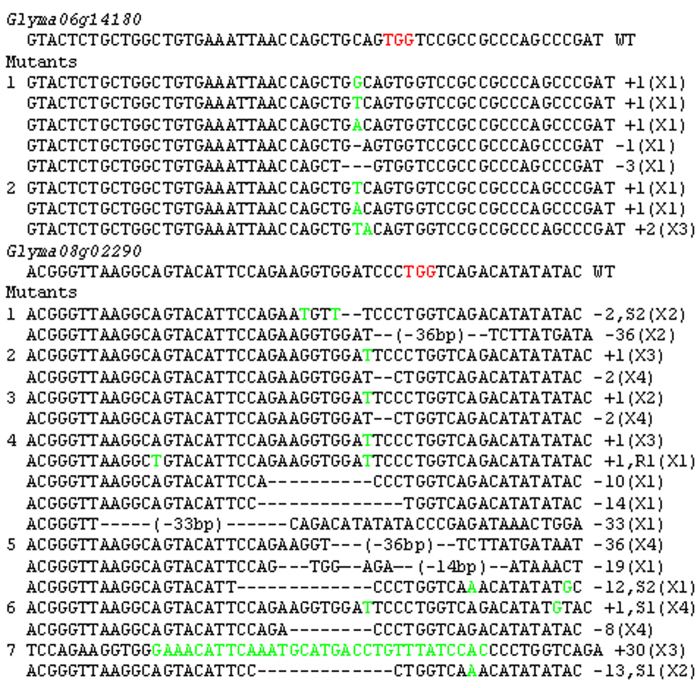
Gene sequences from 9 independent biallelic mutants. Gene sequences are shown for 9 independent biallelic mutants. Wild-type sequences of the target genes are shown with the protospacer-adjacent motif sequence highlighted in red. The change in the number of nucleotides is shown to the right of each sequence. +: insertion; D: deletion; S: substitution. Inserted and substituted nucleotides are shown in green.
Figure 6
Figure 6
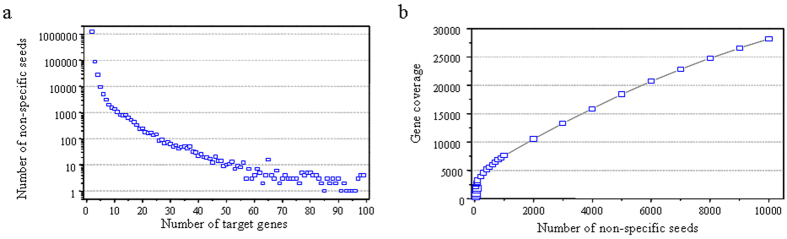
Non-specific synthetic guide RNA (sgRNA) seeds in soybean. (6a) Distribution of non-specific sgRNA seeds and the number of their target genes. More than 1 million sgRNA seeds were associated with two target genes; approximately 100,000 sgRNA seeds were able to target three genes. sgRNA seeds having more than 100 target genes are not shown. (6b) Maximal gene coverage of non-specific sgRNA seeds. The non-specific sgRNA seeds were sorted by their target gene numbers before calculating the maximal gene coverage.

References

    1. Chen K. & Gao C. Targeted genome modification technologies and their applications in crop improvements. Plant Cell Rep. 33, 575–583 (2014). - PubMed
    1. Wyman C. & Kanaar R. DNA double-strand break repair: all’s well that ends well. Annu. Rev. Genet. 40, 363–383 (2006). - PubMed
    1. Gaj T., Gersbach C. A. & Barbas C. F. 3rd. ZFN, TALEN, and CRISPR/Cas-based methods for genome engineering. Trends Biotechnol. 31, 397–405 (2013). - PMC - PubMed
    1. Puchta H. & Fauser F. Synthetic nucleases for genome engineering in plants: prospects for a bright future. Plant J. 78, 727–741 (2013). - PubMed
    1. Koonin E. V. & Makarova K. S. CRISPR-Cas: an adaptive immunity system in prokaryotes. F1000 Biol. Rep. 1, 95 (2009). - PMC - PubMed

Publication types

Substances