


Unravelling core microbial metabolisms in the hypersaline microbial mats of Shark Bay using high-throughput metagenomics
- PMID: 26023869
- PMCID: PMC4681862
- DOI: 10.1038/ismej.2015.87
Unravelling core microbial metabolisms in the hypersaline microbial mats of Shark Bay using high-throughput metagenomics
Abstract
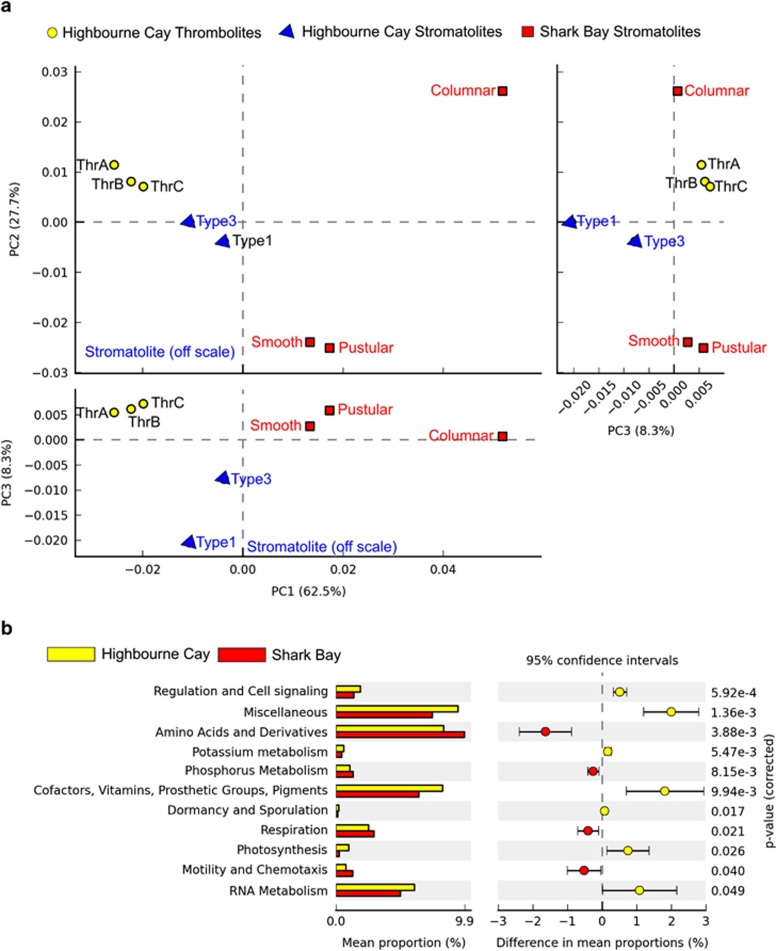
Modern microbial mats are potential analogues of some of Earth's earliest ecosystems. Excellent examples can be found in Shark Bay, Australia, with mats of various morphologies. To further our understanding of the functional genetic potential of these complex microbial ecosystems, we conducted for the first time shotgun metagenomic analyses. We assembled metagenomic next-generation sequencing data to classify the taxonomic and metabolic potential across diverse morphologies of marine mats in Shark Bay. The microbial community across taxonomic classifications using protein-coding and small subunit rRNA genes directly extracted from the metagenomes suggests that three phyla Proteobacteria, Cyanobacteria and Bacteriodetes dominate all marine mats. However, the microbial community structure between Shark Bay and Highbourne Cay (Bahamas) marine systems appears to be distinct from each other. The metabolic potential (based on SEED subsystem classifications) of the Shark Bay and Highbourne Cay microbial communities were also distinct. Shark Bay metagenomes have a metabolic pathway profile consisting of both heterotrophic and photosynthetic pathways, whereas Highbourne Cay appears to be dominated almost exclusively by photosynthetic pathways. Alternative non-rubisco-based carbon metabolism including reductive TCA cycle and 3-hydroxypropionate/4-hydroxybutyrate pathways is highly represented in Shark Bay metagenomes while not represented in Highbourne Cay microbial mats or any other mat forming ecosystems investigated to date. Potentially novel aspects of nitrogen cycling were also observed, as well as putative heavy metal cycling (arsenic, mercury, copper and cadmium). Finally, archaea are highly represented in Shark Bay and may have critical roles in overall ecosystem function in these modern microbial mats.
Figures
References
-
- Allakhverdiev S, Murata N. (2008). Salt stress inhibits photosystems II and I in cyanobacteria. Photosynthesis Res 98: 529–539. - PubMed
-
- Allen MA, Goh F, Leuko S, Echigo A, Mizuki T, Usami R et al. (2008). Haloferax elongans sp. nov. and Haloferax mucosum sp. nov., isolated from microbial mats from Hamelin Pool, Shark Bay, Australia. Int J Syst Evol Microbiol 58: 798–802. - PubMed
-
- Allen MA, Goh F, Burns BP, Neilan BA. (2009). Bacterial, archaeal and eukaryotic diversity of smooth and pustular microbial mat communities in the hypersaline lagoon of Shark Bay. Geobiology 7: 82–96. - PubMed
-
- Atkinson MJ. (1987). Low phosphorus sediments in a Hypersaline Marine Bay. Estuar Coast Shelf S 24: 335–347.
Publication types
MeSH terms
Substances
LinkOut - more resources
Full Text Sources
Other Literature Sources
Molecular Biology Databases
