. 2015 Oct 1;24(19):5589-602.
doi: 10.1093/hmg/ddv203. Epub 2015 May 29.

Multiple novel prostate cancer susceptibility signals identified by fine-mapping of known risk loci among Europeans

Ali Amin Al Olama  1 Tokhir Dadaev  2 Dennis J Hazelett  3 Qiuyan Li  4 Daniel Leongamornlert  2 Edward J Saunders  2 Sarah Stephens  2 Clara Cieza-Borrella  2 Ian Whitmore  2 Sara Benlloch Garcia  1 Graham G Giles  5 Melissa C Southey  6 Liesel Fitzgerald  7 Henrik Gronberg  8 Fredrik Wiklund  8 Markus Aly  9 Brian E Henderson  10 Fredrick Schumacher  10 Christopher A Haiman  10 Johanna Schleutker  11 Tiina Wahlfors  12 Teuvo L Tammela  13 Børge G Nordestgaard  14 Tim J Key  15 Ruth C Travis  15 David E Neal  16 Jenny L Donovan  17 Freddie C Hamdy  18 Paul Pharoah  19 Nora Pashayan  20 Kay-Tee Khaw  21 Janet L Stanford  22 Stephen N Thibodeau  23 Shannon K Mcdonnell  23 Daniel J Schaid  23 Christiane Maier  24 Walther Vogel  25 Manuel Luedeke  24 Kathleen Herkommer  26 Adam S Kibel  27 Cezary Cybulski  28 Dominika Wokołorczyk  28 Wojciech Kluzniak  28 Lisa Cannon-Albright  29 Hermann Brenner  30 Katja Butterbach  30 Volker Arndt  31 Jong Y Park  32 Thomas Sellers  32 Hui-Yi Lin  33 Chavdar Slavov  34 Radka Kaneva  35 Vanio Mitev  35 Jyotsna Batra  36 Judith A Clements  36 Amanda Spurdle  37 Manuel R Teixeira  38 Paula Paulo  39 Sofia Maia  39 Hardev Pandha  40 Agnieszka Michael  40 Andrzej Kierzek  40 Koveela Govindasami  2 Michelle Guy  2 Artitaya Lophatonanon  41 Kenneth Muir  41 Ana Viñuela  42 Andrew A Brown  43 PRACTICAL ConsortiumCOGS-CRUK GWAS-ELLIPSE (Part of GAME-ON) InitiativeAustralian Prostate Cancer BioResourceUK Genetic Prostate Cancer Study CollaboratorsUK ProtecT Study CollaboratorsMathew Freedman  44 David V Conti  3 Douglas Easton  1 Gerhard A Coetzee  3 Rosalind A Eeles  2 Zsofia Kote-Jarai  45
Collaborators, Affiliations

Multiple novel prostate cancer susceptibility signals identified by fine-mapping of known risk loci among Europeans

Ali Amin Al Olama et al. Hum Mol Genet. .

Abstract

Genome-wide association studies (GWAS) have identified numerous common prostate cancer (PrCa) susceptibility loci. We have fine-mapped 64 GWAS regions known at the conclusion of the iCOGS study using large-scale genotyping and imputation in 25 723 PrCa cases and 26 274 controls of European ancestry. We detected evidence for multiple independent signals at 16 regions, 12 of which contained additional newly identified significant associations. A single signal comprising a spectrum of correlated variation was observed at 39 regions; 35 of which are now described by a novel more significantly associated lead SNP, while the originally reported variant remained as the lead SNP only in 4 regions. We also confirmed two association signals in Europeans that had been previously reported only in East-Asian GWAS. Based on statistical evidence and linkage disequilibrium (LD) structure, we have curated and narrowed down the list of the most likely candidate causal variants for each region. Functional annotation using data from ENCODE filtered for PrCa cell lines and eQTL analysis demonstrated significant enrichment for overlap with bio-features within this set. By incorporating the novel risk variants identified here alongside the refined data for existing association signals, we estimate that these loci now explain ∼38.9% of the familial relative risk of PrCa, an 8.9% improvement over the previously reported GWAS tag SNPs. This suggests that a significant fraction of the heritability of PrCa may have been hidden during the discovery phase of GWAS, in particular due to the presence of multiple independent signals within the same region.


Figures

Figure 1.
Figure 1.
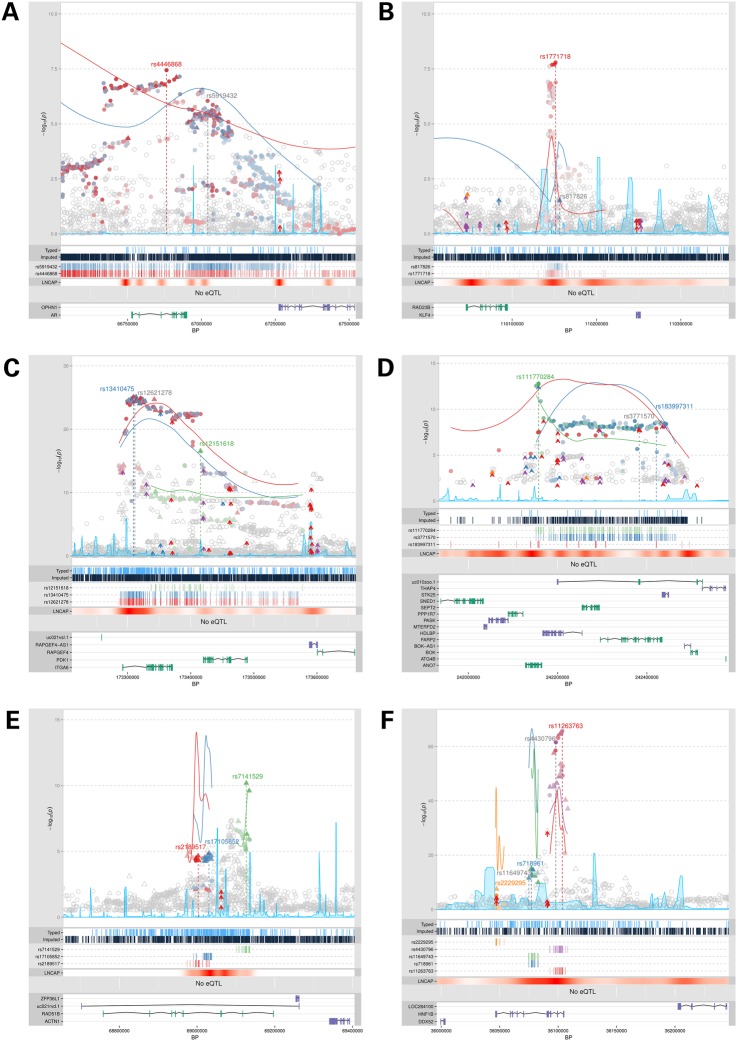
Locus explorer plots of two simple and four complex regions. (A) Region 23_3 at ChrXq12, (B) Region 9_1 at Chr9q31, (C) Region 2_6 at Chr2q31, (D) Region 2_8 at Chr2q37, (E) Region 14_2 at Chr14q24 and (F) Region 17_2 at Chr17q12. For regions containing multiple independent association signals, the separate lead SNPs are indicated and colored red, blue, green, orange and purple, respectively. Original GWAS tag SNPs that were replaced during fine-mapping are marked in gray on the plot. Clusters of correlated variants for each signal are distinguished using different colors in the plot and on the panel below, including for the original GWAS SNPs. Stronger shading indicates greater correlation with the lead SNP, with variants not correlated at r2 ≥ 0.5 with any lead SNP uncolored. Directly genotyped variants are denoted as triangles and imputed variants as circles. Log10 P-values are shown on the Y-axis of the plot. Colored arrows within the plot mark SNPs that overlap with regulatory elements in ENCODE; red for 3′UTRs, blue for coding variants, purple for promoters and orange for miRNA sites. The position of genes within the region and the genomic coordinates of the plot are shown on the lower panel, with genes on the positive strand in green and the negative strand in purple. The LNCaP track shows the density of annotated bio-features within the LNCaP cell-line (data from ENCODE).
Figure 2.
Figure 2.
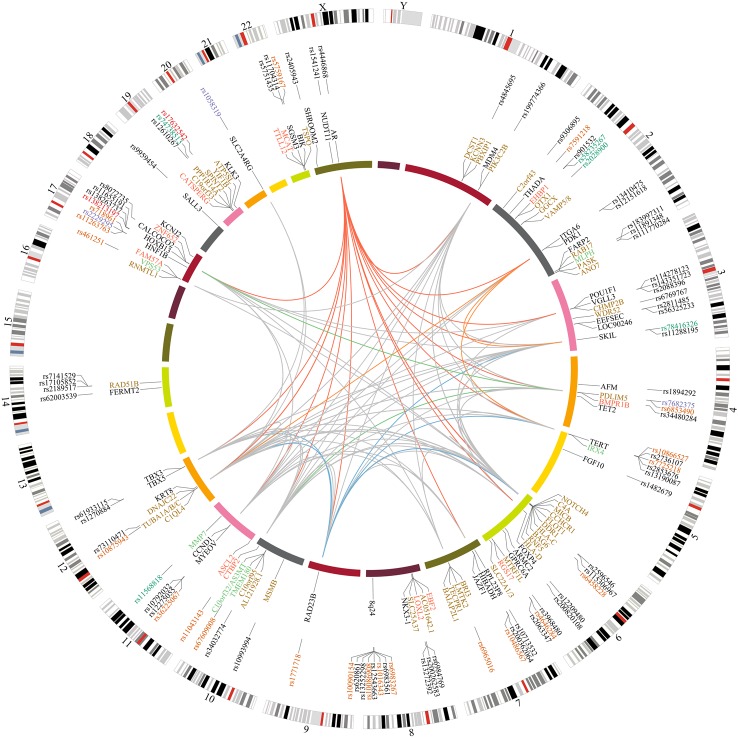
Circos plot overview of functional annotation and eQTL data for fine-mapped PrCa risk loci generated using Circos (http://circos.ca/, 62). The outer ring is a circular ideogram of the human genome annotated with chromosome number. The positions of the novel index SNPs for PrCa susceptibility identified through fine-mapping are indicated adjacent to this and are color coded for overlap with enhancer elements in LNCaP in orange, promoter regions in green, coding SNPs in red, variants within UTR regions in purple and variants with no annotated functionality in black. The inner ring denotes potential candidate genes for the refined PrCa regions. Genes for which an SNP in the best candidate list is a significant eQTL in prostate tissue in TCGA data are indicated in red, eQTLs in skin tissue from EuroBATS data are marked in brown, eQTLs for both prostate and skin in green and for regions with no significant eQTL in either tissue the closest flanking gene is indicated in black. Gene interaction networks between potential candidate genes are shown as links in the central portion of the plot. The genes annotated on the inner ring were used to construct a network using the BioGRID interaction database filtered to exclude ubiquitin and interactions with more than a single intervening gene between the candidate genes. Red links indicate an interaction network with the AR gene, other examples of interaction highlighted in color: blue—RAD23B, green—BMPR1B, orange—PDK1 and all other interactions are marked in gray.

References

    1. Hjelmborg J.B., Scheike T., Holst K., Skytthe A., Penney K.L., Graff R.E., Pukkala E., Christensen K., Adami H.O., Holm N.V. et al. (2014) The heritability of prostate cancer in the Nordic Twin Study of Cancer. Cancer Epidemiol. Biomarkers Prev., 23, 2303–2312. - PMC - PubMed
    1. Leongamornlert D., Saunders E., Dadaev T., Tymrakiewicz M., Goh C., Jugurnauth-Little S., Kozarewa I., Fenwick K., Assiotis I., Barrowdale D. et al. (2014) Frequent germline deleterious mutations in DNA repair genes in familial prostate cancer cases are associated with advanced disease. Br. J. Cancer, 110, 1663–1672. - PMC - PubMed
    1. Ewing C.M., Ray A.M., Lange E.M., Zuhlke K.A., Robbins C.M., Tembe W.D., Wiley K.E., Isaacs S.D., Johng D., Wang Y. et al. (2012) Germline mutations in HOXB13 and prostate-cancer risk. N. Engl. J. Med., 366, 141–149. - PMC - PubMed
    1. Al Olama A.A., Kote-Jarai Z., Berndt S.I., Conti D.V., Schumacher F., Han Y., Benlloch S., Hazelett D.J., Wang Z., Saunders E. et al. (2014) A meta-analysis of 87,040 individuals identifies 23 new susceptibility loci for prostate cancer. Nat. Genet., 46, 1103–1109. - PMC - PubMed
    1. Kote-Jarai Z., Amin Al Olama A., Leongamornlert D., Tymrakiewicz M., Saunders E., Guy M., Giles G.G., Severi G., Southey M., Hopper J.L. et al. (2011) Identification of a novel prostate cancer susceptibility variant in the KLK3 gene transcript. Hum. Genet., 129, 687–694. - PMC - PubMed

Publication types