


An economic evaluation of a contingency-management intervention for stimulant use among community mental health patients with serious mental illness
- PMID: 26026494
- PMCID: PMC4509830
- DOI: 10.1016/j.drugalcdep.2015.05.004
An economic evaluation of a contingency-management intervention for stimulant use among community mental health patients with serious mental illness
Abstract
Background: This study examines the cost-effectiveness of contingency-management (CM) for stimulant dependence among community mental health patients with serious mental illness (SMI) METHODS: Economic evaluation of a 12-week randomized controlled trial investigating the efficacy of CM added to treatment-as-usual (CM+TAU), relative to TAU without CM, for treating stimulant dependence among patients with a SMI. The trial included 176 participants diagnosed with SMI and stimulant dependency who were receiving community mental health and addiction treatment at one community mental health center in Seattle, Washington. Participants were also assessed during a 12-week follow-up period. Positive and negative syndrome scale (PANSS) scores were used to calculate quality-adjusted life-years (QALYs) for the primary economic outcome. The primary clinical outcome, the stimulant-free year (SFY) is a weighted measure of time free from stimulants. Two perspectives were adopted, those of the provider and the payer.
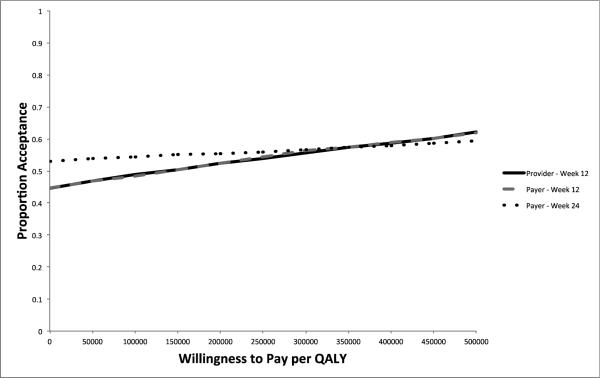
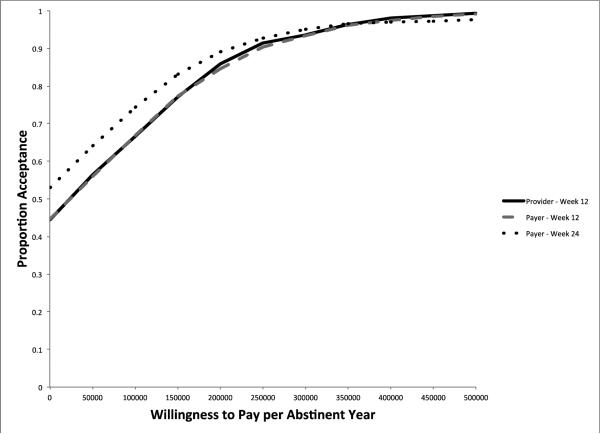
Results: At 12-weeks neither the provider ($2652, p=0.74) nor the payer ($2611, p=0.99) cost differentials were statistically significant. This was also true for the payer at 24-weeks (-$125, p=1.00). QALYs gained were similar across groups, resulting in small, insignificant differences (0.04, p=0.23 at 12-weeks; 0.01, p=0.70 at 24 weeks). CM+TAU experienced significantly more SFYs, 0.24 (p<0.001) at 12 weeks and 0.20 (p=0.002) at 24 weeks, resulting in at least an 85% chance of being considered cost-effective at a threshold of $200,000/SFY.
Conclusion: Contingency management appears to be a wise investment for both the provider and the payer with regard to the clinical outcome of time free from stimulants.
Keywords: Contingency management; Cost effectiveness; Serious mental illness; Stimulant use.
Copyright © 2015 Elsevier Ireland Ltd. All rights reserved.
Figures
References
-
- Abram KM, Teplin LA. Co-occurring disorders among mentally ill jail detainees. Implications for public policy. Am. Psychol. 1991;46:1036–1045. - PubMed
-
- Baker A, Bucci S, Lewin TJ, Kay-Lambkin F, Constable PM, Carr VJ. Cognitive-behavioural therapy for substance use disorders in people with psychotic disorders: Randomised controlled trial. Br. J. Psychiatry 188 439-448. 2006 - PubMed
-
- Barrowclough C, Haddock G, Wykes T, Beardmore R, Conrod P, Craig T, Davies L, Dunn G, Eisner E, Lewis S, Moring J, Steel C, Tarrier N. Integrated motivational interviewing and cognitive behavioural therapy for people with psychosis and comorbid substance misuse: randomised controlled trial. BMJ. 2010 epub ahead of print. - PMC - PubMed
-
- Bartels SJ, T.G.B., Drake RE, Clark RE, Bush PW, Noordsy DL. Substance abuse in schizophrenia: service utilization and costs. J. Nerv. Ment. Dis. 1993;181:227–232. - PubMed
-
- Bellack AS, Bennett ME, Gearon JS, Brown CH, Yang Y. A randomized clinical trial of a new behavioral treatment for drug abuse in people with severe and persistent mental illness. Arch. Gen. Psychiatry. 2006;63:426–432. - PubMed
Publication types
MeSH terms
Substances
Grants and funding
LinkOut - more resources
Full Text Sources
Other Literature Sources
Medical
