


Research Priorities in Pediatric Palliative Care
- PMID: 26028284
- PMCID: PMC4516589
- DOI: 10.1016/j.jpeds.2015.05.002
Research Priorities in Pediatric Palliative Care
Abstract
Objective: To synthesize the perspectives of a broad range of pediatric palliative care (PPC) clinicians and parents, to formulate a consensus on prioritization of the PPC research agenda.
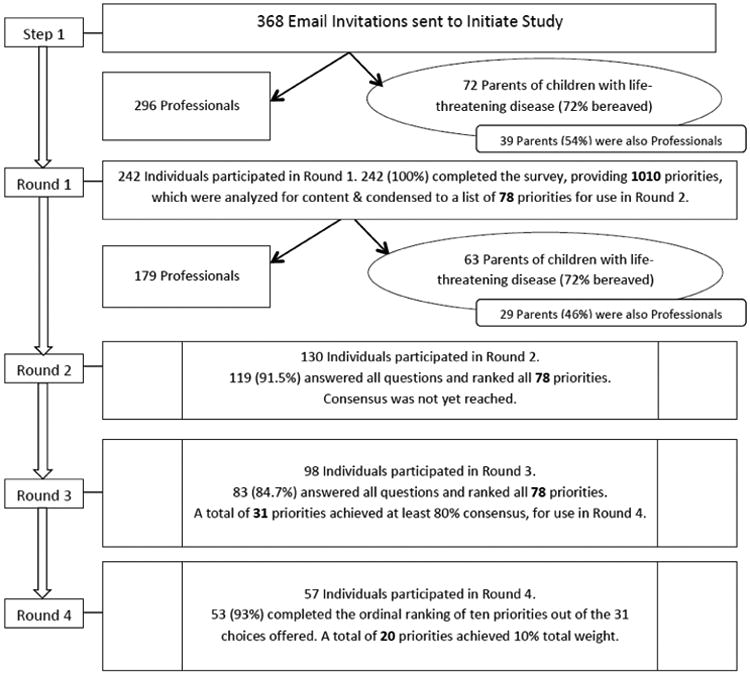
Study design: A 4-round modified Delphi online survey was administered to PPC experts and to parents of children who had received PPC. In round 1, research priorities were generated spontaneously. Rounds 2 and 3 then served as convergence rounds to synthesize priorities. In round 4, participants were asked to rank the research priorities that had reached at least 80% consensus.
Results: A total of 3093 concepts were spontaneously generated by 170 experts and 72 parents in round 1 (65.8% response rate [RR]). These concepts were thematically organized into 78 priorities and recirculated for round 2 ratings (n = 130; 53.7% RR). Round 3 achieved response stability, with 31 consensus priorities oscillating within 10% of the mode (n = 98; 75.4% RR). Round 4 resulted in consensus recognition of 20 research priorities, which were thematically grouped as decision making, care coordination, symptom management, quality improvement, and education.
Conclusions: This modified Delphi survey used professional and parental consensus to identify preeminent PPC research priorities. Attentiveness to these priorities may help direct resources and efforts toward building a formative evidence base. Investigating PPC implementation approaches and outcomes can help improve the quality of care services for children and families.
Copyright © 2015 Elsevier Inc. All rights reserved.
Conflict of interest statement
The authors declare no conflicts of interest
References
-
- American Academy of Pediatrics. Section on Hospice and Palliative Medicine and Committee on Hospital Care. Pediatric palliative care and hospice care commitments, guidelines, and recommendations. Pediatrics. 2013;132:966–72. - PubMed
-
- Field JF, Behrman RE. When children die: Improving palliative and end-of-life care for children and their families. Washington, DC: National Academies Press; 2003. - PubMed
-
- Wolfe J, Hammel JF, Edwards KE, Duncan J, Comeau M, Breyer J, et al. Easing of suffering in children with cancer at the end of life: is care changing? J Clin Oncol. 2008;26:1717–23. - PubMed
-
- Steele R, Bosma H, Johnston MF, Cadell S, Davies B, Siden H, et al. Research priorities in pediatric palliative care: a Delphi study. J Palliat Care. 2008;24:229–39. - PubMed
-
- Powell C. The Delphi technique: myths and realities. J Adv Nurs. 2003;41:376–82. - PubMed
Publication types
MeSH terms
Grants and funding
LinkOut - more resources
Full Text Sources
Other Literature Sources
Medical
