


The potential impact of coinfection on antimicrobial chemotherapy and drug resistance
- PMID: 26028590
- PMCID: PMC4835347
- DOI: 10.1016/j.tim.2015.05.002
The potential impact of coinfection on antimicrobial chemotherapy and drug resistance
Erratum in
- Trends Microbiol. 2015 Nov;23(11):742. Mina, Michael [Corrected to Mina, Michael J]
-
Erratum to: 'The potential impact of coinfection on antimicrobial chemotherapy and drug resistance'.Trends Microbiol. 2015 Nov;23(11):742. doi: 10.1016/j.tim.2015.09.001. Epub 2015 Oct 1. Trends Microbiol. 2015. PMID: 29482745 No abstract available.
Abstract
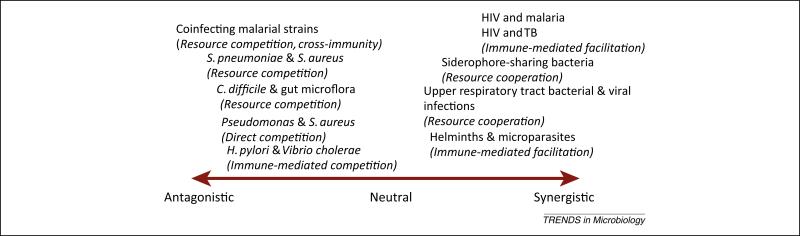
Across a range of pathogens, resistance to chemotherapy is a growing problem in both public health and animal health. Despite the ubiquity of coinfection, and its potential effects on within-host biology, the role played by coinfecting pathogens on the evolution of resistance and efficacy of antimicrobial chemotherapy is rarely considered. In this review, we provide an overview of the mechanisms of interaction of coinfecting pathogens, ranging from immune modulation and resource modulation, to drug interactions. We discuss their potential implications for the evolution of resistance, providing evidence in the rare cases where it is available. Overall, our review indicates that the impact of coinfection has the potential to be considerable, suggesting that this should be taken into account when designing antimicrobial drug treatments.
Keywords: coinfection; drug resistance; immune modulation; parasite interactions; resource competition.
Copyright © 2015 Elsevier Ltd. All rights reserved.
Figures
References
-
- World Health Organization . Antimicrobial Resistance: Global Report on Surveillance 2014. World Health Organization; 2014.
Publication types
MeSH terms
Substances
Grants and funding
LinkOut - more resources
Full Text Sources
Other Literature Sources
Medical
