. 2015;17(1):3-13.

Finding the Wolf in Sheep's Clothing: The 4Kscore Is a Novel Blood Test That Can Accurately Identify the Risk of Aggressive Prostate Cancer

Affiliations

Finding the Wolf in Sheep's Clothing: The 4Kscore Is a Novel Blood Test That Can Accurately Identify the Risk of Aggressive Prostate Cancer

Sanoj Punnen et al. Rev Urol. 2015.

Abstract

Better biomarkers that can discriminate between aggressive and indolent phenotypes of prostate cancer are urgently needed. In the first 20 years of the prostate-specific antigen (PSA) era, screening for prostate cancer has successfully reduced prostate cancer mortality, but has led to significant problems with overdiagnosis and overtreatment. As a result, many men are subjected to unnecessary prostate biopsies and overtreatment of indolent cancer in order to save one man from dying of prostate cancer. A novel blood test known as the 4Kscore® Test (OPKO Lab, Nashville, TN) incorporates a panel of four kallikrein protein biomarkers (total PSA, free PSA, intact PSA, and human kallikrein-related peptidase 2) and other clinical information in an algorithm that provides a percent risk for a high-grade (Gleason score ≥ 7) cancer on biopsy. In 10 peer-reviewed publications, the four kallikrein biomarkers and algorithm of the 4Kscore Test have been shown to improve the prediction not only of biopsy histopathology, but also surgical pathology and occurrence of aggressive, metastatic disease. Recently, a blinded prospective trial of the 4Kscore Test was conducted across the United States among 1012 men. The 4Kscore Test replicated previous European results showing accuracy in predicting biopsy outcome of Gleason score ≥ 7. In a recent case-control study nested within a population-based cohort from Västerbotten, Sweden, the four kallikrein biomarkers of the 4Kscore Test also predicted the risk for aggressive prostate cancer that metastasized within 20 years after the test was administered. These results indicate that men with an abnormal PSA or digital rectal examination result, and for whom an initial or repeat prostate biopsy is being considered, would benefit from a reflex 4Kscore Test to add important information to the clinical decision-making process. A high-risk 4Kscore Test result may be used to select men with a high probability of aggressive prostate cancer who would benefit from a biopsy of the prostate to prevent an adverse and potentially lethal outcome from prostate cancer. Men with a low 4Kscore Test result may safely defer biopsy.

Keywords: Biomarker; High-grade prostate cancer; Prostate cancer; Screening.


Figures
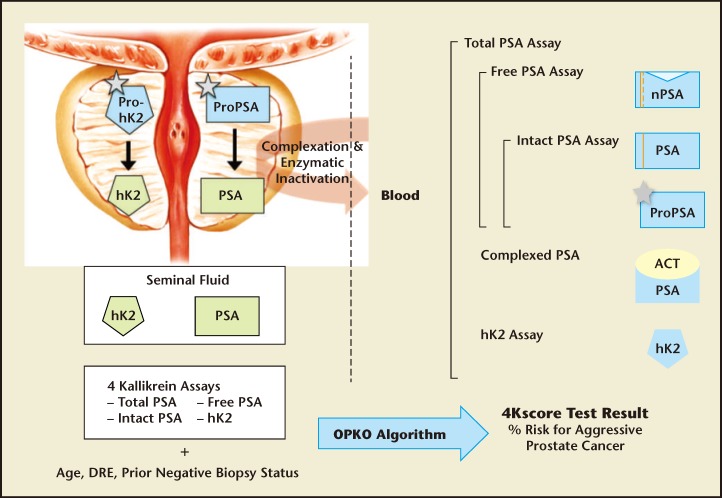
Figure 1
Figure 1
Active forms of prostate-specific antigen (PSA; human kallikrein-3) and human kallikrein-2 (hK2) are shown in green, inactive forms are shown in blue. In the prostate, propeptides (represented as grey stars) are removed from proPSA and prohK2, leaving the mature, catalytically active forms. PSA and hK2 are released at high concentrations (mg/mL level) into prostatic fluid to liquefy semen delivered by the vas deferens. The prostatic kallikreins are found in blood at the ng/mL level (total PSA and free PSA) or pg/mL level (intact PSA and hK2), approximately 1 million-fold lower concentration than levels in seminal fluid. Blood contains a variety of forms of PSA. The most abundant form in blood is PSA complexed with a-1-antichymotrypsin (ACT). Free PSA not complexed with ACT has several molecular forms (nicked, intact, and proPSA). Commercial total PSA assays measure all forms of PSA (complexed and free) and the highly homologous kallikrein, hK2. The 4Kscore Test® (OPKO Lab, Nashville, TN) utilizes four specific kallikrein immunoassays: total PSA, free PSA, intact PSA, and hK2. The patient’s age, digital rectal examination (DRE) results (nodules/no nodules), and prior negative biopsy status (yes/no) are combined in an algorithm to produce the 4Kscore Test result: an individual patient’s risk of having aggressive cancer. The result is reported on a continuous scale from < 1% to > 95%. Adapted from Lilja H et al.
Figure 2
Figure 2
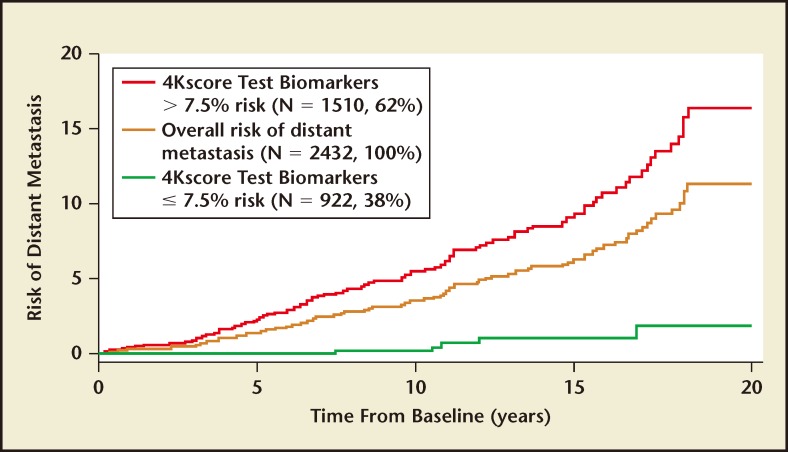
All 60-year-old men with PSA ≥3 ng/mL (N = 2432) in the Västerbotten Intervention Project (VIP) were stratified into two groups: men with ≥ 7.5% 4Kscore Test® (OPKO Lab, Nashville, TN) value (high risk) versus men with < 7.5% 4Kscore Test value (low risk). The absolute risk for metastatic prostate cancer at 5, 10, 15, and 20 years for the low-risk group (green line) was 0.0%, 0.2%, 1.0%, and 1.8% risk. For the high-risk group (red line) the risk for metastatic prostate cancer was 2.4%, 5.6%, 9.9%, and 16.4%. Adapted from Stattin P et al.
Figure 3
Figure 3
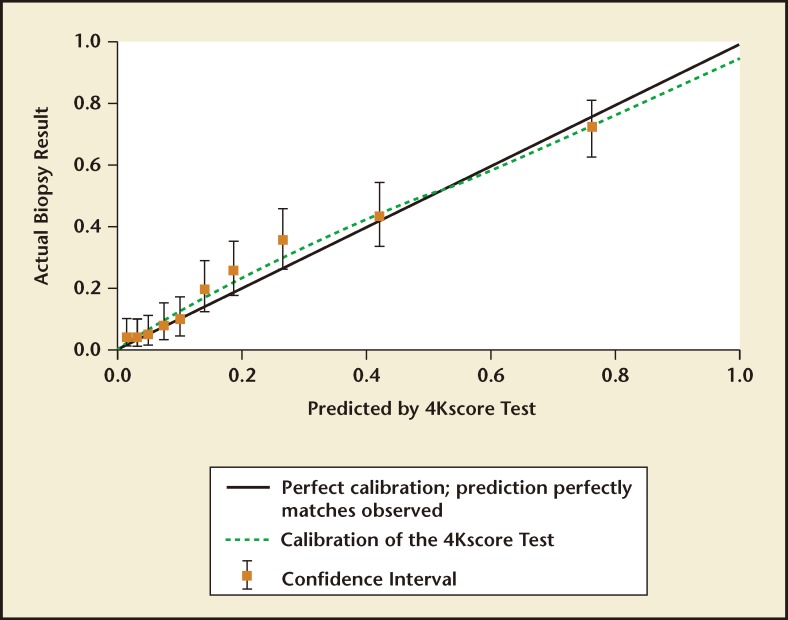
A calibration plot showing the risk for Gleason score ≥ 7 prostate cancer predicted by the 4Kscore Test® (OPKO Lab, Nashville, TN) compared with the actual prostate biopsy results. Data are from the US Validation Study. Perfect calibration is noted by the solid black line; the green line displays the calibration of the 4Kscore Test. The results show near perfect correlation between the risk predicted by the 4Kscore Test versus actual risk for high-grade prostate cancer determined by biopsy. Adapted from Parekh D et al.
Figure 4
Figure 4
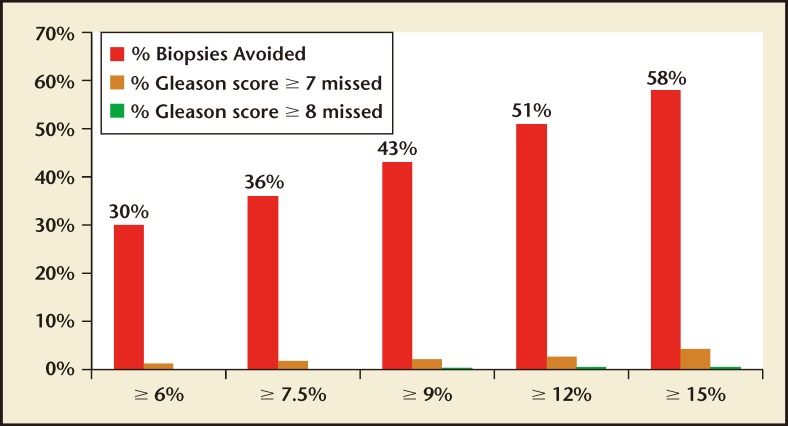
Graph displaying the percentage of biopsies avoided and the proportion of Gleason score ≥ 7, and Gleason score ≥ 8 cancers missed at various 4Kscore Test® (OPKO Lab, Nashville, TN) thresholds for performing a biopsy based on the US Validation Study. Adapted from Parekh D et al.
Figure 5
Figure 5
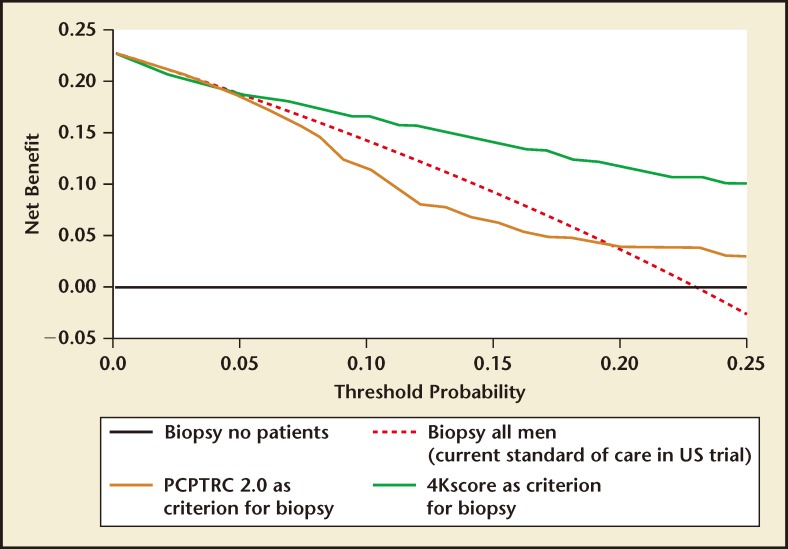
Decision curve analysis demonstrating the higher net benefit of the 4Kscore Test® (OPKO Lab, Nashville, TN) (green line) compared with biopsy all (dashed line) and the Prostate Cancer Prevention Trial Risk Calculator (PCPTRC) 2.0 (yellow line) across all relevant risk threshold values for clinical decision making from the US Validation Study. Adapted from Parekh D, et al.

References

    1. Siegel R, Ma J, Zou Z, Jemal A. Cancer statistics, 2014. CA Cancer J Clin. 2014;64:9–29. - PubMed
    1. Schröder FH, Hugosson J, Roobol MJ, et al. ERSPC Investigators. Screening and prostate-cancer mortality in a randomized European study. N Engl J Med. 2009;360:1320–1328. - PubMed
    1. Hugosson J, Carlsson S, Aus G, et al. Mortality results from the Göteborg randomised population-based prostate-cancer screening trial. Lancet Oncol. 2010;11:725–732. - PMC - PubMed
    1. Andriole GL, Crawford ED, Grubb RL, 3rd, et al. PLCO Project Team. Prostate cancer screening in the randomized Prostate, Lung, Colorectal, and Ovarian Cancer Screening Trial: mortality results after 13 years of follow-up. J Natl Cancer Inst. 2012;104:125–132. - PMC - PubMed
    1. Nam RK, Saskin R, Lee Y, et al. Increasing hospital admission rates for urological complications after transrectal ultrasound guided prostate biopsy. J Urol. 2013;189(1 suppl):S12–S18. - PubMed