. 2015 May-Jun;9(5-6):E284-90.
doi: 10.5489/cuaj.2692.

Bricker versus Wallace anastomosis: A meta-analysis of ureteroenteric stricture rates after ileal conduit urinary diversion

Affiliations

Bricker versus Wallace anastomosis: A meta-analysis of ureteroenteric stricture rates after ileal conduit urinary diversion

Niall F Davis et al. Can Urol Assoc J. 2015 May-Jun.

Abstract

Introduction: Data comparing the incidence of ureteroenteric strictures for Bricker and Wallace anastomoses are limited. This study compares both anastomotic techniques in terms of ureteroenteric stricture rates after radical cystectomy and ileal conduit urinary diversion.

Methods: Electronic databases (Medline, EMBASE, and Cochrane database) were searched for studies comparing Bricker and Wallace ureteroeneteric anastomoses for ileal conduit urinary diversion after radical cystectomy. Meta-analyses were performed using the random effects method. The primary outcome measure was to determine differences in postoperative ureteroenteric stricture rates for both surgical techniques. Four studies describing 658 patients met the inclusion criteria. The total number of ureters used for ureteroeneteric anastomoses was 1217 (545 in the Bricker group and 672 in the Wallace group).

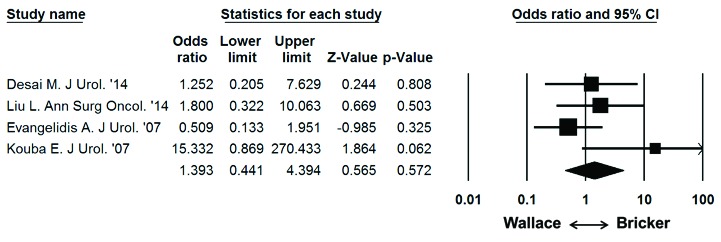
Results: There were no significant differences in age (p = 0.472), gender (p = 0.897), duration of follow-up (p = 0.168), and duration to stricture development between groups (p = 0.439). The overall stricture rate was 29 of 1217 (2.4%); 16 of 545 ureters (2.9%) in the Bricker group and 13 of 672 ureters (1.9%) in the Wallace group. The Bricker anastomosis was not associated with a significantly higher overall stricture rate compared to the Wallace ureteroenteric anastomosis (odds ratio: 1.393, 95% confidence interval: 0.441-4.394, p = 0.572).

Conclusion: Accepting limitations in the available data, we found no significant difference in the incidence of ureteroenteric stricture for Bricker and Wallace anastomoses.


Figures
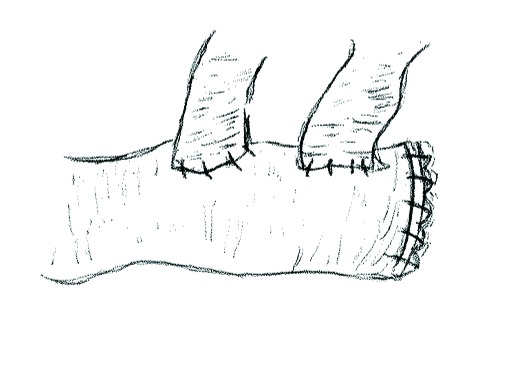
Fig. 1.
Fig. 1.
Bricker ureteroenteric anastomosis. Ureters are spatulated and anastomosed independently to the ileal segment, (the ureteroileal anastomoses can be tunnelled). The proximal ileal loop is closed as indicated.
Fig. 2.
Fig. 2.
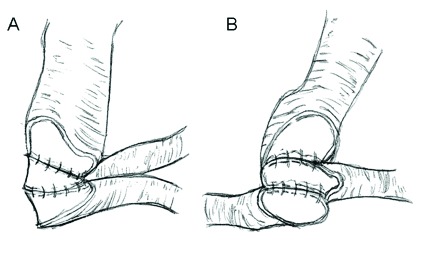
Wallace ureterouretero and ureteroenteric anastomoses. A. Wallace 1 technique: Ureters are spatulated to the same length and medial walls anastomosed in line. The free edges of the newly conjoined ureters are then anastomosed to the proximal end ileal loop. B. Wallace 2 technique (‘head-to-tail anastomosis’): After spatulation, the distal ureteric margin is anastomosed to apex of spatulated contralateral ureter. The free edges of the newly conjoined ureters are again anastomosed to the proximal end ileal loop.
Fig. 3.
Fig. 3.
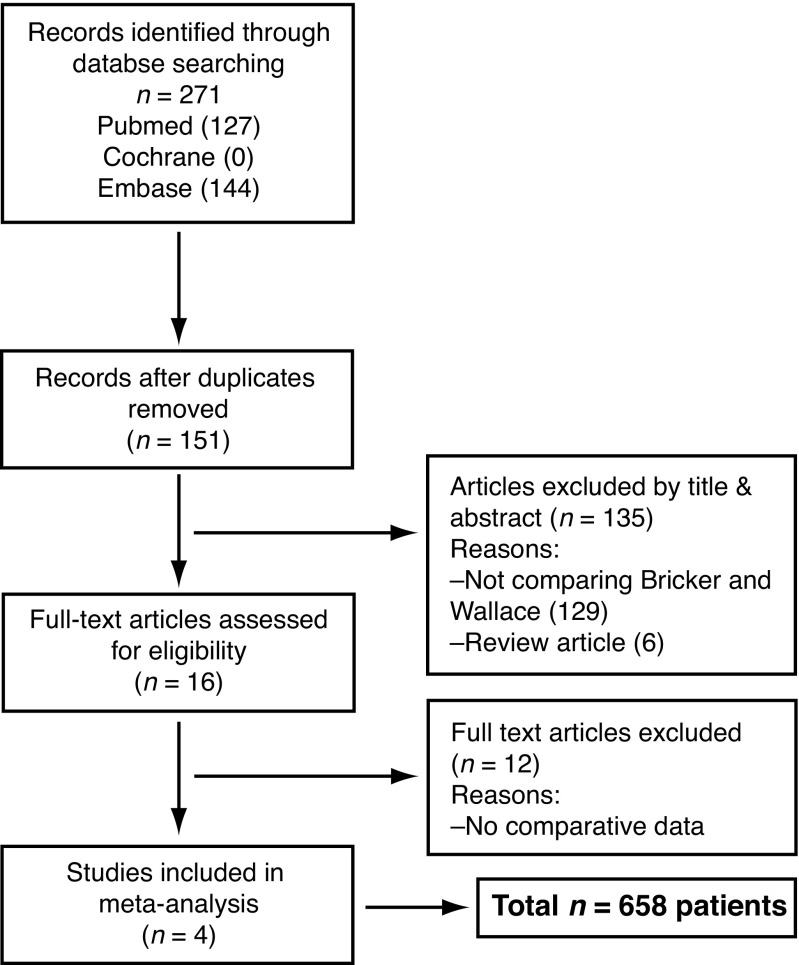
PRISMA diagram of studies identified in the systematic review and meta-analysis (PRISMA: Preferred Reporting Items for Systematic Reviews and Meta-Analyses).
Fig. 4.
Fig. 4.
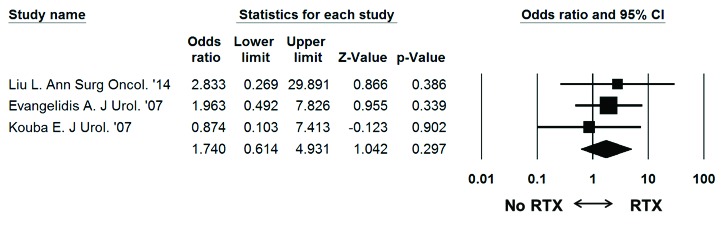
Meta-analysis of stricture rates in patients that received radiotherapy versus no radiotherapy in each study. Each study is shown by the point estimate of the odds ratio (OR; square proportional to the weight of each study) and 95% confidence intervals for the OR (extending lines); the combined OR and 95% confidence intervals by random-effects calculations are shown by diamonds. N = 483 (stricture radiotherapy: n = 5/70, stricture no radiotherapy: n = 18/413), p = 0.297; test for heterogeneity, Cochran Q = 0.6 (df: 2), p = 0.744; I2 = 0.0%.
Fig. 5.
Fig. 5.
Meta-analysis of overall stricture rate per ureter and ureteroenteric anastomosis. Each study is shown by the point estimate of the odds ratio (OR; square proportional to the weight of each study) and 95% confidence intervals for the OR (extending lines); the combined OR and 95% confidence intervals by random-effects calculations are shown by diamonds. N = 1217, P = 0.572; test for heterogeneity, Cochran Q = 4.8 (df=3), p = 0.187; I2 = 37.6%.
Fig. 6.
Fig. 6.
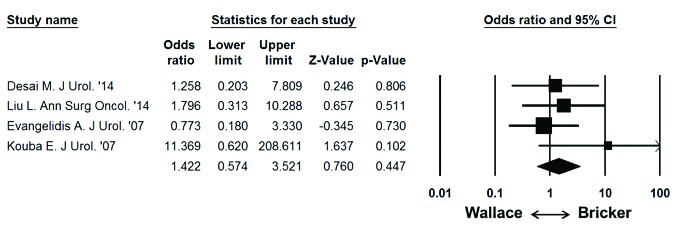
Meta-analysis of overall stricture rate per patient and ureteroenteric anastomosis. Each study is shown by the point estimate of the odds ratio (OR; square proportional to the weight of each study) and 95% confidence intervals for the OR (extending lines); the combined Ors and 95% CIs by random-effects calculations are shown by diamonds. N = 615, P = 0.447; test for heterogeneity, Cochran Q = 2.7 (df = 3), p = 0.438; I2 = 0.0%.
Fig. 7.
Fig. 7.
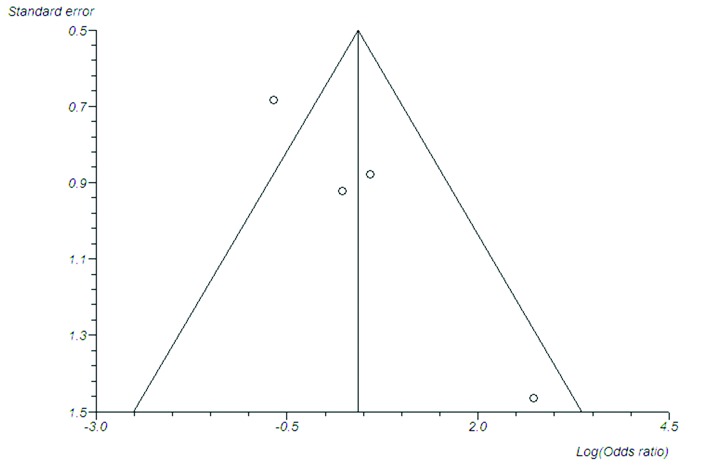
Funnel plot to demonstrate publication bias (Begg-Mazumdar test [p = 0.330], Egger test [p = 0.023]).

References

    1. Butcher HR, Jr, Sugg WL, McA C, et al. Ileal conduit method of ureteral urinary diversion. Ann Surg. 1962;156:682–91. doi: 10.1097/00000658-196210000-00015. - DOI - PMC - PubMed
    1. Bricker EM. Bladder substitution after pelvic evisceration. Surg Clin North Am. 1950;30:1511–21. - PubMed
    1. Riches EW, Jacobs A, Wallace DM, et al. Discussion on the treatment of carcinoma of the bladder. Proc R Soc Med. 1952;45:191–206. - PMC - PubMed
    1. Hendry WF. Morbidity and mortality of radical cystectomy (1971–78 and 1978–85) J R Soc Med. 1986;79:395–400. - PMC - PubMed
    1. Wallace DM. Strategy of surgical management of bladder cancer. Proc R Soc Med. 1973;66:286–8. - PMC - PubMed

LinkOut - more resources