. 2015:2:702-715.
doi: 10.1016/j.toxrep.2015.03.015.

Comparative Metal Oxide Nanoparticle Toxicity Using Embryonic Zebrafish

Affiliations

Comparative Metal Oxide Nanoparticle Toxicity Using Embryonic Zebrafish

Leah C Wehmas et al. Toxicol Rep. 2015.

Abstract

Engineered metal oxide nanoparticles (MO NPs) are finding increasing utility in the medical field as anticancer agents. Before validation of in vivo anticancer efficacy can occur, a better understanding of whole-animal toxicity is required. We compared the toxicity of seven widely used semiconductor MO NPs made from zinc oxide (ZnO), titanium dioxide, cerium dioxide and tin dioxide prepared in pure water and in synthetic seawater using a five-day embryonic zebrafish assay. We hypothesized that the toxicity of these engineered MO NPs would depend on physicochemical properties. Significant agglomeration of MO NPs in aqueous solutions is common making it challenging to associate NP characteristics such as size and charge with toxicity. However, data from our agglomerated MO NPs suggests that the elemental composition and dissolution potential are major drivers of toxicity. Only ZnO caused significant adverse effects of all MO particles tested, and only when prepared in pure water (point estimate median lethal concentration = 3.5-9.1 mg/L). This toxicity was life stage dependent. The 24 h toxicity increased greatly (~22.7 fold) when zebrafish exposures started at the larval life stage compared to the 24 hour toxicity following embryonic exposure. Investigation into whether dissolution could account for ZnO toxicity revealed high levels of zinc ion (40-89% of total sample) were generated. Exposure to zinc ion equivalents revealed dissolved Zn2+ may be a major contributor to ZnO toxicity.

Keywords: ICP OES; cerium dioxide; dissolution; nanoparticles; tin dioxide; titanium dioxide; zebrafish; zinc oxide.


Figures
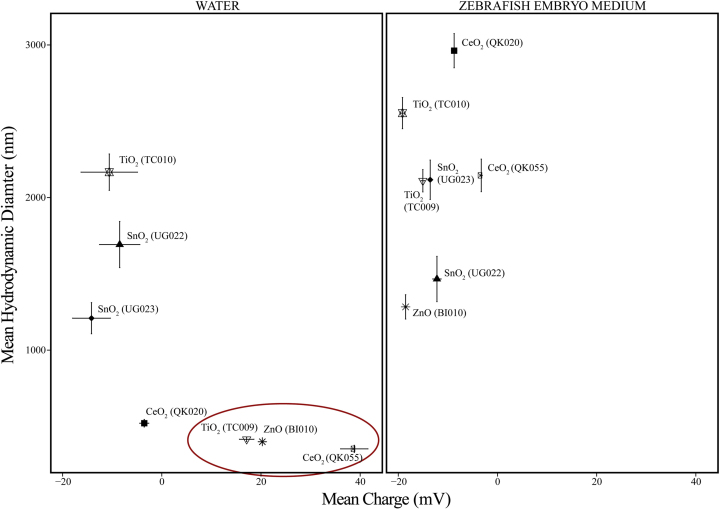
Fig. 1
Fig. 1
Dynamic light scattering measurements of 50 mg/L metal oxide nanoparticles (MO NPs) suspended in ion-free medium (water) and high ionic strength medium (zebrafish embryo medium). Error bars represent standard error of the mean (n = 4) of hydrodynamic diameter vertically and charge horizontally. Red circle highlights the MO NPs with very similar sizes and charges that created stable suspensions when prepared in water, however, only ZnO was the only MO NP to cause significant mortality and malformations in the five-day embryonic zebrafish bioassay with water as the exposure medium.
Fig. 2
Fig. 2
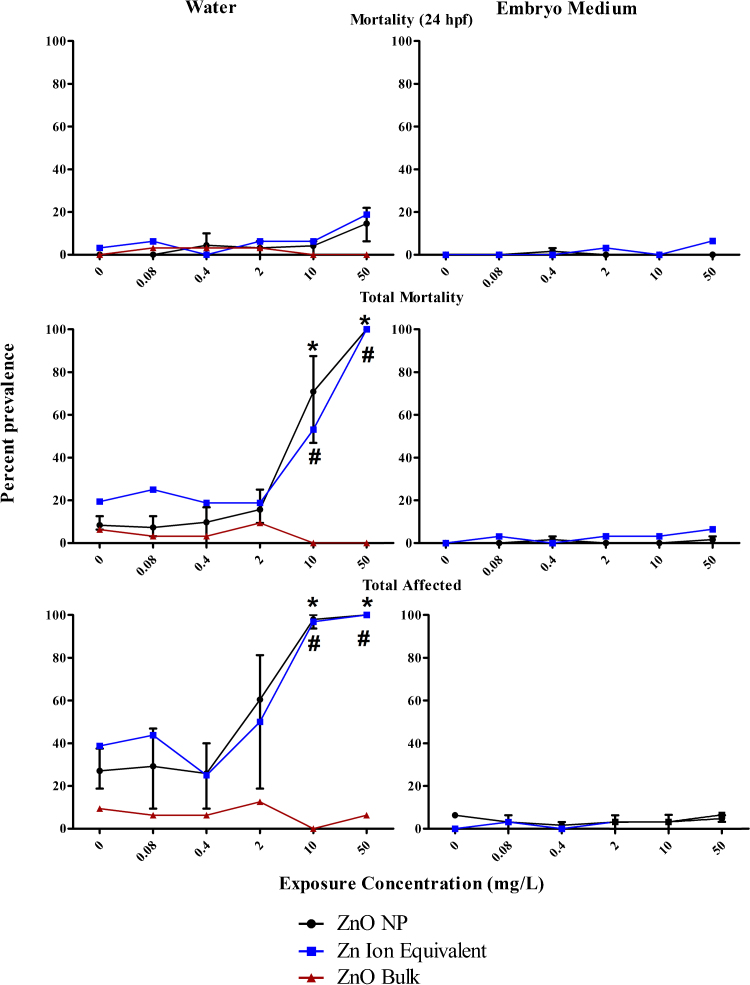
Toxicity of zinc oxide nanoparticles (ZnO NP) compared to ZnO bulk and Zn ion equivalent controls with 0.5% DMSO vehicle in five-day embryonic zebrafish bioassay under two medium conditions (water and embryo medium). The Zn ion equivalent represents the approximate amount of dissolved zinc present in ZnO NP samples as determined by inductively coupled plasma optical emission spectrometry. Total affected represents the combined percent of zebrafish with mortality or any morphological malformation(s) at 120 h post fertilization. For the ZnO NP prepared in water and embryo medium, the error bars represent the range in mean percent response (3 experiments and 2 experiments respectively, n = 32 per experiment per concentration). For the other exposures, the data represents the percent response of 1 experiment, n = 32 per concentration. For ZnO NP (*) and Zn ion equivalent (#) data, symbol indicates concentrations where percent prevalence is significantly above background (p < 0.05 Fisher's Exact Test) for all experiments studied.
Fig. 3
Fig. 3
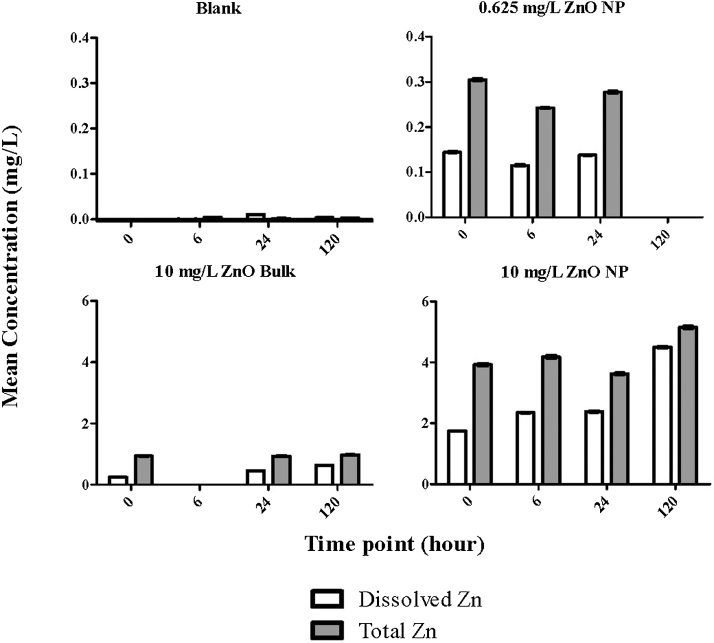
Dissolved zinc (Zn) present in blanks (0.5% DMSO in ultrapure water), 0.625 and 10 mg/L zinc oxide nanoparticle (ZnO NP) and 10 mg/L ZnO Bulk suspensions prepared in 0.5% DMSO, ultrapure water as measured by ICP-OES over different time points. Error bars represent ±SD, n = 3.
Fig. 4
Fig. 4
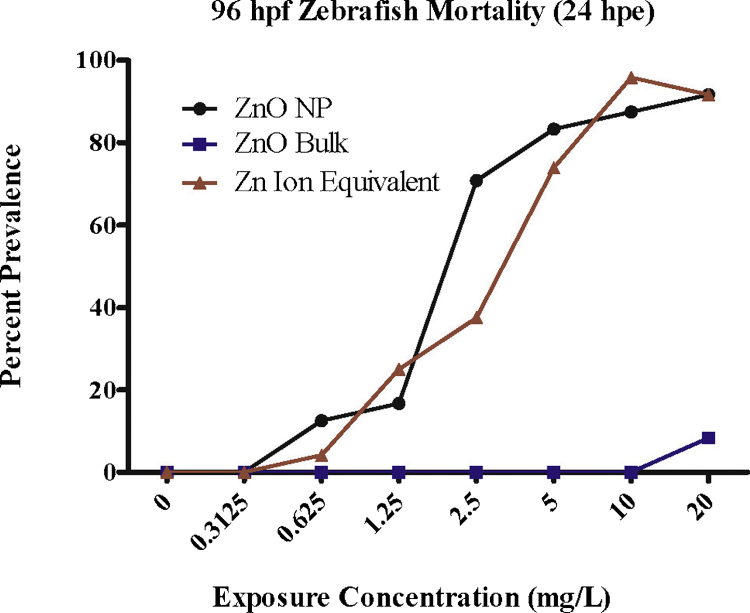
Larval zebrafish mortality 24 h post exposure (hpe) to zinc oxide nanoparticle (ZnO NP) (n = 24 per concentration) ZnO Bulk (n = 24 per concentration) and Zn Ion Equivalent (n = 32 per concentration) prepared in ultrapure water assuming ∼48% nanoparticle dissolution. Exposures started when zebrafish were 96 h post fertilization (hpf).
Fig. A1
Fig. A1
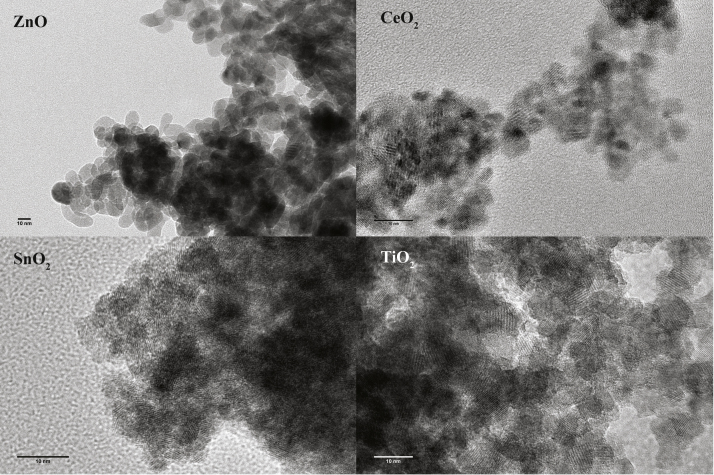
Representative TEM images of each metal oxide nanoparticle synthesis method. Abbreviations: ZnO = zinc oxide, CeO2 = cerium dioxide, SnO2 = tin dioxide, TiO2 = titanium dioxide.
Fig. A2
Fig. A2
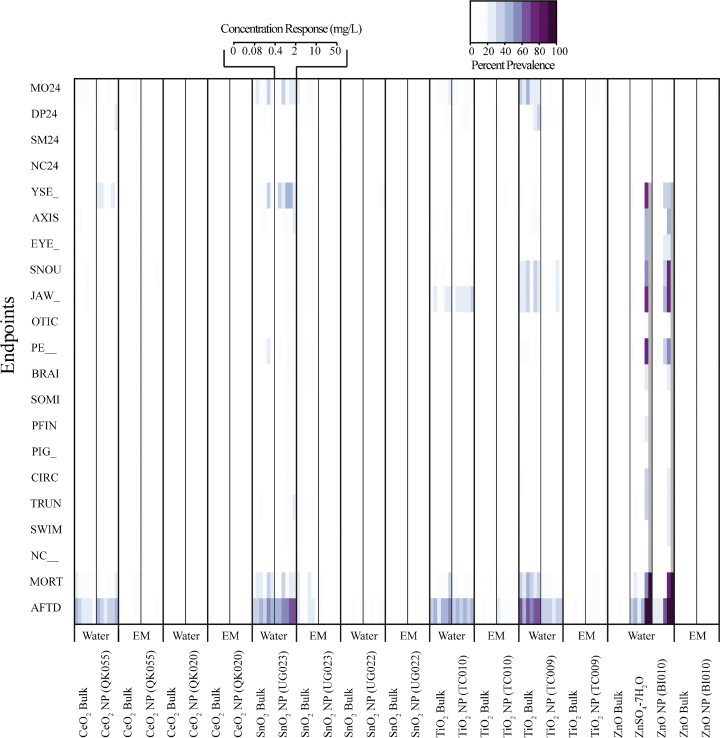
Heat map displaying the percent prevalence of malformations and mortality resulting from a five-day embryonic zebrafish exposure to a five-fold concentration response series ranging from 0 50 mg/L metal oxide nanoparticles, bulk controls, and, in the case of zinc, a dissolved zinc equivalent (0–99 mg/L) ionic control (n = 32 except ZnO NP in water where n = 96). Exposures were conducted in ultrapure water or embryo medium (EM). The color scale above the heat map indicates the percent prevalence of a particular endpoint assessed in the zebrafish at 24 h post fertilization (hpf) or 120 hpf. Abbreviations for endpoints assessed at 24 hpf: MO24 = mortality, DP = delayed developmental progression, SM = reduced or excessive frequency of zebrafish spontaneous tail coiling, and NC24 = notochord malformation. Abbreviations for endpoints assessed at 120 hpf: YSE = yolk sac edema, AXIS = abnormal body axis curvature, EYE = eye malformation, SNOU = snout malformation, JAW = jaw malformation, OTIC = otic vesicle malformation, PE = pericardial edema, BRAIN = brain malformation, SOMI = abnormal somite development, PFIN = malformed pectoral fins, PIG = hypo or hyper pigmentation, CIRC = abnormal circulation or circulatory vasculature, TRUN = shorted body axis, SWIM = abnormal swim bladder development, NC = notochord malformation, MORT = total mortality, and AFTD = total dead and malformed larvae.
Fig. A3
Fig. A3
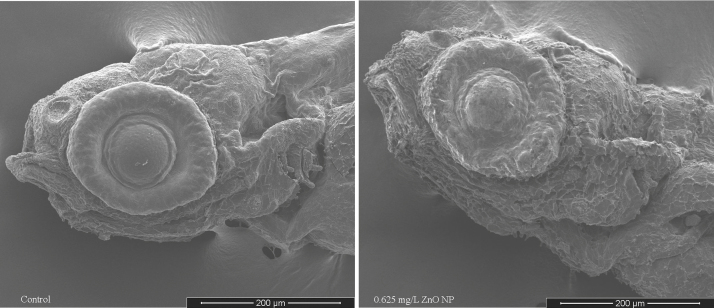
Representative scanning electron microscopy images of 96 hpf zebrafish exposed to zinc oxide nanoparticle (ZnO NP) and control prepared in ultrapure water for ∼1–2 h prior to fixation.

References

    1. Nel A., Xia T., Mädler L., Li N. Toxic potential of materials at the nanolevel. Science. 2006;311:622–627. - PubMed
    1. Oberdörster G., Oberdörster E., Oberdörster J. Nanotoxicology: an emerging discipline evolving from studies of ultrafine particles. Environ. Health Perspect. 2005;113:823. - PMC - PubMed
    1. Adams L.K., Lyon D.Y., Alvarez P.J.J. Comparative eco-toxicity of nanoscale TiO2, SiO2, and ZnO water suspensions. Water Res. 2006;40:3527–3532. - PubMed
    1. Li Q., Mahendra S., Lyon D.Y., Brunet L., Liga M.V., Li D., Alvarez P.J. Antimicrobial nanomaterials for water disinfection and microbial control: potential applications and implications. Water Res. 2008;42:4591–4602. - PubMed
    1. Premanathan M., Karthikeyan K., Jeyasubramanian K., Manivannan G. Selective toxicity of ZnO nanoparticles toward gram-positive bacteria and cancer cells by apoptosis through lipid peroxidation. Nanomed. Nanotechnol. Biol. Med. 2011;7:184–192. - PubMed

LinkOut - more resources