Review
. 2015 Jun;5(3):433-47.
doi: 10.3978/j.issn.2223-4292.2015.03.16.

PET/SPECT molecular imaging in clinical neuroscience: recent advances in the investigation of CNS diseases

Affiliations
Review

PET/SPECT molecular imaging in clinical neuroscience: recent advances in the investigation of CNS diseases

Feng-Mei Lu et al. Quant Imaging Med Surg. 2015 Jun.

Abstract

Molecular imaging is an attractive technology widely used in clinical practice that greatly enhances our understanding of the pathophysiology and treatment in central nervous system (CNS) diseases. It is a novel multidisciplinary technique that can be defined as real-time visualization, in vivo characterization and qualification of biological processes at the molecular and cellular level. It involves the imaging modalities and the corresponding imaging agents. Nowadays, molecular imaging in neuroscience has provided tremendous insights into disturbed human brain function. Among all of the molecular imaging modalities, positron emission tomography (PET) and single photon emission computed tomography (SPECT) have occupied a particular position that visualize and measure the physiological processes using high-affinity and high-specificity molecular radioactive tracers as imaging probes in intact living brain. In this review, we will put emphasis on the PET/SPECT applications in Alzheimer's disease (AD) and Parkinson's disease (PD) as major CNS disorders. We will first give an overview of the main classical molecular neuroimaging modalities. Then, the major clinical applications of PET and SPECT along with molecular probes in the fields of psychiatry and neurology will be discussed.

Keywords: Molecular imaging; central nervous system (CNS) diseases; positron emission tomography (PET); single photon emission computed tomography (SPECT).


Figures

Figure 1
Figure 1
The 18F-FDDNP-PET, MRI, and FDG-PET images for a representative AD patient (the top row) and an HC (the bottom row). The 18F-FDDNP images were acquired by summing frames 12-14, corresponding to 25-54 minutes post-18F-FDDNP injection. The FDG images were obtained by summing frames corresponding to 20-60 minutes post-FDG administration. The arrows display that brain areas with FDG low glucose metabolism are matched with the localization of NFTs and Aps resulting from 18F-FDDNP binding. Reproduced with the permission from ref. (14). PET, positron emission tomography; MRI, magnetic resonance imaging; AD, Alzheimer’s disease; HC, healthy control; NFTs, neurofibrillary tangles; Aps, β-amyloid plaques.
Figure 2
Figure 2
PIB standardized uptake value (SUV) images of PIB retention in a 79-year-old AD patient (right) and a 67-year-old HC (left). PIB and 18FDG images were obtained within 3 days of each other. The SUV PIB images summed over 40-60 minutes are displayed in top and the 18FDG rCMRglc images (µmol/min/100 mL) are shown in bottom. The lack of PIB retention in the entire gray matter and nonspecific PIB retention in the white matter of the HC are showed in the top left column. The normal 18FDG uptake is seen in the bottom left column. The high PIB retention of the AD patient is seen in the frontal and temporoparietal cortices (top right). A typical pattern of 18FDG hypometabolism of AD patient is shown in the temporoparietal cortex (arrows; bottom right) along with preserved metabolic rate in the frontal cortex. Reproduced with the permission from ref. (17). PIB, Pittsburgh Compound-B; AD, Alzheimer’s disease; HC, healthy control.
Figure 3
Figure 3
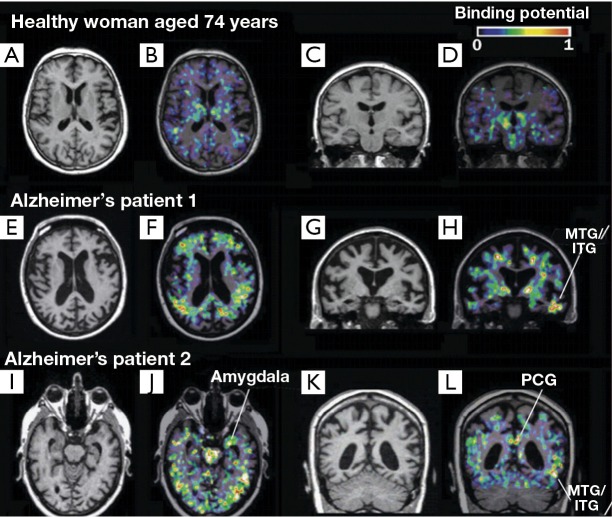
11C (R)-PK11195 binding in HC and AD patients. No significant 11C (R)-PK11195 binding in cortex was found in HC [(A,C) T1-weighted MRI images; (B,D) MRI-PET fusion images]; however, in AD with severe dementia (E-H), widespread cortical 11C (R)-PK11195 binding was found mainly in the left MTG/ITG; in AD with moderate dementia (I-L), substantial 11C (R)-PK11195 binding was found mainly in the left PCG. Reproduced with the permission from ref. (43). HC, healthy controls; AD, Alzheimer’s disease; MRI, magnetic resonance imaging; PET, positron emission tomography; MTG, middle temporal gyrus; ITG, inferior temporal gyrus; PCG, posterior cingulate gyrus.
Figure 4
Figure 4
Results of cerebral glucose metabolism with 18FDG-PET. (B) Indicates the PK11195 images co-registered and fused to MRI; (C) stands for subtraction MRI obtained half to one year after the 11C (R)-PK11195 PET scan; in AD patient 8, regions such as temporal lobe (B) with high 11C (R)-PK11195 binding have subsequently undergone atrophy (C) after half a year. The white arrow shows volume loss of hypointense areas; (D) reveals bilateral hypometabolism done within 1 month of 11C (R)-PK11195 PET scan compared with healthy controls, particularly in left temporal lobe. All image volumes have been coregistered into same space. Reproduced with the permission from ref. (43). PET, positron emission tomography; MRI, magnetic resonance imaging; AD, Alzheimer’s disease.
Figure 5
Figure 5
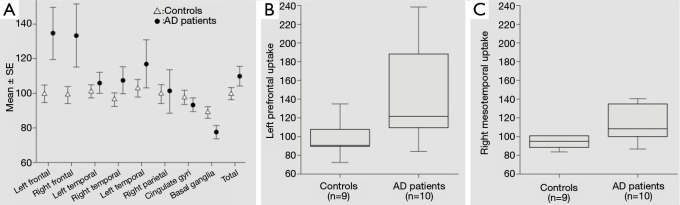
(A) Grouped mean ± standard error of 123I-iodo-PK11195 uptake values; (B) and (C) represents the 123I-iodo-PK11195 uptake values for the left prefrontal and the right mesiotemporal area, respectively. Reproduced with the permission from ref. (24).
Figure 6
Figure 6
The left figure shows the 11C-PK11195 binding in a Parkinson’s disease (PD) patient (A,B) and a healthy control (C,D). The right figure illustrated the mean regional binding potential (BP) values in subcortical and cortical regions in both PD patients and healthy controls. Reproduced with the permission from ref. (49).

References

    1. James ML, Gambhir SS. A molecular imaging primer: modalities, imaging agents, and applications. Physiol Rev 2012;92:897-965. - PubMed
    1. Weissleder R, Mahmood U.Molecular imaging. Radiology 2001;219:316-33. - PubMed
    1. Kim E, Howes OD, Kapur S. Molecular imaging as a guide for the treatment of central nervous system disorders. Dialogues Clin Neurosci 2013;15:315-28. - PMC - PubMed
    1. Balas C.Review of biomedical optical imaging—a powerful, non-invasive, non-ionizing technology for improving in vivo diagnosis. Meas Sci Technol 2009;20:104020.
    1. Phelps ME. Positron emission tomography provides molecular imaging of biological processes. Proc Natl Acad Sci U S A 2000;97:9226-33. - PMC - PubMed