. 2015 Jun;129(3):257-68.
doi: 10.1037/bne0000055.

Stability of age-related deficits in the mnemonic similarity task across task variations

Affiliations

Stability of age-related deficits in the mnemonic similarity task across task variations

Shauna M Stark et al. Behav Neurosci. 2015 Jun.

Abstract

Several studies in our lab and others have demonstrated age-related declines in mnemonic discrimination during a recognition memory paradigm using repeated items, similar lures, and novel foils. In particular, older adults exhibit a shift in lure discriminability, identifying similar lures as old items at a greater rate than young adults. This shift likely reflects deficits in pattern separation processing as a result of underlying changes in the dentate gyrus of the hippocampus. Here, we explored whether alterations in the task design could rescue the age-related impairment or whether it was ubiquitous as one might expect if the neurobiological mechanisms were truly disturbed by typical aging. Despite overt instructions to study item details during encoding, we replicated the age-related deficit in mnemonic discrimination. We established reliable effects with short lists of stimuli and with repeated testing. Altering the task design from a study/test to a continuous recognition paradigm replicated the age-related shift in lure discrimination as well. Modifying the task to an old/new response (rather than old/similar/new) showed the same effect and a d' analysis showed that lure items were more akin to target items in older adults. Finally, we varied the test instructions in order to promote gist or veridical responses in the old/new task. Even these overt veridical test instructions did not ameliorate older adults' lure discrimination problems. Together, these findings demonstrate the robust nature of this age-related deficit and support the hypothesis that typical aging results in neurobiological changes that underlie this impairment.


Figures

Figure 1
Figure 1
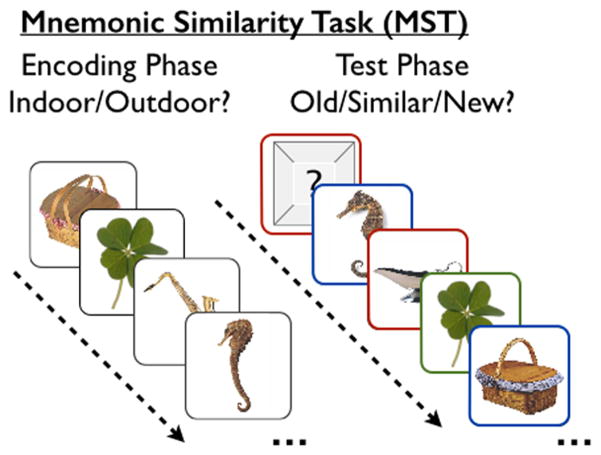
The Mnemonic Similarity Task (MST) typically consists of two phases: an incidental-encoding phase, followed by a surprise recognition test with a three-choice response. Importantly, the test consists of three stimulus types: exact repetitions of earlier items (outlined in green), lures that are similar but not identical to earlier items (outlined in blue), and novel foils (outlined in red). The colored outlines are for illustrative purposes only and were not present in the actual experiment.
Figure 2
Figure 2
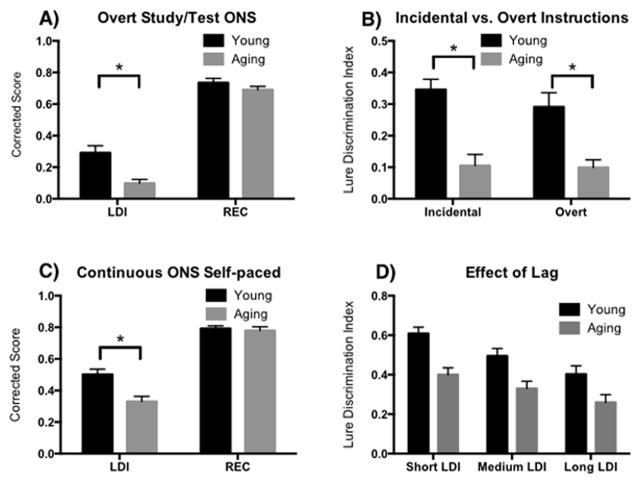
A) Experiment 1. LDI (Lure Discrimination Index) is impaired in aging, while REC (Recognition) is intact following overt instructions prior to encoding regarding the design of the recognition test. B) Experiment 1. Overt instructions resulted in comparable LDI performance when compared to performance following incidental instructions. C) Experiment 2. In a continuous recognition design with self-paced responses, older adults are still impaired compared to young in LDI, but their REC scores remain matched. D) Experiment 2. There is a lag effect (number of intervening trials between the first presentation and lure) with a main effect of age, but no interaction. * denotes p<.05
Figure 3
Figure 3
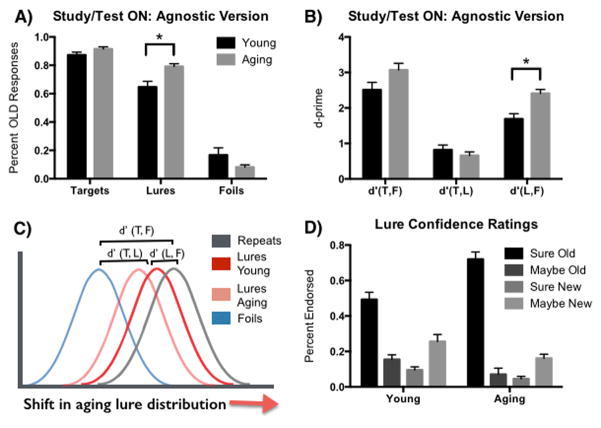
Experiment 4. A) When restricted to old/new responses during the recognition task and no instructions on how to respond to the similar lures, older adults demonstrated a greater bias to respond “old” to those lures. B) When we calculated d′ scores for each of the three test item distributions, older adults showed a greater disparity between the lure and foil distributions than younger adults. C) These data support the theory that there is an age-related shift in the lure distribution towards the repeated items (T=target, L=Lure, F=Foils). D) An evaluation of confidence ratings for lure items reflected high confidence in responding “old” for the aging group. * denotes p<.05
Figure 4
Figure 4
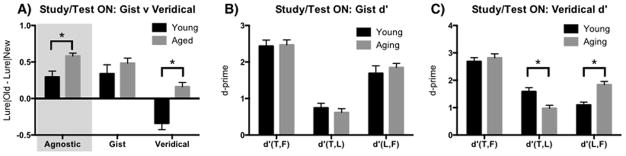
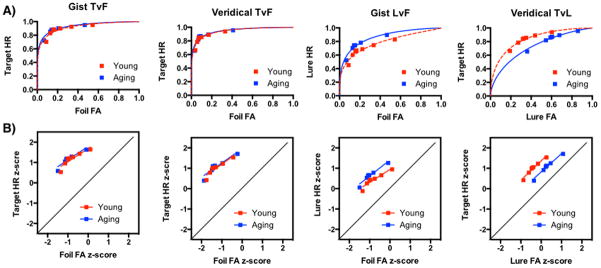
Experiment 4. A) Providing instructions to bias participants to respond based on gist (respond old to the lures) versus veridical (respond new to lures) representations attenuated the age-related difference. Data from the agnostic instructions from Experiment 3 are presented in the shaded box for comparison. The shift in the underlying distributions for the three test types can be observed in the veridical condition (C), but not the gist condition (B). * denotes p<.05
Figure 5
Figure 5
Experiment 4. A) ROC curves and B) slopes on the z-scores for “old” responses to targets and foils are the same for each set of instructions. When given the veridical instructions, young adults are better at discriminating between the targets and lures than older adults. In contrast, with the gist instructions, the aging group is better at discriminating the lures from the foils (i.e. they are more likely to identify the lures as “old”).

References

    1. Alley BA, Hussey EP, Ko PC, Molitor RJ. Pattern separation and pattern completion in Alzheimer’s disease: evidence of rapid forgetting in amnestic mild cognitive impairment. Hippocampus. 2013;23:1246–1258. - PMC - PubMed
    1. Andreano JM, Cahill L. Sex influenced on the neurobiology of learning and memory. Learning and Memory. 2009;16:248–266. - PubMed
    1. Bakker A, Kirwan CB, Miller M, Stark CE. Pattern separation in the human hippocampal CA3 and dentate gyrus. Science. 2008;319(5870):1640–1642. doi: 10.1126/science.1152882. - DOI - PMC - PubMed
    1. Bakker A, Krauss GL, Albert MS, Speck CL, Jones LR, Stark CE, Gallagher M. Reduction of hippocampal hyperactivity improves cognition in amnestic mild cognitive impairment. Neuron. 2012;74(3):467–474. doi: 10.1016/j.neuron.2012.03.023. - DOI - PMC - PubMed
    1. Brandt J, Spencer M, Folstein MF. The telephone interview for cognitive status. Neuropsychiatry, Neuropsychology, & Behavioral Neurology. 1988;1:111–117.

Publication types