


Exercise, cognitive function, and aging
- PMID: 26031719
- PMCID: PMC4587595
- DOI: 10.1152/advan.00101.2014
Exercise, cognitive function, and aging
Abstract
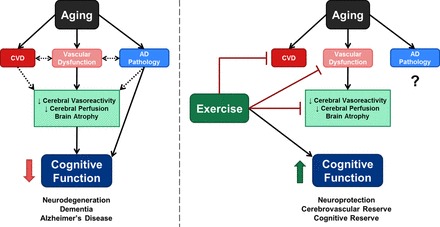
Increasing the lifespan of a population is often a marker of a country's success. With the percentage of the population over 65 yr of age expanding, managing the health and independence of this population is an ongoing concern. Advancing age is associated with a decrease in cognitive function that ultimately affects quality of life. Understanding potential adverse effects of aging on brain blood flow and cognition may help to determine effective strategies to mitigate these effects on the population. Exercise may be one strategy to prevent or delay cognitive decline. This review describes how aging is associated with cardiovascular disease risks, vascular dysfunction, and increasing Alzheimer's disease pathology. It will also discuss the possible effects of aging on cerebral vascular physiology, cerebral perfusion, and brain atrophy rates. Clinically, these changes will present as reduced cognitive function, neurodegeneration, and the onset of dementia. Regular exercise has been shown to improve cognitive function, and we hypothesize that this occurs through beneficial adaptations in vascular physiology and improved neurovascular coupling. This review highlights the potential interactions and ideas of how the age-associated variables may affect cognition and may be moderated by regular exercise.
Keywords: brain; cardiovascular; physical activity; physiology.
Copyright © 2015 The American Physiological Society.
Figures
References
-
- Anderson-Hanley C, Arciero PJ, Brickman AM, Nimon JP, Okuma N, Westen SC, Merz ME, Pence BD, Woods JA, Kramer AF, Zimmerman EA. Exergaming and older adult cognition: a cluster randomized clinical trial. Am J Prev Med 42: 109–119, 2012. - PubMed
-
- Alzheimer's Association. 2013 Alzheimer's Disease Facts and Figures. http://www.alz.org/downloads/facts_figures_2013.pdf [16 March 2015].
-
- Bailey DM, Marley CJ, Brugniaux JV, Hodson D, New KJ, Ogoh S, Ainslie PN. Elevated aerobic fitness sustained throughout the adult lifespan is associated with improved cerebral hemodynamics. Stroke 44: 3235–3238, 2013. - PubMed
Publication types
MeSH terms
Grants and funding
LinkOut - more resources
Full Text Sources
Other Literature Sources
Medical
