The impact of vitamin D3 supplementation on muscle function among HIV-infected children and young adults: a randomized controlled trial
- PMID: 26032206
- PMCID: PMC4533987
The impact of vitamin D3 supplementation on muscle function among HIV-infected children and young adults: a randomized controlled trial
Abstract
Objectives: We tested the hypothesis that daily vitD3 supplementation increases neuromuscular motor skills, jump power, jump energy, muscular force, and muscular strength.
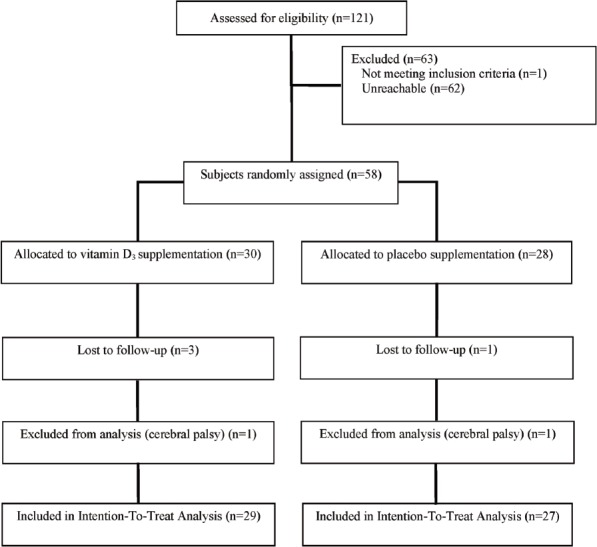
Methods: This was a secondary analysis of a randomized controlled trial of 12-months of oral 7,000 IU/day vitD3 supplementation or placebo among 56 persons living with HIV aged 9-25 years. Neuromuscular motor skills were quantified using the Bruininks-Oseretsky Test of Motor Proficiency. Power was quantified using peak jump power, and energy was quantified using peak jump height. Muscular force was quantified using isometric ankle plantar- and dorsiflexion, isokinetic knee flexion and extension. Muscular strength was quantified using isometric handgrip strength.
Results: After 12-months, serum 25-hydroxyvitamin D [25(OH)D] was higher with supplementation versus placebo (β=12.1 ng/mL; P<0.001). In intention-to-treat analyses, supplementation improved neuromuscular motor skills versus placebo (β=1.14; P=0.041). We observed no effect of supplementation on jump power, jump energy, muscular force, or muscular strength outcomes versus placebo.
Conclusions: Among HIV-infected children and young adults supplementation with daily high-dose vitD3 increased concentration of serum 25(OH)D and improved neuromuscular motor skills versus placebo.
Trial registration: ClinicalTrials.gov NCT01475890.
Conflict of interest statement
This work was supported by the NIH/National Center for Complementary and Alternative Medicine, Grant R01AT005531, NIH/National Institute of Diabetes and Digestive and Kidney Diseases, Grant K24DK076808, the National Center for Research Resources, Grant UL1RR024134, and is now at the National Center for Advancing Translational Sciences, Grant UL1TR000003. The content is solely the responsibility of the authors and does not necessarily represent the official views of the NIH. Life Extension (Ft. Lauderdale, FL) and J.R. Carlson Laboratories, Inc. (Arlington Heights, IL) donated the vitamin D3 supplements and placebo capsules and drops, respectively. The authors have no funding or conflicts of interest to disclose. Clinical Trial Registration Number: NCT01475890.
Figures
References
-
- Gortmaker SL, Hughes M, Cervia J, et al. Effect of combination therapy including protease inhibitors on mortality among children and adolescents infected with HIV-1. N Engl J Med. 2001;345(21):1522–8. - PubMed
-
- Pearson DA, McGrath NM, Nozyce M, et al. Predicting HIV disease progression in children using measures of neuropsychological and neurological functioning. Pediatric AIDS clinical trials 152 study team. Pediatrics. 2000;106(6):E76. - PubMed
-
- Humphries C, Potterton J, Mudzi W. A pilot study to investigate the muscle strength of children infected with HIV. International Journal of Therapy and Rehabilitation. 2014;21(1):19–24.
-
- Macdonald HM, Chu J, Nettlefold L, et al. Bone geometry and strength are adapted to muscle force in children and adolescents perinatally infected with HIV. J Musculoskelet Neuronal Interact. 2013;13(1):53–65. - PubMed