


Sustained Blood Pressure Control Following Discontinuation of a Pharmacist Intervention for Veterans
- PMID: 26032843
- PMCID: PMC8032120
- DOI: 10.1111/jch.12577
Sustained Blood Pressure Control Following Discontinuation of a Pharmacist Intervention for Veterans
Abstract
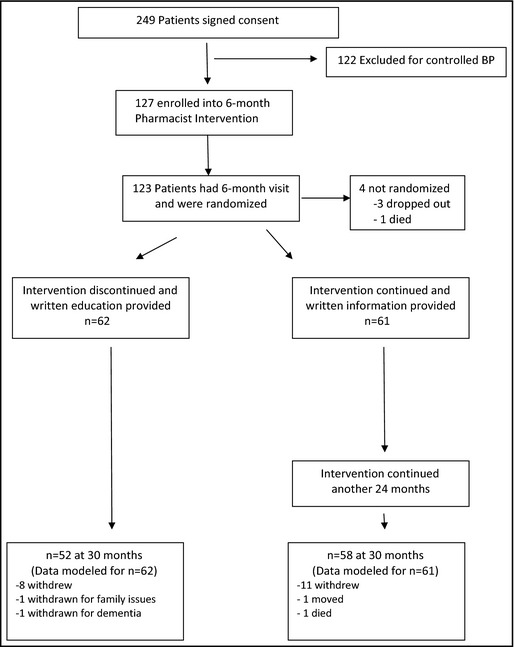
Clinical pharmacists are utilized in Veterans Health Administration (VHA) facilities to assist with management of patients with chronic conditions including hypertension. The goal of this study was to examine blood pressure (BP) control after discontinuation of an intensive pharmacist-managed intervention. The study was conducted at a single Midwest VHA medical center and two affiliated community-based outpatient clinics. Patients with uncontrolled BP received an intensive pharmacist intervention for the first 6 months. Patients were then stratified based on whether their BP was controlled or not and were randomized to either continue the intervention for another 24 months (30 month total time period) or the intervention was discontinued following one-time receipt of educational materials. Mean systolic and diastolic BPs were reduced (P<.001) in diabetic patients (8.0±14.4 mm Hg and 4.0±9.1 mm Hg, respectively) and in nondiabetic patients (14.0±16.4 mm Hg and 5.0±10.0 mm Hg, respectively) following the 6-month intervention, with 54% of the total sample achieving BP control. BP control and the reduction in mean BP was maintained to a similar degree in both study groups at 12, 18, 24, and 30 months. There were no significant differences in BP at any of the follow-up periods in patients who did and did not receive the continued pharmacist intervention. This study found that BP control was maintained for at least 24 months following discontinuation of an intensive pharmacist intervention. These findings were seen in both the group that had a continued pharmacist intervention and in the group that had a one-time educational session when the intervention was discontinued. This study suggests that once BP control is achieved following a pharmacist intervention, patients can be referred back to their primary care provider for continued follow-up.
Trial registration: ClinicalTrials.gov NCT00760552.
©2015 Wiley Periodicals, Inc.
Figures
References
-
- Vivian EM. Improving blood pressure control in a pharmacist‐managed hypertension clinic. Pharmacotherapy. 2002;22:1533–1540. - PubMed
-
- Lee JK, Grace KA, Taylor AJ. Effect of a pharmacy care program on medication adherence and persistence, blood pressure, and low‐density lipoprotein cholesterol: a randomized controlled trial. JAMA. 2006;296:2563–2571. - PubMed
-
- Monson R, Bond CA, Schuna A. Role of the clinical pharmacist in improving drug therapy. Clinical pharmacists in outpatient therapy. Arch Intern Med. 1981;141:1441–1444. - PubMed
-
- Bond CA, Monson R. Sustained improvement in drug documentation, compliance, and disease control. A four‐year analysis of an ambulatory care model. Arch Intern Med. 1984;144:1159–1162. - PubMed
Publication types
MeSH terms
Associated data
LinkOut - more resources
Full Text Sources
Medical
