


Women's perception of risks of adverse fetal pregnancy outcomes: a large-scale multinational survey
- PMID: 26033946
- PMCID: PMC4458601
- DOI: 10.1136/bmjopen-2014-007390
Women's perception of risks of adverse fetal pregnancy outcomes: a large-scale multinational survey
Abstract
Objective: To determine pregnant women and new mothers' perception of risks in pregnancy.
Design, settings and participants: This was a large-scale multinational survey including 9113 pregnant women and new mothers from 18 countries in Europe, North America and Australia.
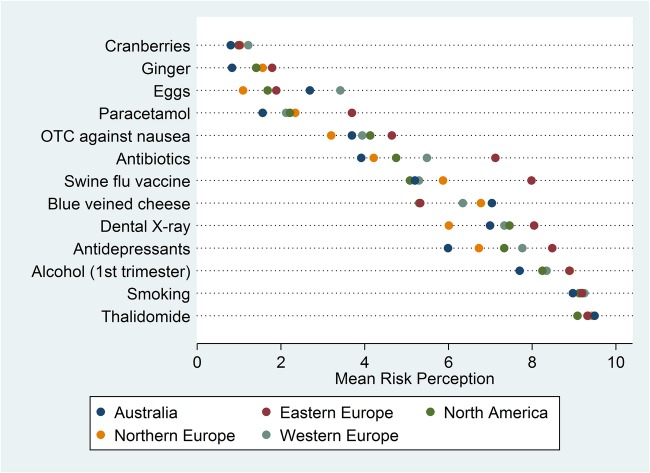
Main outcomes: Risk perception scores (0-10) for harmful effects to the fetus were derived for: (1) medicines (over-the-counter medicine and prescribed medicine), (2) food substances (eggs and blue veined cheese), (3) herbal substances (ginger and cranberries) (4) alcohol and tobacco, and (5) thalidomide.
Results: Overall, 80% (6453/8131) of women perceived the risk of giving birth to a child with a birth defect to be ≤ 5 of 100 births. The women rated cranberries and ginger least harmful (mean risk perception scores 1.1 and 1.5 of 10, respectively) and antidepressants, alcohol, smoking and thalidomide as most harmful (7.6, 8.6, 9.2 and 9.4 out of 10, respectively). The perception varied with age, level of education, pregnancy status, profession and geographical region. Noticeably, 70% had not heard about thalidomide, but of those who had (2692/9113), the risk perception scores were 0.4-0.5 points lower in women below 25 years compared to women aged 26-30 years.
Conclusions: In general, women perceived the risks of giving birth to a child with birth defects low, but there were substantial disparities between women's perceived risks and the actual risks when it comes to over-the-counter agents against nausea and prescribed medication. The study revealed that few women knew of thalidomide, suggesting that the general awareness among women of the teratogenic effects of thalidomide is declining, but it has left a general scepticism about safety of medication in pregnancy. This may have some severe consequences if women are left without medical treatments in pregnancy.
Keywords: perception of risks; pregnancy.
Published by the BMJ Publishing Group Limited. For permission to use (where not already granted under a licence) please go to http://group.bmj.com/group/rights-licensing/permissions.
Figures
References
-
- McBride W. Thalidomide and congenital abnormalities. Lancet 1961;2:1358 10.1016/S0140-6736(61)90927-8 - DOI
Publication types
MeSH terms
Substances
LinkOut - more resources
Full Text Sources
Other Literature Sources
