Knee Pain and a Prior Injury Are Associated with Increased Risk of a New Knee Injury: Data from the Osteoarthritis Initiative
- PMID: 26034152
- PMCID: PMC4522334
- DOI: 10.3899/jrheum.150016
Knee Pain and a Prior Injury Are Associated with Increased Risk of a New Knee Injury: Data from the Osteoarthritis Initiative
Abstract
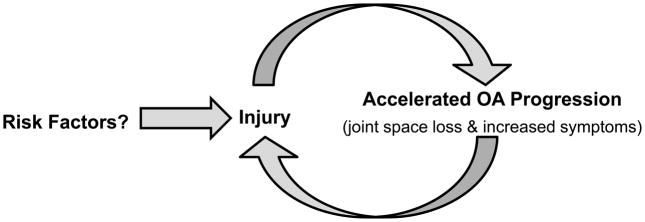
Objective: We explored whether knee pain or a history of knee injury were associated with a knee injury in the following 12 months.
Methods: We conducted longitudinal knee-based analyses among knees in the Osteoarthritis Initiative. We included both knees of all participants who had at least 1 followup visit with complete data. Our first sets of exposures were knee pain (chronic knee symptoms and severity) at baseline, 12-month, 24-month, and 36-month visits. Another exposure was a history of injury that we defined as a self-reported injury at any time prior to baseline, 12-month, 24-month, or 36-month visit. The outcome was self-reported knee injury during the past year at 12-month, 24-month, 36-month, and 48-month visits. We evaluated the association between ipsilateral and contralateral knee pain or history of injury and a new knee injury within 12 months of the exposure using generalized linear mixed model for repeated binary outcomes.
Results: A knee with reported chronic knee symptoms or ipsilateral or contralateral history of an injury was more likely to experience a new knee injury in the following 12 months than a knee without chronic knee symptoms (OR 1.84, 95% CI 1.57-2.16) or prior injury (prior ipsilateral knee injury: OR 1.81, 95% CI 1.56-2.09. Prior contralateral knee injury: OR 1.43, 95% CI 1.23-1.66).
Conclusion: Knee pain and a history of injury are associated with new knee injuries. It may be beneficial for individuals with knee pain or a history of injury to participate in injury prevention programs.
Keywords: KNEE INJURIES; MUSCULOSKELETAL PAIN; OSTEOARTHRITIS.
Figures
References
-
- Muthuri SG, McWilliams DF, Doherty M, Zhang W. History of knee injuries and knee osteoarthritis: a meta-analysis of observational studies. Osteoarthritis Cartilage. 2011;19:1286–93. - PubMed
-
- Felson DT, Zhang Y. An update on the epidemiology of knee and hip osteoarthritis with a view to prevention. Arthritis Rheum. 1998;41(8):1343–55. - PubMed
-
- Brown TD, Johnston RC, Saltzman CL, Marsh JL, Buckwalter JA. Posttraumatic osteoarthritis: a first estimate of incidence, prevalence, and burden of disease. J Orthop Trauma. 2006;20:739–44. - PubMed
-
- Zeng C, Gao SG, Wei J, Yang TB, Cheng L, Luo W, et al. The influence of the intercondylar notch dimensions on injury of the anterior cruciate ligament: a meta-analysis. Knee Surg Sports Traumatol Arthrosc. 2013;21:804–15. - PubMed
Publication types
MeSH terms
Grants and funding
LinkOut - more resources
Full Text Sources
Other Literature Sources
Medical
Miscellaneous