Review
. 2015 Sep;11(9):541-51.
doi: 10.1038/nrrheum.2015.71. Epub 2015 Jun 2.

Immune cell profiling to guide therapeutic decisions in rheumatic diseases

Affiliations
Review

Immune cell profiling to guide therapeutic decisions in rheumatic diseases

Joerg Ermann et al. Nat Rev Rheumatol. 2015 Sep.

Abstract

Biomarkers are needed to guide treatment decisions for patients with rheumatic diseases. Although the phenotypic and functional analysis of immune cells is an appealing strategy for understanding immune-mediated disease processes, immune cell profiling currently has no role in clinical rheumatology. New technologies, including mass cytometry, gene expression profiling by RNA sequencing (RNA-seq) and multiplexed functional assays, enable the analysis of immune cell function with unprecedented detail and promise not only a deeper understanding of pathogenesis, but also the discovery of novel biomarkers. The large and complex data sets generated by these technologies--big data--require specialized approaches for analysis and visualization of results. Standardization of assays and definition of the range of normal values are additional challenges when translating these novel approaches into clinical practice. In this Review, we discuss technological advances in the high-dimensional analysis of immune cells and consider how these developments might support the discovery of predictive biomarkers to benefit the practice of rheumatology and improve patient care.


Conflict of interest statement

Competing interests

The authors declare no competing interests.

Figures

Figure 1
Figure 1
Cellular immunophenotyping by multiparameter single-cell analysis. a | Fluorescence-based flow cytometry. Cells are stained with monoclonal antibodies conjugated to various fluorescent dyes. A stream of single cells is guided through a beam of monochromatic laser light, exciting the dye molecules to emit a characteristic spectrum of less energetic photons with longer wavelengths. Mirrors and filters direct the emitted light to photomultiplier tubes for quantification. Scattered laser light provides additional information about cell size and granularity that permits discrimination of the major subsets of lymphocytes, monocytes and granulocytes. The emission spectra of fluorophores overlap; therefore, signals from one fluorophore might be detected by more than one channel. This problem can be partially corrected by compensation, but ultimately limits the number of parameters measurable per cell. b | Mass cytometry. Cells are labelled with antibodies conjugated to rare earth metals not present in biological specimens. Individual cells are vaporized and ionized by an ICP torch. The resulting ion cloud is passed into a mass spectrometer to detect and quantify antibody-derived metal isotopes. Mass cytometry does not require compensation due to distinct mass peaks of the metal isotopes. Abbreviations: Cy, cyanine; FITC, fluorescein isothiocyanate; ICP, inductively coupled plasma; MS, mass spectrometer; PE, phycoerythrin; PerCp, peridinin chlorophyll.
Figure 2
Figure 2
Timeline of technical advances. Advances in flow cytometry and gene expression analysis since 1969. Abbreviations: CFSE, carboxyfluorescein succinimidyl ester; FACS, fluorescence-activated cell sorting; mAb, monoclonal antibody; RNA-seq, RNA sequencing.
Figure 3
Figure 3
Methods for genome-wide and multiparameter gene expression analysis. cDNA microarrays: sample mRNA is reverse-transcribed into fluorescently labelled cDNA, which is then hybridized to gene-specific oligonucleotide probes arrayed on a solid matrix (the ‘chip’). After complementary sequences have bound, and unbound sample is washed away, the chip is scanned. Fluorescence intensity detected at a specific location on the array provides a measurement of mRNA abundance. RNA-sequencing: RNA is reverse-transcribed into short double-stranded cDNA fragments that are sequenced using next-generation sequencers, mapped in silico to the reference genome and counted. The number of reads representing a specific mRNA corresponds to the abundance of that mRNA in the sample. nCounter® analysis system (NanoString Technologies®, USA): mRNA molecules are hybridized in solution to two sequence-specific probes per gene of interest—a capture probe that anchors the hybrids to a solid support for analysis and a reporter probe carrying a fluorescent barcode to identify the RNA. The number of hybrids with a specific barcode corresponds to the abundance of that mRNA species in the sample.
Figure 4
Figure 4
In vitro assays of cell function. a | Mycobacterium tuberculosis IFN-γ-release assay. In the ELISA method (marketed as QuantiFERON®-TB Gold In-Tube Test; Quest Diagnostics, USA), whole blood is stimulated with M. tuberculosis proteins, and the amount of IFN-γ secreted into the supernatant is quantified by ELISA. In the ELISPOT method (marketed as T-SPOT.TB; Oxford Immunotec, UK), PBMCs are prepared by density gradient centrifugation. A defined number of cells is then stimulated with M. tuberculosis protein for 24h on plates coated with anti-IFN-γ antibodies. Antigen-responsive cells secrete IFN-γ, which binds to these antibodies and is, after removal of the cells, subsequently detected by a second labelled anti-IFN-γ antibody. The number of spots on the plate corresponds to the number of IFN-γ+ cells in the sample. b | Whole blood multiparameter stimulation assay. Whole blood is added to a battery of TruCulture® tubes (Myriad RBM, USA) prefilled with standardized amounts of individual stimuli. The tubes are incubated on a simple heating block. After 24h, the supernatant is separated from the cells by centrifugation and analytes of interest are measured in the supernatant using a bead-based multiplex ELISA. The number of data points generated per sample is equal to the number of stimuli multiplied by the number of analytes measured in the supernatant. Abbreviations: ELISA, enzyme-linked immunosorbent assay; ELISPOT, enzyme-linked Immunospot; M.tb., Mycobacterium tuberculosis; PBMC, peripheral blood mononuclear cell; RBC, red blood cell.
Figure 5
Figure 5
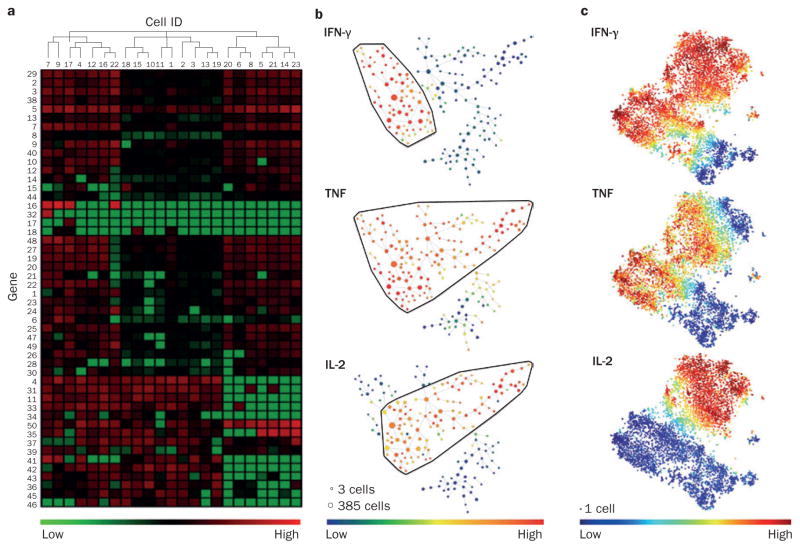
Analysing and displaying large complex data sets. Human memory CD4+ T cells were stimulated for 24 h with anti-CD3 and anti-CD28 beads. After 24 h of incubation, cells were either sorted for single-cell RNA-seq or analyzed by 32-parameter mass cytometry. a | Cluster analysis of single-cell RNA-seq data. 50 differentially expressed genes are depicted (green, high expression; red, low expression). A cluster algorithm has ordered cells (columns) and genes (rows) by expression, revealing shared and distinct transcriptional patterns. Cellular hierarchy is represented by a dendrogram. b | SPADE for mass cytometry data. With 32 markers, SPADE groups cells into nodes on the basis of panel-wide similarity of marker expression. Node size represents the number of cells in the cluster. Nodes are joined in a minimal-spanning tree that represents phenotypic similarity; the degree of dissimilarity between two nodes increases with the number of nodes separating them. Colour depicts expression of an individual marker across all nodes. IFN-γ, TNF and IL-2 are shown as examples. c | viSNE map for mass cytometry data. A dimensionality reduction algorithm (t-SNE) ‘projects’ the 32-parameter data set onto a 2D plane. Each dot represents an individual cell and phenotypic similarity across the marker panel is represented by distance. Colour represents expression of individual markers. Abbreviations: RNA-seq, RNA sequencing; SPADE, spanning-tree progression analysis of density-normalized events; viSNE, visualization of the t-distributed Stochastic Neighbor Embedding algorithm.

References

    1. Robinson WH, et al. Mechanistic biomarkers for clinical decision making in rheumatic diseases. Nat Rev Rheumatol. 2013;9:267–276. - PMC - PubMed
    1. Emery P, Dörner T. Optimising treatment in rheumatoid arthritis: a review of potential biological markers of response. Ann Rheum Dis. 2011;70:2063–2070. - PubMed
    1. Virgo PF, Gibbs GJ. Flow cytometry in clinical pathology. Ann Clin Biochem. 2012;49:17–28. - PubMed
    1. Kittleson MM, Kobashigawa JA. Long-term care of the heart transplant recipient. Curr Opin Organ Transplant. 2014;19:515–524. - PubMed
    1. Mirnezami R, Nicholson J, Darzi A. Preparing for precision medicine. N Engl J Med. 2012;366:489–491. - PubMed

Publication types