


An Observational Study of Decision Making by Medical Intensivists
- PMID: 26035147
- PMCID: PMC8120648
- DOI: 10.1097/CCM.0000000000001084
An Observational Study of Decision Making by Medical Intensivists
Abstract
Objectives: The ICU is a place of frequent, high-stakes decision making. However, the number and types of decisions made by intensivists have not been well characterized. We sought to describe intensivist decision making and determine how the number and types of decisions are affected by patient, provider, and systems factors.
Design: Direct observation of intensivist decision making during patient rounds.
Setting: Twenty-four-bed academic medical ICU.
Subjects: Medical intensivists leading patient care rounds.
Intervention: None.
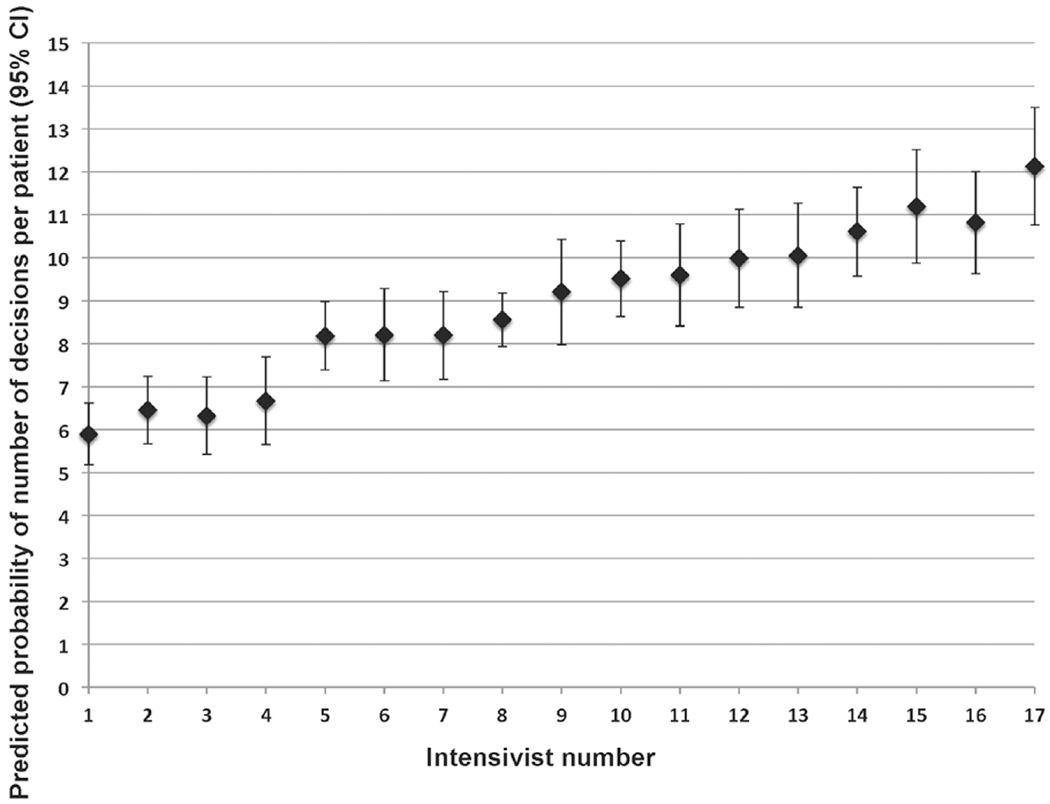
Measurements and main results: During 920 observed patient rounds on 374 unique patients, intensivists made 8,174 critical care decisions (mean, 8.9 decisions per patient daily, 102.2 total decisions daily) over a mean of 3.7 hours. Patient factors associated with increased numbers of decisions included a shorter time since ICU admission and an earlier slot in rounding order (both p < 0.05). Intensivist identity explained the greatest proportion of variance in number of decisions per patient even when controlling for all other factors significant in bivariable regression. A given intensivist made more decisions per patient during days later in the 14-day rotation (p < 0.05). Female intensivists made significantly more decisions than male intensivists (p < 0.05).
Conclusions: Intensivists made over 100 daily critical care decisions during rounds. The number of decisions was influenced by a variety of patient- and system-related factors and was highly variable among intensivists. Future work is needed to explore effects of the decision-making burden on providers' choices and on patient outcomes.
Figures
Comment in
-
More Than Meets the Eye: Supervision and Teaching Decisions Need to be Noticed Too.Crit Care Med. 2016 Jan;44(1):e56. doi: 10.1097/CCM.0000000000001367. Crit Care Med. 2016. PMID: 26672949 No abstract available.
References
-
- Aitken LM, Marshall AP, Elliott R, et al. : Critical care nurses’ decision making: Sedation assessment and management in intensive care. J Clin Nurs 2009; 18:36–45 - PubMed
-
- Garg AX, Adhikari NK, McDonald H, et al. : Effects of computerized clinical decision support systems on practitioner performance and patient outcomes: A systematic review. JAMA 2005; 293:1223–1238 - PubMed
-
- Howe DC: Observational study of admission and triage decisions for patients referred to a regional intensive care unit. Anaesth Intensive Care 2011; 39:650–658 - PubMed
Publication types
MeSH terms
Grants and funding
LinkOut - more resources
Full Text Sources
Medical
