Effects of Hormone Therapy on Cognition and Mood in Recently Postmenopausal Women: Findings from the Randomized, Controlled KEEPS-Cognitive and Affective Study
- PMID: 26035291
- PMCID: PMC4452757
- DOI: 10.1371/journal.pmed.1001833
Effects of Hormone Therapy on Cognition and Mood in Recently Postmenopausal Women: Findings from the Randomized, Controlled KEEPS-Cognitive and Affective Study
Abstract
Background: Menopausal hormone therapy (MHT) reportedly increases the risk of cognitive decline in women over age 65 y. It is unknown whether similar risks exist for recently postmenopausal women, and whether MHT affects mood in younger women. The ancillary Cognitive and Affective Study (KEEPS-Cog) of the Kronos Early Estrogen Prevention Study (KEEPS) examined the effects of up to 4 y of MHT on cognition and mood in recently postmenopausal women.
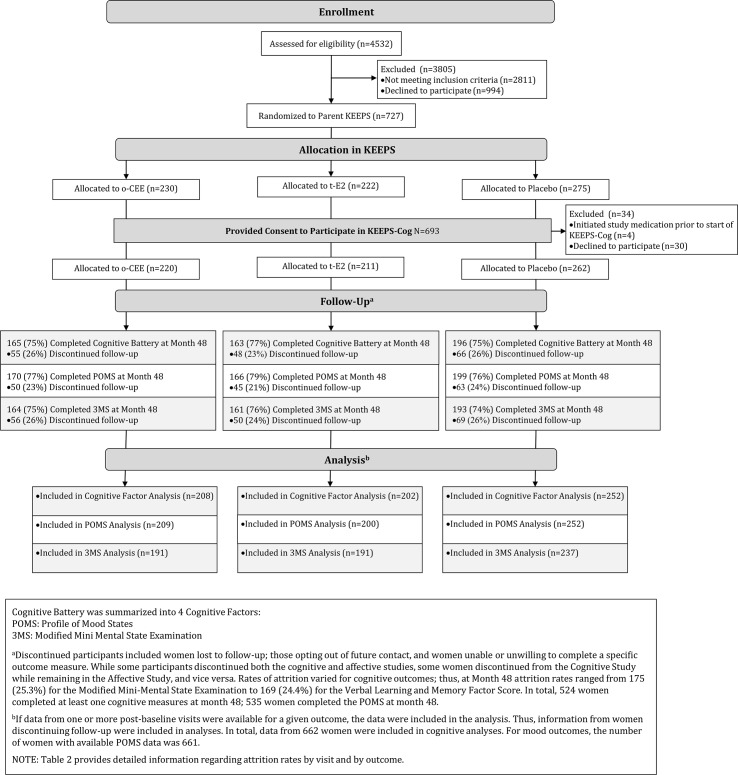
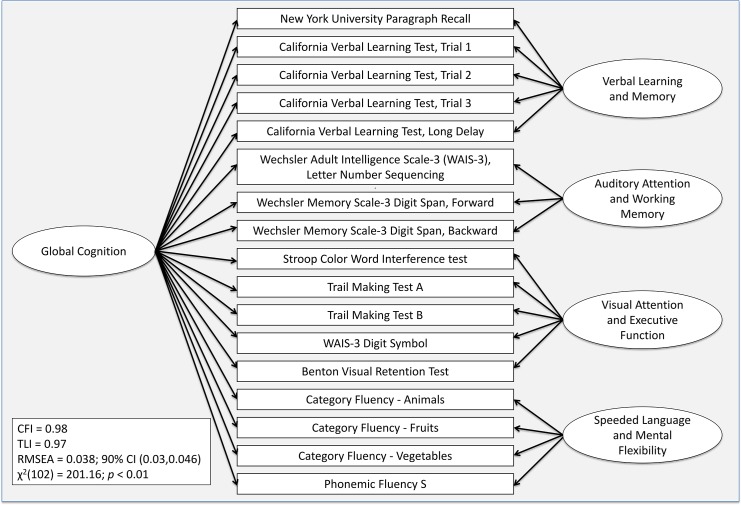
Methods and findings: KEEPS, a randomized, double-blinded, placebo-controlled clinical trial, was conducted at nine US academic centers. Of the 727 women enrolled in KEEPS, 693 (95.3%) participated in the ancillary KEEPS-Cog, with 220 women randomized to receive 4 y of 0.45 mg/d oral conjugated equine estrogens (o-CEE) plus 200 mg/d micronized progesterone (m-P) for the first 12 d of each month, 211 women randomized to receive 50 μg/d transdermal estradiol (t-E2) plus 200 mg/d m-P for the first 12 d of each month, and 262 women randomized to receive placebo pills and patches. Primary outcomes included the Modified Mini-Mental State examination; four cognitive factors: verbal learning/memory, auditory attention/working memory, visual attention/executive function, and speeded language/mental flexibility; and a mood measure, the Profile of Mood States (POMS). MHT effects were analyzed using linear mixed-effects (LME) models, which make full use of all available data from each participant, including those with missing data. Data from those with and without full data were compared to assess for potential biases resulting from missing observations. For statistically significant results, we calculated effect sizes (ESs) to evaluate the magnitude of changes. On average, participants were 52.6 y old, and 1.4 y past their last menstrual period. By month 48, 169 (24.4%) and 158 (22.8%) of the 693 women who consented for ancillary KEEPS-Cog were lost to follow-up for cognitive assessment (3MS and cognitive factors) and mood evaluations (POMS), respectively. However, because LME models make full use all available data, including data from women with missing data, 95.5% of participants were included in the final analysis (n = 662 in cognitive analyses, and n = 661 in mood analyses). To be included in analyses, women must have provided baseline data, and data from at least one post-baseline visit. The mean length of follow-up was 2.85 y (standard deviation [SD] = 0.49) for cognitive outcomes and 2.76 (SD = 0.57) for mood outcomes. No treatment-related benefits were found on cognitive outcomes. For mood, model estimates indicated that women treated with o-CEE showed improvements in depression and anxiety symptoms over the 48 mo of treatment, compared to women on placebo. The model estimate for the depression subscale was -5.36 × 10(-2) (95% CI, -8.27 × 10(-2) to -2.44 × 10(-2); ES = 0.49, p < 0.001) and for the anxiety subscale was -3.01 × 10(-2) (95% CI, -5.09 × 10(-2) to -9.34 × 10(-3); ES = 0.26, p < 0.001). Mood outcomes for women randomized to t-E2 were similar to those for women on placebo. Importantly, the KEEPS-Cog results cannot be extrapolated to treatment longer than 4 y.
Conclusions: The KEEPS-Cog findings suggest that for recently postmenopausal women, MHT did not alter cognition as hypothesized. However, beneficial mood effects with small to medium ESs were noted with 4 y of o-CEE, but not with 4 y of t-E2. The generalizability of these findings is limited to recently postmenopausal women with low cardiovascular risk profiles.
Trial registration: ClinicalTrials.gov NCT00154180 and NCT00623311.
Conflict of interest statement
I have read the journal's policy and the authors of this manuscript have the following competing interests: MIC declared: I have research funding from Nora Therapeutics and Ferring pharmaceuticals. I am a member of ASRM Executive Board. NFS declared: 1. Menogenix: stock options (this is a company that has patented a novel non hormonal treatment for menopausal hot flashes and to date I have not exercised my stock options but would rather report this than give the appearance of not disclosing sufficient information). 2. Bayer, Inc: grant support (this is an investigator initiated grant that is supported by funds given to my institution. I receive no personal funds for this work). SA declared: 1) NIH Grants to support my research—NIA P50 Center Grant to support the Wisconsin Alzheimer's Disease Research Center (ADRC). 2) NIA T32 Training Grant in the Biology of Aging and Age-Related Diseases. 3) NIA RO1 that supported the KEEPS Cognitive and Affective Study. 4) Following Pharma Industry-supported research grants to serve as a site PI to conduct treatment trials in patients with Alzheimer's disease and Mild Cognitive Impairment (MCI): Merck Sharp and Dohme; H. Lundbeck A-S; Toyama Chemical Company. 5) Rockpointe Corporation—I am on the Speaker's Bureau of this science-based education corporation that sponsors CME-accredited education programs. My presentations are on Alzheimer's disease and not related to the focus of the manuscript under review. HST declared: I have served as a consultant to Bayer, Abbvie, Pfizer and Theraputics MD. My University has received grant support toward my work from Pfizer. I have authored papers with employees of Pfizer and Shionogi.
Figures
References
-
- Resnick SM, Henderson VW. Hormone therapy and risk of Alzheimer disease: a critical time. JAMA. 2002;288:2170–2172. - PubMed
-
- Sherwin BB. Estrogen and memory in women: how can we reconcile the findings? Horm Behav. 2005;47:371–375. - PubMed
-
- Joffe H, Hall JE, Gruber S, Sarmiento IA, Cohen LS, Yurgelun-Todd D, et al. Estrogen therapy selectively enhances prefrontal cognitive processes: a randomized, double-blind, placebo-controlled study with functional magnetic resonance imaging in perimenopausal and recently postmenopausal women. Menopause. 2006;13:411–422. - PubMed
Publication types
MeSH terms
Substances
Associated data
Grants and funding
- KL2 RR025749/RR/NCRR NIH HHS/United States
- R01 AG029624/AG/NIA NIH HHS/United States
- UL1 RR024131/RR/NCRR NIH HHS/United States
- 1UL1RR025011/RR/NCRR NIH HHS/United States
- UL1 RR024150/RR/NCRR NIH HHS/United States
- NCRR000167/PHS HHS/United States
- P50 AG033514/AG/NIA NIH HHS/United States
- R01 HL090639/HL/NHLBI NIH HHS/United States
- P50AG033514/AG/NIA NIH HHS/United States
- UL1 RR024139/RR/NCRR NIH HHS/United States
- UL1 RR025750/RR/NCRR NIH HHS/United States
- UL1 TR000427/TR/NCATS NIH HHS/United States
- R01AG031790/AG/NIA NIH HHS/United States
- R01 AG031790/AG/NIA NIH HHS/United States
- HL90639/HL/NHLBI NIH HHS/United States
- P30 AG017266/AG/NIA NIH HHS/United States
- TL1 RR025748/RR/NCRR NIH HHS/United States
- UL1 RR025011/RR/NCRR NIH HHS/United States
LinkOut - more resources
Full Text Sources
Other Literature Sources
Medical
Miscellaneous