


Periodontal treatment for preventing adverse pregnancy outcomes: a meta- and trial sequential analysis
- PMID: 26035835
- PMCID: PMC4452791
- DOI: 10.1371/journal.pone.0129060
Periodontal treatment for preventing adverse pregnancy outcomes: a meta- and trial sequential analysis
Abstract
Objectives: Periodontal treatment might reduce adverse pregnancy outcomes. The efficacy of periodontal treatment to prevent preterm birth, low birth weight, and perinatal mortality was evaluated using meta-analysis and trial sequential analysis.
Methods: An existing systematic review was updated and meta-analyses performed. Risk of bias, heterogeneity, and publication bias were evaluated, and meta-regression performed. Subgroup analysis was used to compare different studies with low and high risk of bias and different populations, i.e., risk groups. Trial sequential analysis was used to assess risk of random errors.
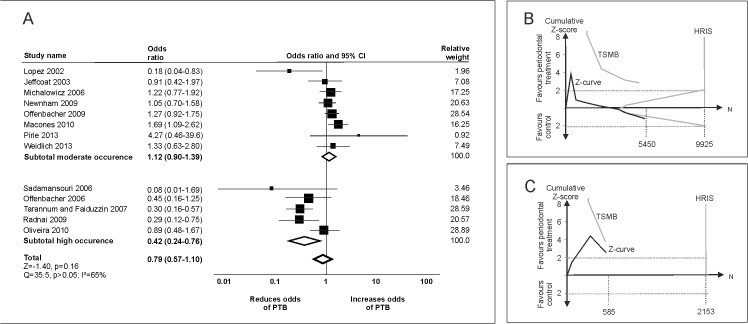
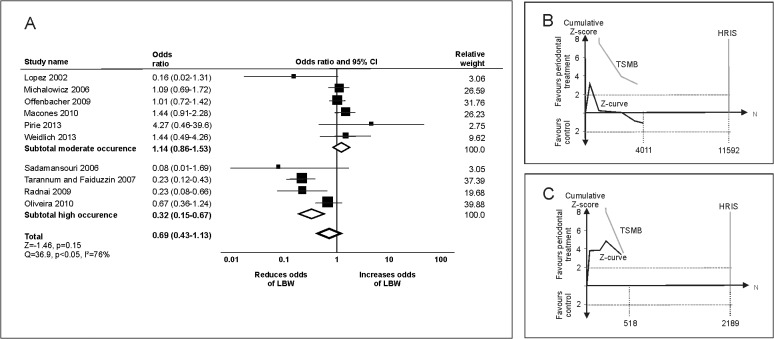
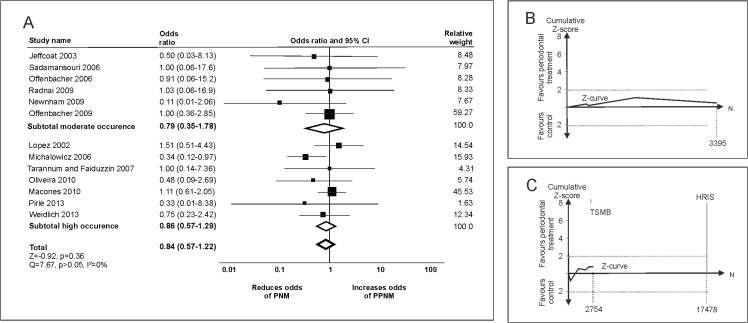
Results: Thirteen randomized clinical trials evaluating 6283 pregnant women were meta-analyzed. Four and nine trials had low and high risk of bias, respectively. Overall, periodontal treatment had no significant effect on preterm birth (odds ratio [95% confidence interval] 0.79 [0.57-1.10]) or low birth weight (0.69 [0.43-1.13]). Trial sequential analysis demonstrated that futility was not reached for any of the outcomes. For populations with moderate occurrence (< 20%) of preterm birth or low birth weight, periodontal treatment was not efficacious for any of the outcomes, and trial sequential analyses indicated that further trials might be futile. For populations with high occurrence (≥ 20%) of preterm birth and low birth weight, periodontal treatment seemed to reduce the risk of preterm birth (0.42 [0.24-0.73]) and low birth weight (0.32 [0.15-0.67]), but trial sequential analyses showed that firm evidence was not reached. Periodontal treatment did not significantly affect perinatal mortality, and firm evidence was not reached. Risk of bias, but not publication bias or patients' age modified the effect estimates.
Conclusions: Providing periodontal treatment to pregnant women could potentially reduce the risks of perinatal outcomes, especially in mothers with high risks. Conclusive evidence could not be reached due to risks of bias, risks of random errors, and unclear effects of confounding. Further randomized clinical trials are required.
Conflict of interest statement
Figures
References
-
- Kim AJ, Lo AJ, Pullin DA, Thornton-Johnson DS, Karimbux NY. Scaling and Root Planing Treatment for Periodontitis to Reduce Preterm Birth and Low Birth Weight: A Systematic Review and Meta-Analysis of Randomized Controlled Trials. Journal of Periodontology. 2012;83(12):1508–19. 10.1902/jop.2012.110636 - DOI - PubMed
-
- Polyzos NP, Polyzos IP, Zavos A, Valachis A, Mauri D, Papanikolaou EG, et al. Obstetric outcomes after treatment of periodontal disease during pregnancy: systematic review and meta-analysis. Bmj. 2010;341:c7017 Epub 2010/12/31. 10.1136/bmj.c7017 ; PubMed Central PMCID: PMCPmc3011371. - DOI - PMC - PubMed
Publication types
MeSH terms
LinkOut - more resources
Full Text Sources
Other Literature Sources
