


Childhood maltreatment, 9/11 exposure, and latent dimensions of psychopathology: A test of stress sensitization
- PMID: 26037889
- PMCID: PMC4677391
- DOI: 10.1016/j.jpsychires.2015.05.005
Childhood maltreatment, 9/11 exposure, and latent dimensions of psychopathology: A test of stress sensitization
Abstract
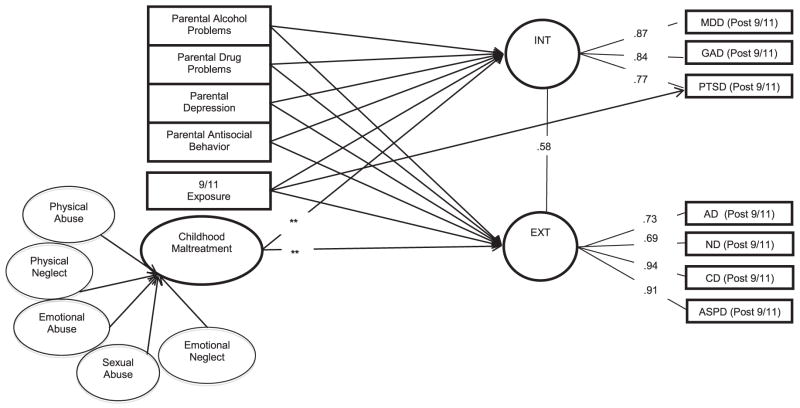
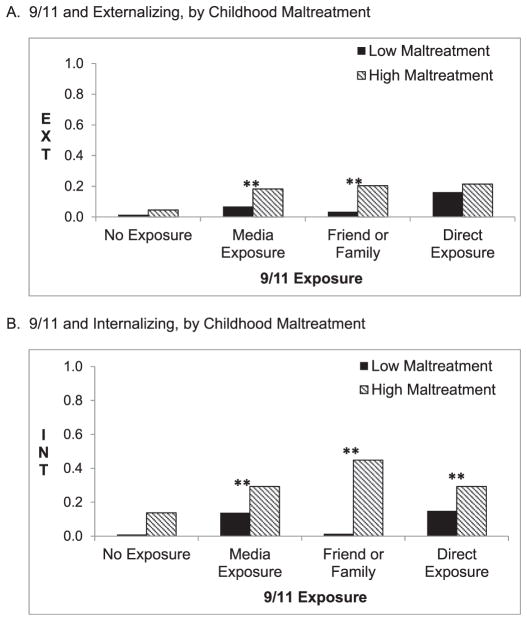
On September 11, 2001, a terrorist attack occurred in the U.S. (9/11). Research on 9/11 and psychiatric outcomes has focused on individual disorders rather than the broader internalizing (INT) and externalizing (EXT) domains of psychopathology, leaving unknown whether direct and indirect 9/11 exposure differentially impacted these domains rather than individual disorders. Further, whether such effects were exacerbated by earlier childhood maltreatment (i.e. stress sensitization) is unknown. 18,713 participants from a U.S. national sample with no history of psychiatric disorders prior to 9/11 were assessed using a structured in-person interview. Structural equation modeling conducted in a sample who endorsed no psychiatric history prior to 9/11, indicated that indirect exposure to 9/11 (i.e. media, friends/family) was related to both EXT (alcohol, nicotine, and cannabis dependence, and antisocial personality disorder) and INT (major depression, generalized anxiety, and post-traumatic stress disorder (PTSD)) dimensions of psychopathology (EXT: β = 0.10, p < 0.001; INT: β = 0.11, p < 0.001) whereas direct exposure was associated with the INT dimension only (β = 0.11, p < 0.001). For individuals who had experienced childhood maltreatment, the risk for EXT and INT dimensions associated with 9/11 was exacerbated (Interactions: β = 0.06, p < 0.01; β = 0.07, p < 0.001, respectively). These findings indicate that 9/11 impacted latent liability to broad domains of psychopathology in the US general population rather than specific disorders with the exception of PTSD, which had independent effects beyond INT (as indicated by a significant (p < 0.05) improvement in modification indices). Findings also indicated that childhood maltreatment increases the risk associated with adult trauma exposure, providing further evidence for the concept of stress sensitization.
Keywords: 9/11; Child abuse; Child neglect; Externalizing; Internalizing; NESARC; Psychopathology; Stress sensitization; Substance use; World Trade Center.
Copyright © 2015. Published by Elsevier Ltd.
Conflict of interest statement
The authors have no conflicts of interest.
Figures
References
-
- Andreasen NC, Endicott J, Spitzer RL, Winokur G. The family history method using diagnostic criteria. Reliab Validity. Arch of Gen Psychiatr. 1977 Oct;34(10):1229–35. - PubMed
-
- American Psychological Association; American Psychiatric, editor. Diagnostic and statistical manual of mental disorders. 4. Washington D.C: 2000.
-
- Ben Barnes J, Dickstein BD, Maguen S, Neria Y, Litz BT. The distinctiveness of prolonged grief and posttraumatic stress disorder in adults bereaved by the attacks of September 11th. J Affect Disord. 2012 Feb;136(3):366–9. - PubMed
-
- Breslau N, Bohnert KM, Koenen KC. The 9/11 terrorist attack and posttraumatic stress disorder revisited. J Nerv Ment Dis. 2010 Aug;198(8):539–43. - PubMed
-
- Canino G, Bravo M, Ramirez R, Febo VE, Rubio-Stipec M, Fernandez RL, et al. The Spanish Alcohol Use Disorder and Associated Disabilities Interview Schedule (AUDADIS): reliability and concordance with clinical diagnoses in a Hispanic population. J Stud Alcohol. 1999;60(6):790–9. 1999/12/22. - PubMed
Publication types
MeSH terms
Grants and funding
LinkOut - more resources
Full Text Sources
Other Literature Sources
Medical
