Association Between Specific Mutations in KRAS Codon 12 and Colorectal Liver Metastasis
- PMID: 26038887
- PMCID: PMC4696064
- DOI: 10.1001/jamasurg.2015.0313
Association Between Specific Mutations in KRAS Codon 12 and Colorectal Liver Metastasis
Abstract
Importance: Currently, one of the most commonly available biomarkers in the treatment of patients with colorectal liver metastases (CRLM) is the Kirsten rat sarcoma viral oncogene homolog (KRAS); however, the prognostic implications of specific mutations of the KRAS gene are still not well defined.
Objective: To investigate the prognostic impact of specific KRAS mutations on patients undergoing liver resection for CRLM.
Design, setting, and participants: This retrospective single-center study was conducted from January 1, 2003, to December 31, 2013. Data about specific KRAS mutations for 331 patients who underwent hepatic resection for CRLM at Johns Hopkins Hospital between 2003 and 2013 were analyzed. Clinicopathological characteristics, perioperative details, and outcomes were stratified by specific KRAS mutation at codons 12 and 13.
Intervention: Resection of CRLM.
Main outcomes and measures: Overall survival (OS) and recurrence-free survival.
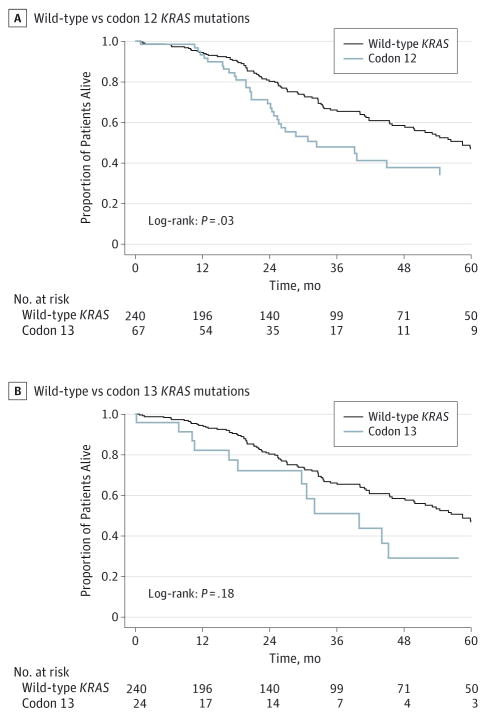
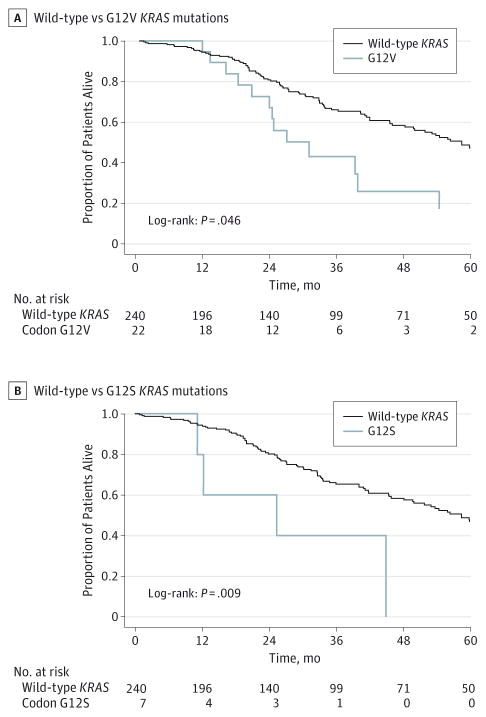
Results: A mutated KRAS (mtKRAS) was identified in 91 patients (27.5%). At a median follow-up of 27.4 months, recurrence was observed in 48 patients (52.7%) with mtKRAS and 130 patients (54.2%) with wild-type KRAS (wtKRAS) (P = .82). Median and 5-year survival among patients with mtKRAS was 32.4 months and 32.7%, respectively, vs 58.5 months and 46.9%, respectively, for patients with wtKRAS (P = .02). Patients with KRAS codon 12 mutations had worse OS (hazard ratio [HR], 1.54; 95% CI, 1.05-2.27; P = .03) vs those with wtKRAS, whereas a KRAS codon 13 mutation was not associated with prognosis (HR, 1.47; 95% CI, 0.83-2.62; P = .19). Among the 6 most common mutations in codons 12 and 13, only G12V (HR, 1.78; 95% CI, 1.00-3.17; P = .05) and G12S (HR, 3.33; 95% CI, 1.22-9.10; P = .02) were associated with worse OS compared with patients with wtKRAS (both P < .05). Among patients who recurred, G12V (HR, 2.96; 95% CI, 1.32-6.61; P = .01), G12C (HR, 6.74; 95% CI, 2.05-22.2; P = .002), and G12S mutations (HR, 4.91; 95% CI, 1.52-15.8; P = .01) were associated with worse OS (both P < .05).
Conclusions and relevance: G12V and G12S mutations of codon 12 were independent prognostic factors of worse OS. Among patients who recurred after resection of CRLM, G12V, G12C, and G12S mutations were associated with worse OS. Information on specific KRAS mutations may help individualize therapeutic and surveillance strategies for patients with resected CRLM.
Conflict of interest statement
Figures
Comment in
-
Colorectal Liver Metastasis Resection Outcomes Defined by Molecular Biology.JAMA Surg. 2015 Aug;150(8):729. doi: 10.1001/jamasurg.2015.1062. JAMA Surg. 2015. PMID: 26039694 No abstract available.
References
-
- de Jong MC, Pulitano C, Ribero D, et al. Rates and patterns of recurrence following curative intent surgery for colorectal liver metastasis: an international multi-institutional analysis of 1669 patients. Ann Surg. 2009;250(3):440–448. - PubMed
-
- Pawlik TM, Choti MA. Surgical therapy for colorectal metastases to the liver. J Gastrointest Surg. 2007;11(8):1057–1077. - PubMed
-
- Gleisner AL, Choti MA, Assumpcao L, Nathan H, Schulick RD, Pawlik TM. Colorectal liver metastases: recurrence and survival following hepatic resection, radiofrequency ablation, and combined resection-radiofrequency ablation. Arch Surg. 2008;143(12):1204–1212. - PubMed
-
- Andreyev HJ, Norman AR, Cunningham D, Oates JR, Clarke PA. Kirsten ras mutations in patients with colorectal cancer: the multicenter “RASCAL” Study. J Natl Cancer Inst. 1998;90(9):675–684. - PubMed
MeSH terms
Substances
Grants and funding
LinkOut - more resources
Full Text Sources
Other Literature Sources
Medical
Miscellaneous