. 2015 Jun 3;10(6):e0126284.
doi: 10.1371/journal.pone.0126284. eCollection 2015.

Disruption of parenting behaviors in california mice, a monogamous rodent species, by endocrine disrupting chemicals

Affiliations

Disruption of parenting behaviors in california mice, a monogamous rodent species, by endocrine disrupting chemicals

Sarah A Johnson et al. PLoS One. .

Abstract

The nature and extent of care received by an infant can affect social, emotional and cognitive development, features that endure into adulthood. Here we employed the monogamous, California mouse (Peromyscus californicus), a species, like the human, where both parents invest in offspring care, to determine whether early exposure to endocrine disrupting chemicals (EDC: bisphenol A, BPA; ethinyl estradiol, EE) of one or both parents altered their behaviors towards their pups. Females exposed to either compound spent less time nursing, grooming and being associated with their pups than controls, although there was little consequence on their weight gain. Care of pups by males was less affected by exposure to BPA and EE, but control, non-exposed females appeared able to "sense" a male partner previously exposed to either compound and, as a consequence, reduced their own parental investment in offspring from such pairings. The data emphasize the potential vulnerability of pups born to parents that had been exposed during their own early development to EDC, and that effects on the male, although subtle, also have consequences on overall parental care due to lack of full acceptance of the male by the female partner.


Conflict of interest statement

Competing Interests: The authors have declared that no competing interests exist.

Figures

Fig 1
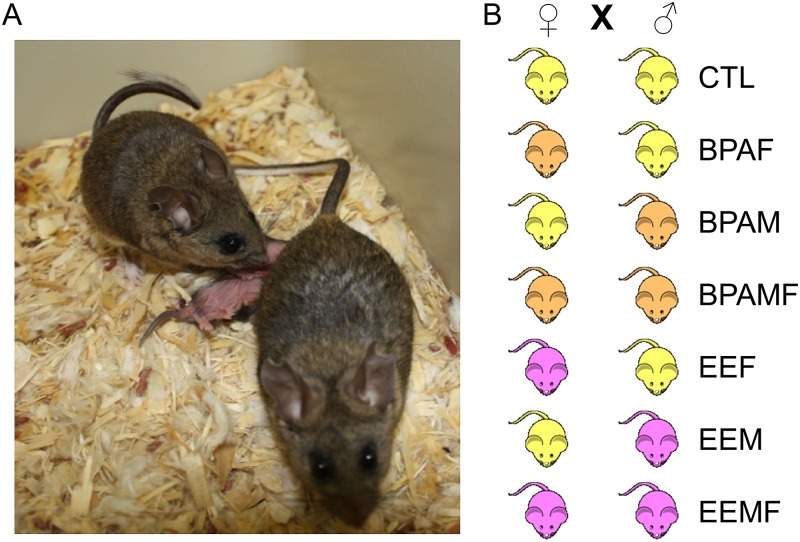
Fig 1. Typical image of a pair of California mice with two pups.
Pups most frequently nurse from the caudally located mammary glands, while the male trails behind the female while simultaneously grooming the pups. The pairing combinations are also illustrated.
Fig 2
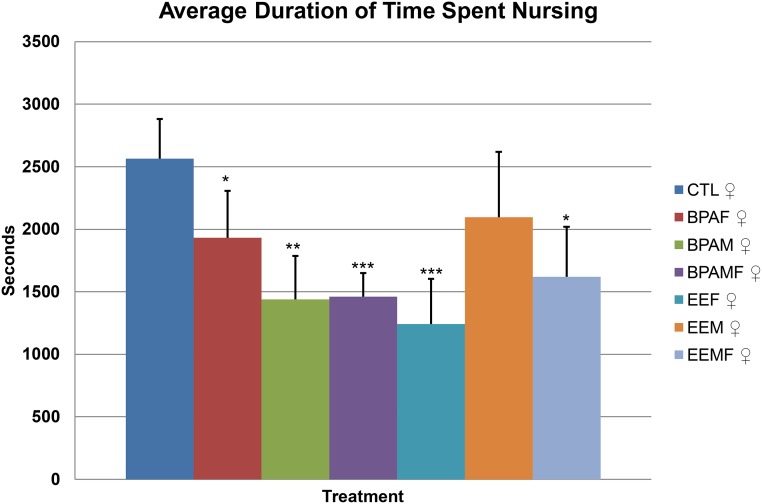
Fig 2. Average hourly duration of time from the day of birth to the end of post-natal day 5 that females spent nursing their pups.
Treatment groups that are significantly different from control pairings are denoted with * P < 0.05; ***, P < 0.001.
Fig 3
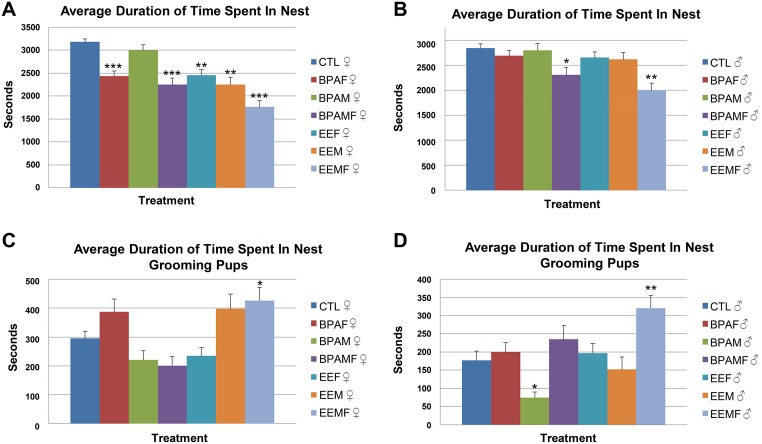
Fig 3. Average hourly duration of time from the day of birth to the end of post-natal day 5 that parents spent in the nest and grooming their pups.
A, Time spent in nest by female parent; B, Time spent in nest by male parent; C, Time spent grooming the pups by female parent; D, Time spent grooming the pups by male parent. Treatment groups that differ from control pairs:*, P < 0.05, **, P < 0.01, and ***, P < 0.001.
Fig 4
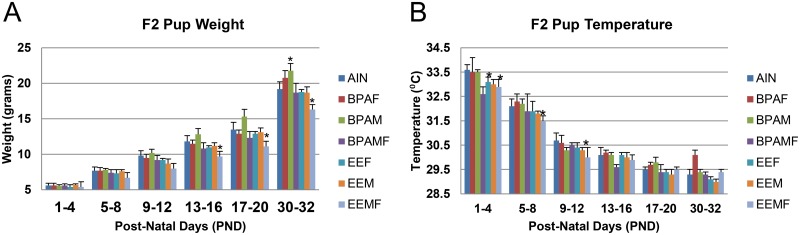
Fig 4. Effects of developmental EDC exposure of parents on body weight gain and body temperature of pups.
A, Body weight of neonatal to weanling offspring. B, Body temperature of neonatal to weanling offspring. Treatment groups that differ from control pairs:*, P value range = 0.01 to 0.003.

References

    1. Clutton-Brock TH. Mammalian mating systems. Proc R Soc Lond B Biol Sci. 1989;236(1285):339–72. Epub 1989/05/22. . - PubMed
    1. Woodroffe R, Vincent A. Mother's little helpers: Patterns of male care in mammals. Trends Ecol Evol. 1994;9(8):294–7. Epub 1994/08/01. 10.1016/0169-5347(94)90033-7 . - DOI - PubMed
    1. Gray PB. Evolution and human sexuality. American journal of physical anthropology. 2013;152 Suppl 57:94–118. Epub 2013/10/24. 10.1002/ajpa.22394 . - DOI - PubMed
    1. Gubernick DJ, Alberts JR. The biparental care system of the California mouse, Peromyscus californicus. J Comp Psychol. 1987;101(2):169–77. Epub 1987/06/01. . - PubMed
    1. Rosenfeld CS, Johnson SA, Ellersieck MR, Roberts RM. Interactions between parents and parents and pups in the monogamous California mouse (Peromyscus californicus). PLoS ONE. 2013;8(9):e75725 Epub 2013/09/27. 10.1371/journal.pone.0075725 - DOI - PMC - PubMed

Publication types

Substances