Review
. 2015 May 18:6:392.
doi: 10.3389/fmicb.2015.00392. eCollection 2015.

Enterobacter aerogenes and Enterobacter cloacae; versatile bacterial pathogens confronting antibiotic treatment

Affiliations
Review

Enterobacter aerogenes and Enterobacter cloacae; versatile bacterial pathogens confronting antibiotic treatment

Anne Davin-Regli et al. Front Microbiol. .

Abstract

Enterobacter aerogenes and E. cloacae have been reported as important opportunistic and multiresistant bacterial pathogens for humans during the last three decades in hospital wards. These Gram-negative bacteria have been largely described during several outbreaks of hospital-acquired infections in Europe and particularly in France. The dissemination of Enterobacter sp. is associated with the presence of redundant regulatory cascades that efficiently control the membrane permeability ensuring the bacterial protection and the expression of detoxifying enzymes involved in antibiotic degradation/inactivation. In addition, these bacterial species are able to acquire numerous genetic mobile elements that strongly contribute to antibiotic resistance. Moreover, this particular fitness help them to colonize several environments and hosts and rapidly and efficiently adapt their metabolism and physiology to external conditions and environmental stresses. Enterobacter is a versatile bacterium able to promptly respond to the antibiotic treatment in the colonized patient. The balance of the prevalence, E. aerogenes versus E. cloacae, in the reported hospital infections during the last period, questions about the horizontal transmission of mobile elements containing antibiotic resistance genes, e.g., the efficacy of the exchange of resistance genes Klebsiella pneumoniae to Enterobacter sp. It is also important to mention the possible role of antibiotic use in the treatment of bacterial infectious diseases in this E. aerogenes/E. cloacae evolution.

Keywords: Enterobacter aerogenes; Enterobacter cloacae; membrane and transporters; regulation; resistance mechanisms.


Figures
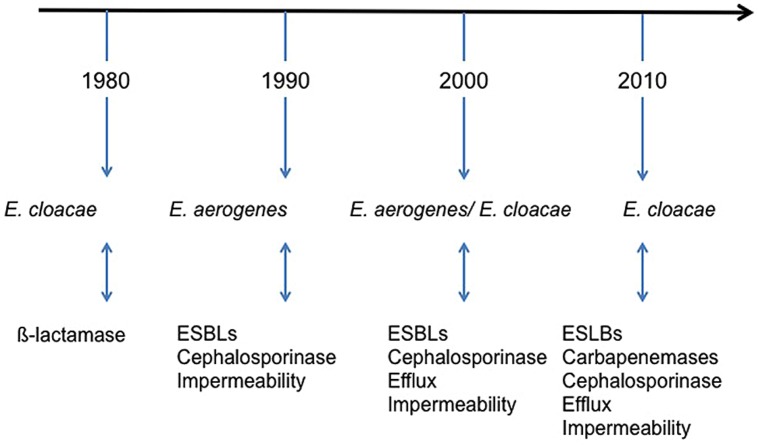
FIGURE 1
FIGURE 1
Schematic illustration of the timing of Enterobacter species during the emergence of resistance outbreaks in France hospitals (Arpin et al., 1996; Bornet et al., 2000; Chevalier et al., 2008; Lavigne et al., 2012; Mezzatesta et al., 2012; Anastay et al., 2013; Robert et al., 2014). ESBLs, extended-spectrum β-lactamases.
FIGURE 2
FIGURE 2
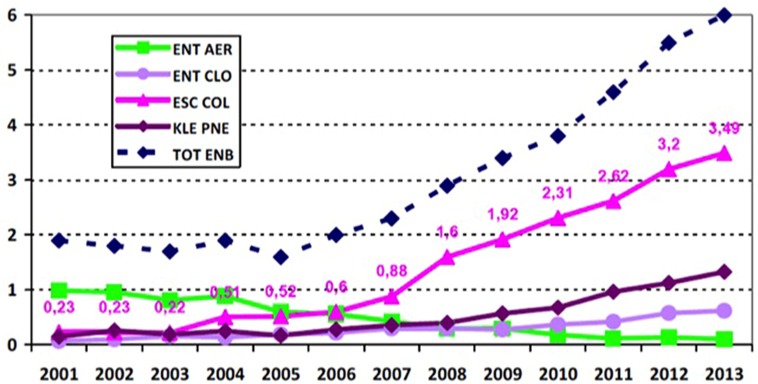
Distribution of the main species of Enterobacteriaceae-ESBL (n for 10,000 patient days): evolution 2002–2013 from the French national coordination of MDRB surveillance (Carbonne et al., 2013; Jarlier and INVS, 2014). ENT AER, Enterobacter aerogenes; ENT CLO, E. cloacae; ESC COL, E. coli; KLE PNE, Klebsiella pneumoniae; TOT ENB, Total Enterobacteriaceae; ESBLs, extended-spectrum β-lactamases.
FIGURE 3
FIGURE 3
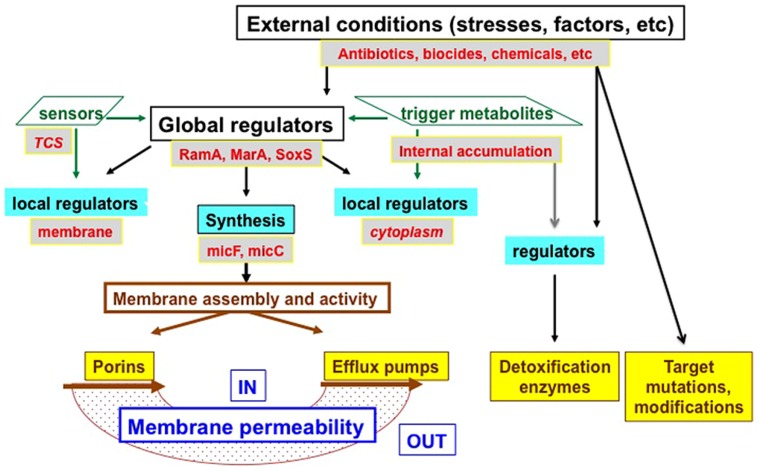
Schematic illustration of resistance mechanism and their regulations. Different levels of regulation are presented: (i) Transcriptional and translational levels controlled by various sensors [two components systems (TCS), such as EnvZ/OmpR for porins], global regulators (RamA, MarA, SoxS are indicated here), and local regulators (AcrR for efflux pumps and OmpX for porins), the accumulation of trigger metabolites inside the bacterial cell can also trigger the expression via local or other regulators, MicF and MicC represent the small interfering RNA controlling porin mRNA stability. (ii) Translational and final membrane assembly in a functional conformation (via chaperones and membrane factors. Porins represent Omp35, Omp36; Efflux pumps represent the AcrAB–TolC family. IN, bacterial cytoplasm; OUT, external medium.

References

    1. Alekshun M. N., Levy S. B. (2007). Molecular mechanisms of antibacterial multidrug resistance. Cell 128 1037–1050 10.1016/j.cell.2007.03.004 - DOI - PubMed
    1. Allerberger F., Koeuth T., Lass-Florl C., Dierich M. P., Putensen C., Schmutzhard E., et al. (1996). Epidemiology of infections due to multiresistant Enterobacter aerogenes in an university hospital. Eur. J. Clin. Microbiol. Infect. Dis. 15 517–521 10.1007/BF01691323 - DOI - PubMed
    1. Anastay M., Lagier E., Blanc V., Chardon H. (2013). Epidémiologie des bêtalactamases à spectre étendu (BLSE) chez les entérobactéries dans un hôpital du sud de la France, 1997-2007. Pathol. Biol. 61 38–43 10.1016/j.patbio.2012.03.001 - DOI - PubMed
    1. Arpin C., Coze C., Rogues A. M., Gachie J. P., Bebear C., Quentin C. (1996). Epidemiological study of an outbreak due to multidrug-resistant Enterobacter aerogenes in a medical intensive care unit. J. Clin. Microbiol. 34 2163–2169. - PMC - PubMed
    1. Arpin C., Labia R., Dubois V., Noury P., Souquet M., Quentin C. (2002). TEM-80 a novel inhibitor-resistant β-lactamase in a clinical isolate of Enterobacter cloacae. Antimicrob. Agents Chemother. 46 1183–1189 10.1128/AAC.46.5.1183-1189.2002 - DOI - PMC - PubMed