


Negative pressure wound therapy for treating surgical wounds healing by secondary intention
- PMID: 26042534
- PMCID: PMC10960640
- DOI: 10.1002/14651858.CD011278.pub2
Negative pressure wound therapy for treating surgical wounds healing by secondary intention
Abstract
Background: Following surgery, incisions are usually closed by fixing the edges together with sutures (stitches), staples, adhesive glue or clips. This process helps the cut edges heal together and is called 'healing by primary intention'. However, not all incised wounds are closed in this way: where there is high risk of infection, or when there has been significant tissue loss, wounds may be left open to heal from the 'bottom up'. This delayed healing is known as 'healing by secondary intention'. Negative pressure wound therapy (NPWT) is one treatment option for surgical wounds that are healing by secondary intention.
Objectives: To assess the effects of negative pressure wound therapy (NPWT) on the healing of surgical wounds healing by secondary intention (SWHSI) in any care setting.
Search methods: For this review, in May 2015 we searched the following databases: the Cochrane Wounds Group Specialised Register; The Cochrane Central Register of Controlled Trials; Ovid MEDLINE; Ovid MEDLINE (In-Process & Other Non-Indexed Citations; Ovid EMBASE; and EBSCO CINAHL. There were no restrictions based on language or date of publication.
Selection criteria: Published or unpublished randomised controlled trials (RCTs) comparing the effects of NPWT with alternative treatments or different types of NPWT in the treatment of SWHSI. We excluded open abdominal wounds from this review as they are the subject of a separate Cochrane review that is in draft.
Data collection and analysis: Two review authors independently performed study selection, risk of bias assessment and data extraction.
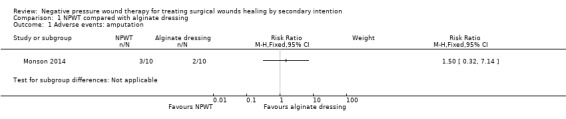
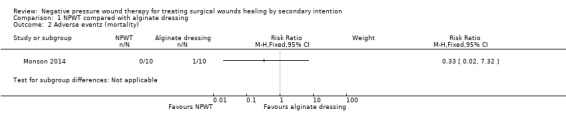
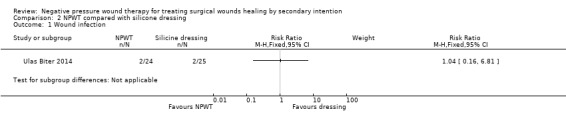
Main results: We located two studies (69 participants) for inclusion in this review. One study compared NPWT with an alginate dressing in the treatment of open, infected groin wounds. and one study compared NPWT with a silicone dressing in the treatment of excised pilonidal sinus. The trials reported limited outcome data on healing, adverse events and resource use.
Authors' conclusions: There is currently no rigorous RCT evidence available regarding the clinical effectiveness of NPWT in the treatment of surgical wounds healing by secondary intention as defined in this review. The potential benefits and harms of using this treatment for this wound type remain largely uncertain.
Conflict of interest statement
Figures


Update of
References
References to studies included in this review
Monson 2014 {published data only}
-
- Monsen C, Wann‐Hansson C, Wictorsson C, Acosta S. Vacuum‐assisted wound closure versus alginate for the treatment of deep perivascular wound infections in the groin after vascular surgery. Journal of Vascular Surgery 2014;59:145‐51. - PubMed
Ulas Biter 2014 {published data only}
-
- Biter LU, Beck GMN, Mannaerts GHH, Stok MM, Ham AC, Grotenhuis BA. The use of negative‐pressure wound therapy in pilonidal sinus disease: a randomized controlled trial comparing negative‐pressure wound therapy versus standard open wound care after surgical excision. Diseases of the colon and rectum 2014;57:1406‐1411. - PubMed
References to studies excluded from this review
Albert 2012 {published data only}
-
- Albert NM, Rock R, Sammon MA, Bena JF, Morrison SL, Whitman A, et al. Do patient and nurse outcome differences exist between two negative pressure wound therapy systems?. Journal of Wound Ostomy and Continence Nursing 2012;39:259‐66. - PubMed
Bee 2008 {published data only}
-
- Bee TK, Croce MA, Magnotti LJ, Zarzaur BL, Maish GO, Minard G, et al. Temporary abdominal closure techniques: a prospective randomized trial comparing polyglactin 910 mesh and vacuum‐assisted closure. Journal of Trauma 2008;65:337‐42. - PubMed
Braakenburg 2006 {published data only}
-
- Braakenburg A, Obdeijn MC, Feitz R, Rooij IA, Griethuysen AJ, Klinkenbijl JH. The clinical efficacy and cost effectiveness of the vacuum‐assisted closure technique in the management of acute and chronic wounds: a randomized controlled trial. Plastic and Reconstructive Surgery 2006;118:390‐7. - PubMed
de Laat 2011 {published data only}
-
- Laat EHEW, Boogaard MHWA, Spauwen PHM, Kuppevelt DHJM, Goor H, Schoonhoven L. Faster wound healing with topical negative pressure therapy in difficult‐to‐heal wound. A prospective randomized controlled trial. Annals of Plastic Surgery 2011;67:626–31. - PubMed
Dorafshar 2011 {published data only}
-
- Dorafshar AH, Franczyk M, Gottlieb LJ, Wroblewski KE, Lohman RF. A prospective randomized trial comparing subatmospheric wound therapy with a sealed gauze dressing and the standard vacuum‐assisted closure device. Annals of Plastic Surgery 2011;27:79‐84. - PubMed
Hu 2009 {published data only}
-
- Hu KX, Zhang HW, Zhou F, Yao G, Shi JP, Cheng Z, et al. Observation on the therapeutic effects of negative‐pressure wound therapy on the treatment of complicated and refractory wounds. Chinese Journal of Burns 2009;25:249‐52. - PubMed
Huang 2006 {published data only}
-
- Huang WS, Hsieh SC, Hsieh CS, Schoung JY, Huang T. Use of vacuum‐assisted wound closure to manage limb wounds in patients suffering from acute necrotizing fasciitis. Asian Journal of Surgery 2006;29:135‐9. - PubMed
Jeschke 2004 {published data only}
-
- Jeschke MG, Rose C, Angele P, Faffchtmeier B, Nerlich MN, Bolder U. Development of new reconstructive techniques: use of Integra in combination with fibrin glue and negative‐pressure therapy for reconstruction of acute and chronic wounds. Plastic and Reconstructive Surgery 2004;113:525‐30. - PubMed
Lei 2011 {published data only}
-
- Lei J, Li HS, Hao ZM, Duan P, Hao WJ. Mode of debridement, negative‐pressure therapy combined with tissue transplantation for treatment of complicated and refractory wounds. Chinese Journal of Burns 2011;27:456‐60. - PubMed
Liao 2012 {published data only}
-
- Liao Q, Xu J, Weng X, Zhong D, Liu Z, Wang C. Effectiveness of vacuum sealing drainage combined with anti‐taken skin graft for primary closing of open amputation wound. Chinese Journal of Reparative and Reconstructive Surgery 2012;26:558‐62. - PubMed
Mees 2012 {published data only}
-
- Mees ST, Palmes D, Mennigen R, Senninger N, Haier J, Bruewer M. Endo‐vacuum assisted closure treatment for rectal anastomotic insufficiency. Diseases of the Colon and Rectum 2008;51:404‐10. - PubMed
Mody 2008 {published data only}
-
- Mody GN, Nirmal IA, Duraisamy S, Perakath B. A blinded, prospective, randomized controlled trial of topical negative pressure wound closure in India. Ostomy/Wound Management 2008;54:36‐46. - PubMed
Moues 2005 {published data only}
-
- Moues CM, Bemd GJCM, Heule F, Hovius SER. A prospective randomized trial comparing vacuum therapy to conventional moist gauze therapy. 2nd World Union of Wound Healing Societies Meeting; 2004 July 8‐13; Paris. 2004:Abstract no A001.
-
- Moues CM, Bemd GJCM, Meerding WJ, Hovius SER. Cost analysis comparing vacuum‐assisted closure wound therapy to conventional moist gauze therapy. 2nd World Union of Wound Healing Societies Meeting; 2004 July 8‐13; Paris. 2004; Vol. 87:Abstract no A008.
-
- Moues CM, Vos MC, Bemd GJ, Stijnen T, Hovius SE. Bacterial load in relation to vacuum‐assisted closure wound therapy: a prospective randomized trial. Wound Repair and Regeneration 2004;12:11‐7. - PubMed
-
- Moues CM, Vos MC, Bemd GJCM, Stijnen T, Hovius SER. Bacterial load in relation to vacuum‐assisted closure wound therapy. 13th conference of the European Wound Management Association; 2003 May 22‐24; Pisa, Italy. 2003:Presentation 42.
-
- Moues CM, Bemd GCM, Meerding WJ, Hovius SER. An economic evaluation of the use of topical negative pressure on full‐thickness wounds. Journal of Wound Care 2005;14:224‐7. - PubMed
Oh 2013 {published data only}
-
- Oh BH, Lee SH, Nam KA, Lee HB, Chung KY. Comparison of negative pressure wound therapy and secondary intention healing after excision of acral lentiginous melanoma on the foot. British Journal of Dermatology 2013;168:333–8. - PubMed
Orgill 2004 {published data only}
-
- Orgill DP, Bayer L. Preliminary results indicate VAC therapy facilitates faster closure of open abdominal wounds. 2nd World Union of Wound Healing Societies Meeting; 2004 July 8‐13; Paris. 2004:77.
Pachowsky 2012 {published data only}
Pan 2013 {published data only}
-
- Pan A, Angelis G, Nicastri E, Sganga G, Tacconelli E. Topical negative pressure to treat surgical site infections,with a focus on post‐sternotomy infections: a systematic review and meta‐analysis. Infection 2013;41:1129–35. - PubMed
Pellino 2014 {published data only}
-
- Pellino G, Sciaudone G, Candilio G, Campitiello F, Selvaggi F, Canonico S. Effects of a new pocket device for negative pressure wound therapy on surgical wounds of patients affected with Crohn’s disease: a pilot trial. Surgical Innovation 2014;21:204–12. - PubMed
Perez 2010 {published data only}
-
- Perez D, Bramkamp M, Exe C, Ruden C, Ziegler A. Modern wound care for the poor: a randomized clinical trial comparing the vacuum system with conventional saline‐soaked gauze dressings. American Journal of Surgery 2010;199:14‐20. - PubMed
Pliakos 2010 {published data only}
-
- Pliakos I, Papavramidis TS, Mihalopoulos N, Koulouris H, Kesisoglou I, Sapalidis K, et al. Vacuum‐assisted closure in severe abdominal sepsis with or without retention sutured sequential fascial closure: a clinical trial. Surgery 2010;148:947‐53. - PubMed
Quantz 2010 {published data only}
-
- Quantz MA. Does incisional VAC therapy (IVAC) reduce wound complications in high risk patients?. Canadian Cardiovascular Congress 2010 Abstracts; Montreal, QC Canada, October. 2010:145D.
Stannard 2009 {published data only}
-
- Stannard JP, Volgas DA, Stewart R, McGwin G Jr, Alonso JE. Negative pressure wound therapy after severe open fractures: a prospective randomized study. Journal of Orthopaedic Trauma 2009;23:552‐7. - PubMed
Tuncal 2013 {published data only}
Walker 2005 {published data only}
-
- Walker PA. Randomised, prospective trial of standard wound drainage medinorm vs constant vacuum drainage to determine whether there is any effect on the amount of wound exudate, haemoglobin & wound bruising. National Research Register, Department of Health: London, United Kingdom 2005.
References to studies awaiting assessment
Bayer 2004 {published data only}
-
- Bayer L, A‐C P, Orgill DP. Has the Wound Vac become the standard of care for sternal wounds?. 2nd World Union of Wound Healing Societies Meeting; ,8‐13 July; Paris. 2004; Vol. 76.
Herrle 2010 {published data only}
-
- Herrle F, Jonescheit J‐O, Kirby J, Kienle P, Post S, Niedergethmann M. Open abdomen treatment with vacuum‐therapy randomized pilot‐trial comparing fascial closure and survival with abdominal‐dressing versus vacuum‐pack‐technique‐rationale and design of the ABDOVAC‐trial. Inflammation Research 2010 2010;59:s136.
Kutovoi 2011 {published data only}
-
- Kutovoi AB, Kosul'nikov SO, Tarnopol'skii SA, Karpenko SI, Kravchenko KV. Treatment of purulent wounds using vacuum‐therapy. Klinichna khirurhiia 2011;6:59‐61. - PubMed
References to ongoing studies
Seidel 2013 {published data only}
-
- Seidel D, Lefering R, Neugebauer EAM. Treatment of subcutaneous abdominal wound healing impairment after surgery without fascial dehiscence by vacuum assisted closure™(SAWHI‐V.A.C.®‐study) versus standard conventional wound therapy: study protocol for a randomized controlled trial. Trials 2013;14:394. - PMC - PubMed
Additional references
Ashby 2015
Deeks 2011
-
- Deeks JJ, Higgins JPT, Altman DG. Chapter 9: Analysing data and undertaking meta‐analysis. In: Higgins JPT, Green S (editors). Cochrane Handbook for Systematic Reviews of Interventions Version 5.1.0 (updated March 2011). The CochraneCollaboration, 2011. Available from www.cochrane‐handbook.org.
Department of Health and Human Services 2009
-
- Department of Health and Human Services, Office of Inspector General. Comparison of prices for negative pressure wound therapy pumps (Edition: OEI‐02‐07‐00660). oig.hhs.gov/oei/reports/oei‐02‐07‐00660.pdf (accessed Dec 2012) 2009.
Dumville 2013
-
- Dumville JC, Hinchliffe RJ, Cullum N, Game F, Stubbs N, Sweeting M, et al. Negative pressure wound therapy for treating foot wounds in people with diabetes mellitus. Cochrane Database of Systematic Reviews 2013, Issue 10. - PubMed
FDA 2011
-
- US Food, Drug Administration. FDA Safety Communication: update on serious complications associated with negative pressure wound therapy systems. www.fda.gov/MedicalDevices/Safety/AlertsandNotices/ucm244211.htm (accessed November 2012) 2011.
Guy 2012
-
- Guy H, Grothier I. Using negative pressure therapy in wound healing. Nursing Times 2012;108:18, 20. - PubMed
Hahn 2005
Higgins 2003
Higgins 2011
-
- Higgins JPT, Altman DG (editors). Chapter 8: Assessing risk of bias in included studies. In: Higgins JPT, Green S (editors). Cochrane Handbook for Systematic Reviews of Interventions Version 5.1.0 (updated March 2011). The Cochrane Collaboration, 2011. Available from www.cochrane‐handbook.org.
KCI 2012
-
- Kinetic Concepts Inc. Science behind wound therapy. /www.kci1.com/KCI1/sciencebehindwoundtherapy (accessed 11 May 2012).
Kontopantelis 2012
-
- Kontopantelis E, Reeves D. Performance of statistical methods for meta‐analysis when true study effects are non‐normally distributed. Statistical Methods Methodology Research 2012;21:409‐26. - PubMed
Kontopantelis 2013
Lefebvre 2011
-
- Lefebvre C, Manheimer E, Glanville J. Chapter 6: Searching for studies. In: Higgins JPT, Green S (editors). Cochrane Handbook for Systematic Reviews of Interventions. 5.1.0 (updated March 2011) edition. The Cochrane Collaboration, 2011. Available from www.cochrane‐handbook.org.
Liberati 2011
McCaughan 2015
NICE 2013
-
- National Institute for Health and Care Excellence. Negative pressure wound therapy for the open abdomen. NICE interventional procedure guidance 467. www.nice.org.uk/nicemedia/live/14315/65841/65841.pdf. Accessed 20th Feb 2015 2013.
Parmar 1998
-
- Parmar MK, Torri V, Stewert L. Extracting summary statistics to perform meta‐analysis of the published literature for survival endpoints. Statistics in Medicine 1998;17:2815‐34. - PubMed
Peinemann 2011
RevMan 2014 [Computer program]
-
- The Nordic Cochrane Centre, The Cochrane Collaboration. Review Manager (RevMan). Version 5.3. The Nordic Cochrane Centre, The Cochrane Collaboration, 2014.
Schulz 2010
Schünemann 2011a
-
- Schünemann HJ, Oxman AD, Higgins JPT, Vist GE, Glasziou P, Guyatt GH. Chapter 11: Presenting results and ‘Summary of findings' tables. In: Higgins JPT, Green S (editors). Cochrane Handbook for Systematic Reviews of Interventions Version 5.1.0 (updated March 2011). The Cochrane Collaboration, 2011. Available from www.cochrane‐handbook.org.
Schünemann 2011b
-
- Schünemann HJ, Oxman AD, Vist GE, Higgins JPT, Deeks JJ, Glasziou P, et al. Chapter 12: Interpreting results and drawing conclusions. In: Higgins JPT, Green S (editors). Cochrane Handbook for Systematic Reviews of Interventions Version 5.1.0 (updated March 2011). The Cochrane Collaboration, 2011. Available from www.cochrane‐handbook.org.
SIGN 2011
-
- Scottish Intercollegiate Guidelines Network. Search filters. www.sign.ac.uk/methodology/filters.html#random (accessed December 2012) 2011.
Srinivasaiah 2007
-
- Srinivasaiah N, Dugdall H, Barrett S, Drew PJ. A point prevalence survey of wounds in north‐east England. Journal of Wound Care 2007;16:413‐6. - PubMed
Sterne 2011
-
- Sterne JAC, Egger M, Moher D (editors). Chapter 10: Addressing reporting biases. In: Higgins JPT, Green S (editors). Cochrane Handbook for Systematic Reviews of Interventions Version 5.1.0 (updated March 2011). The Cochrane Collaboration, 2011. Available from www.cochrane‐handbook.org.
Thompson 1999
-
- Thompson SG, Sharp SJ. Explaining heterogeneity in meta‐analysis: a comparison of methods. Statistics in Medicine 1999;18:2693‐708. - PubMed
Vermeulen 2004
Vowden 2009
-
- Vowden KR, Vowden P. The prevalence, management and outcome for acute wounds identified in a wound care survey within one English health care district. Journal of Tissue Viability 2009;18:7‐12. - PubMed
Publication types
MeSH terms
Grants and funding
LinkOut - more resources
Full Text Sources
Medical
