. 2015 Jun 4;9(6):e0003773.
doi: 10.1371/journal.pntd.0003773. eCollection 2015.

Trypanothione reductase: a target protein for a combined in vitro and in silico screening approach

Affiliations

Trypanothione reductase: a target protein for a combined in vitro and in silico screening approach

Mathias Beig et al. PLoS Negl Trop Dis. .

Abstract

With the goal to identify novel trypanothione reductase (TR) inhibitors, we performed a combination of in vitro and in silico screening approaches. Starting from a highly diverse compound set of 2,816 compounds, 21 novel TR inhibiting compounds could be identified in the initial in vitro screening campaign against T. cruzi TR. All 21 in vitro hits were used in a subsequent similarity search-based in silico screening on a database containing 200,000 physically available compounds. The similarity search resulted in a data set containing 1,204 potential TR inhibitors, which was subjected to a second in vitro screening campaign leading to 61 additional active compounds. This corresponds to an approximately 10-fold enrichment compared to the initial pure in vitro screening. In total, 82 novel TR inhibitors with activities down to the nM range could be identified proving the validity of our combined in vitro/in silico approach. Moreover, the four most active compounds, showing IC50 values of <1 μM, were selected for determining the inhibitor constant. In first on parasites assays, three compounds inhibited the proliferation of bloodstream T. brucei cell line 449 with EC50 values down to 2 μM.


Conflict of interest statement

MB, FO, SN, and PMS were at the time of the studies employed by MSD Animal Health Innovation GmbH in Schwabenheim, Zur Propstei, Germany. This does not alter our adherence to all PLOS NTDs policies on sharing data and materials. Other than the above, the authors declare that no competing interests exist.

Figures
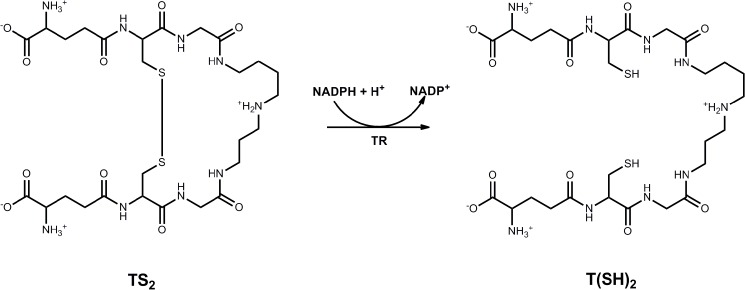
Fig 1
Fig 1. TR-catalyzed reduction of trypanothione disulfide (TS2) to the dithiol trypanothione (T(SH)2).
Fig 2
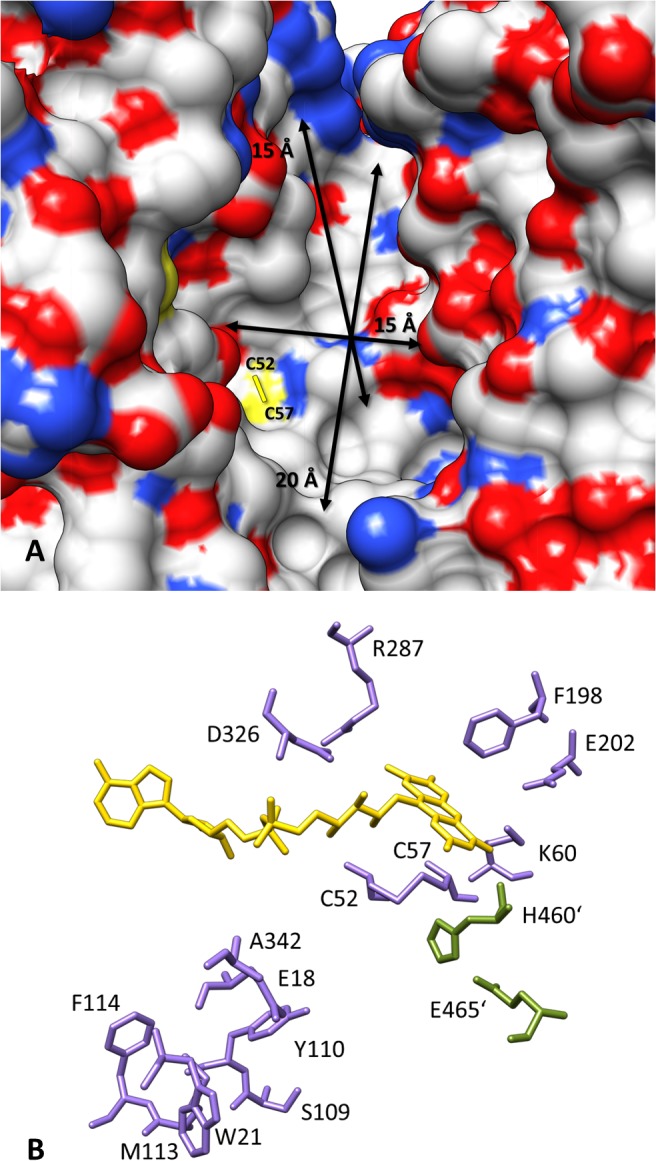
Fig 2. Schematic presentation of the active site of T. cruzi TR.
(A) Top view into the large trypanothione disulfide binding site having a dimension of about 15 x 15 x 20 Å (arrows). The disulfide bridge formed by C52 and C57 in the oxidized form of the enzyme is indicated. The cofactor FAD is not visible because it is buried within the structure. On the solvent accessible surface nitrogen is indicated as blue, oxygen as red and sulfur in yellow. (B) The isoalloxazine ring of FAD (yellow) forms the center of the active site. NADPH binds at the re-site, while TS2 binds at the si-site of the flavin ring where also the redox active dithiol/disulfide couple of Cys52-Cys57 is located. Glu18 (Ala34 in human GR), Trp21 (Arg37), Ser109 (Ile113), Met113 (Asn117) and Ala342 (Arg347) are the five residues in the active site that are not conserved when comparing TR with human GR. Primed residues (green) are provided by the second subunit of the homodimeric protein. The substitution of Ala34 and Arg37 into Glu and Trp, respectively, converts human GR in an enzyme with TR activity and vice versa.
Fig 3
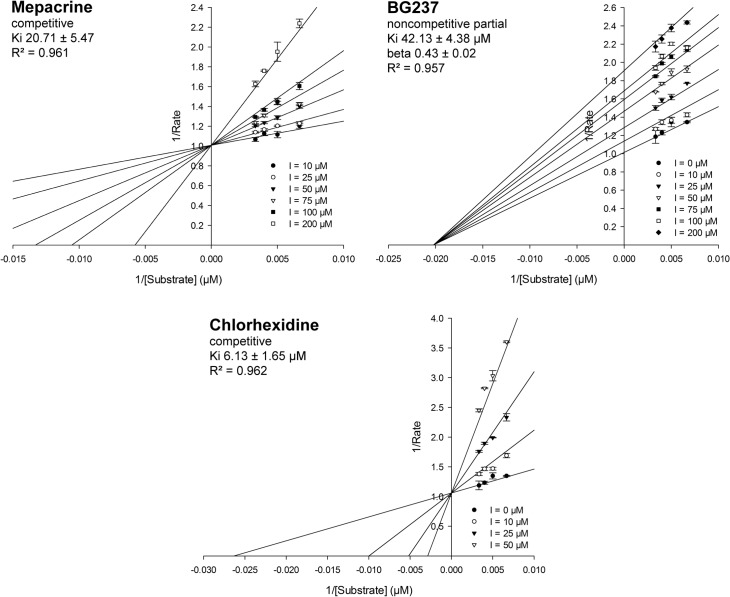
Fig 3. TR assay validation—Lineweaver-Burk plots for known inhibitors.
The Ki values were determined by three independent experiments. Mepacrine: measured Ki 20.71 ± 5.47 μM, competitive binding mode; BG237: measured Ki 42.13 ± 4.38 μM, noncompetitive binding mode, partial. The factor beta reflects the modification of the rate of product formation by the enzyme that is caused by the inhibitor. Chlorhexidine: measured Ki 6.13 ± 1.65 μM, competitive binding mode. Graphs are created using the SigmaPlot Enzyme Kinetics Module routine based on the relevant binding models and the calculated parameter values.
Fig 4
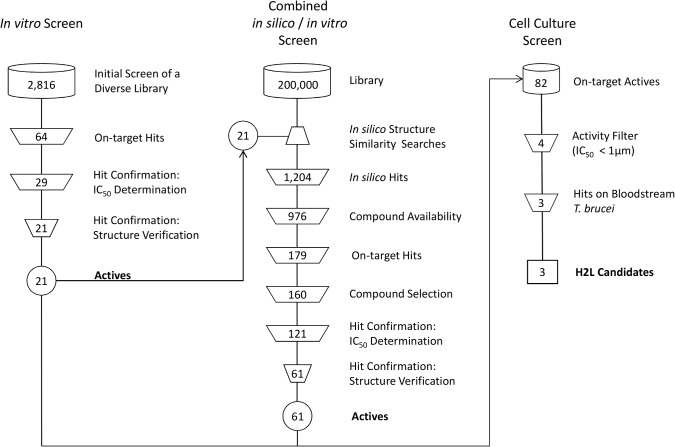
Fig 4. Schematic representation of the combined in vitro and in silico screening approach.
After screening the highly diverse compound set of 2,816 compounds, 21 hits were obtained. These actives were then used as query for an in silico structure similarity search with the aim to create an activity enriched compound set. The resulting focused library of 1,204 compounds was screened again leading to additional 61 novel compounds with inhibitory activity against TR. Four out of the 82 combined, novel TR inhibitors showed activities of < 1 μM and were tested for their ability to interfere with the proliferation of cultured bloodstream T. brucei. Finally, three compounds showed activity in cell culture and were selected for further optimization efforts.
Fig 5
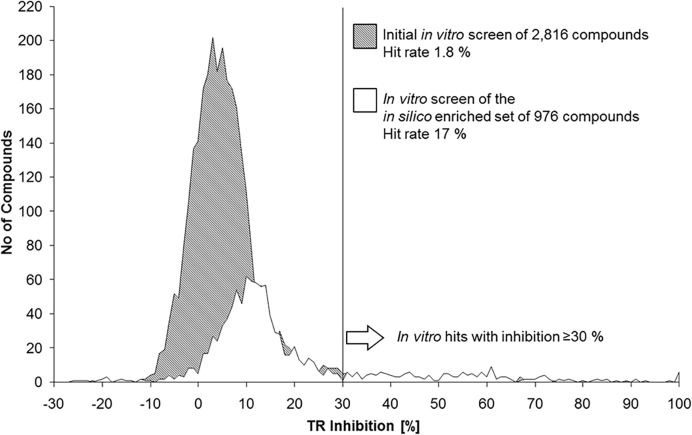
Fig 5. Inhibition distribution of the in vitro screenings.
The number of compounds is plotted against the percentage of TR inhibition. The grey area represents the activity distribution of the compounds in the initial screening, while the white area shows the distribution of the second in vitro screening based on the in silico enriched focused data set. The overall activity of the in silico enriched data set is shifted to the right compared to the initial diverse in vitro screen data set. Importantly, the second screen delivered more in vitro hits with an inhibitory potency of ≥30% although this data set was 3 times smaller.
Fig 6
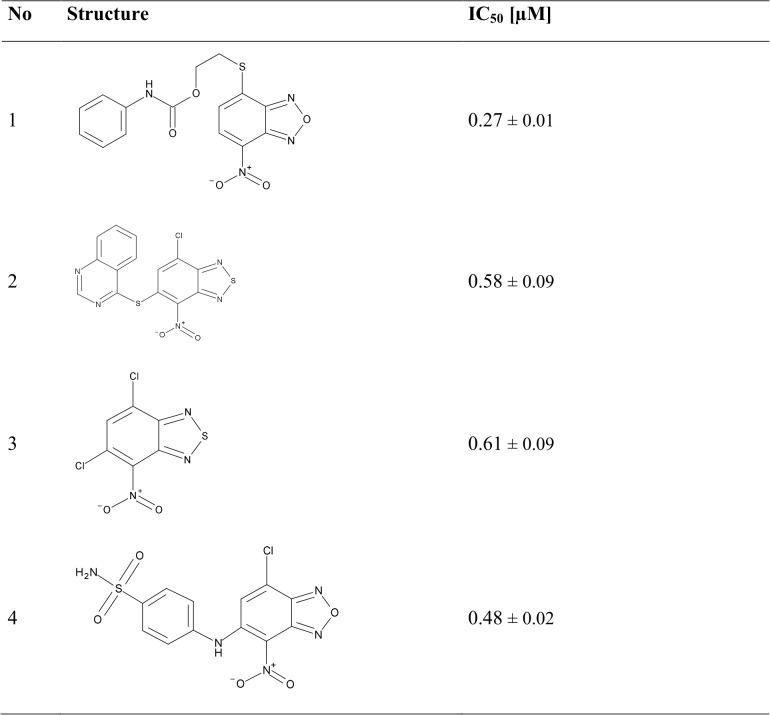
Fig 6. Chemical structures and in vitro inhibition data of the four most active compounds.
IC50 values have been determined using the same conditions as in the primary assay in the presence of 150 μM TS2. IC50 ± SD (n = 3).
Fig 7
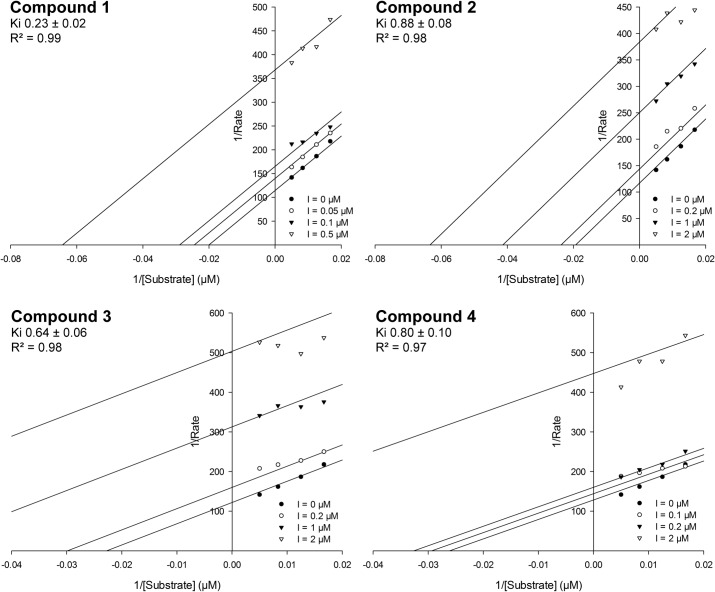
Fig 7. Lineweaver-Burk plots for the most active compounds assuming an uncompetitive mode of inhibition.
The Ki values represent the mean of two independent experiments; standard deviations are based on fitted plots. Data analysis has been performed using the Enzyme Kinetics Module of SigmaPlot, which fits the experimental data to the selected binding model.
Fig 8
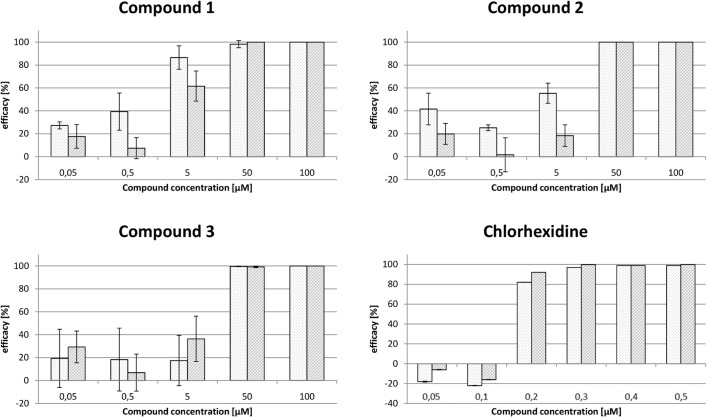
Fig 8. Effect of three top hits on the proliferation of T. brucei.
Bloodstream form trypanosomes were cultured in the presence or absence of the respective compounds. After 48 h (light grey) and 72 h (grey), living cells were counted. The efficacy describes the inhibition of the cell proliferation in the presence of inhibitor compared to DMSO. Chlorhexidine served as positive control. The values are the mean ± SD from three independent series of experiments.

References

    1. Flohé L (2011) The trypanothione system and the opportunities it offers to create drugs for the neglected kinetoplast diseases. Biotechnol Advances 30: 294–301. - PubMed
    1. Brun R, Blum J, Chappuis F, Burri C. Human African trypanosomiasis. Lancet. 2010;375(9709):148–159. 10.1016/S0140-6736(09)60829-1 - DOI - PubMed
    1. Ilemobade A.A., Tsetse and trypanosomosis in Africa: the challenges, the opportunities. Onderstepoort J Vet Res 2009. 76: 35–40. - PubMed
    1. WHO. Working to overcome the global impact of neglected tropical diseases. Available from http://www.who.int/neglected_diseases/2010report/en/ (2010). - PubMed
    1. Fairlamb AH (2013) Foreword. Drug Discovery for Neglected Diseases—Past and Present and Future In: Jäger T, Koch O, Flohé L, editors. Trypanosomatid Diseases, Molecular Routes to Drug Discovery. Weinheim: Wiley-Blackwell, IX p.

Publication types

MeSH terms