Review
. 2015 Aug;5(4):397-406.
doi: 10.1007/s13346-015-0238-y.

Microneedle-based drug and vaccine delivery via nanoporous microneedle arrays

Affiliations
Review

Microneedle-based drug and vaccine delivery via nanoporous microneedle arrays

Koen van der Maaden et al. Drug Deliv Transl Res. 2015 Aug.

Abstract

In the literature, several types of microneedles have been extensively described. However, porous microneedle arrays only received minimal attention. Hence, only little is known about drug delivery via these microneedles. However, porous microneedle arrays may have potential for future microneedle-based drug and vaccine delivery and could be a valuable addition to the other microneedle-based drug delivery approaches. To gain more insight into porous microneedle technologies, the scientific and patent literature is reviewed, and we focus on the possibilities and constraints of porous microneedle technologies for dermal drug delivery. Furthermore, we show preliminary data with commercially available porous microneedles and describe future directions in this field of research.


Figures
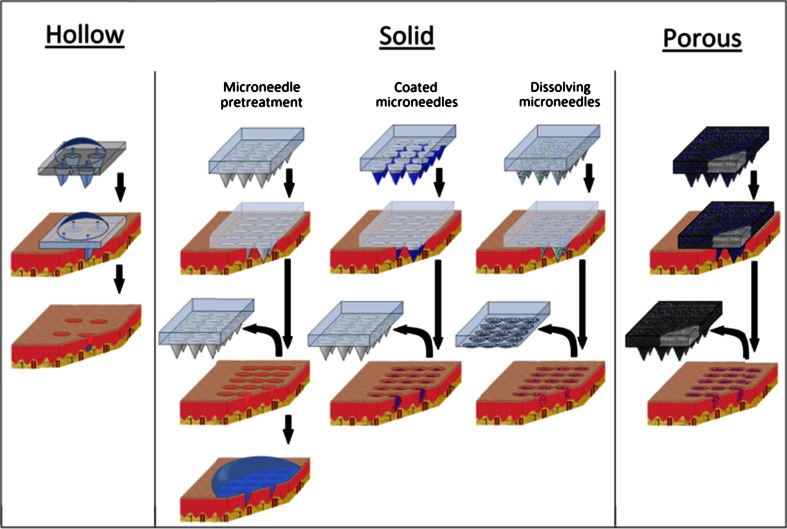
Fig. 1
Fig. 1
Microneedle-based drug delivery via hollow, solid, and porous microneedles. Image adapted from [1]
Fig. 2
Fig. 2
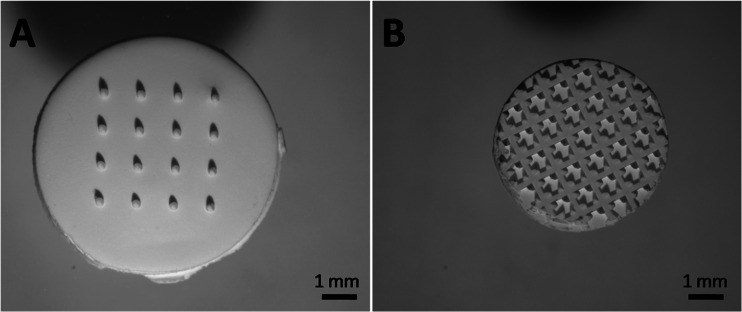
Nanoporous ceramic microneedle arrays (MyLife Technologies) containing 16 microneedles with a length of 370 μm (a) and 126 microneedles with a length of 200 μm (b)
Fig. 3
Fig. 3
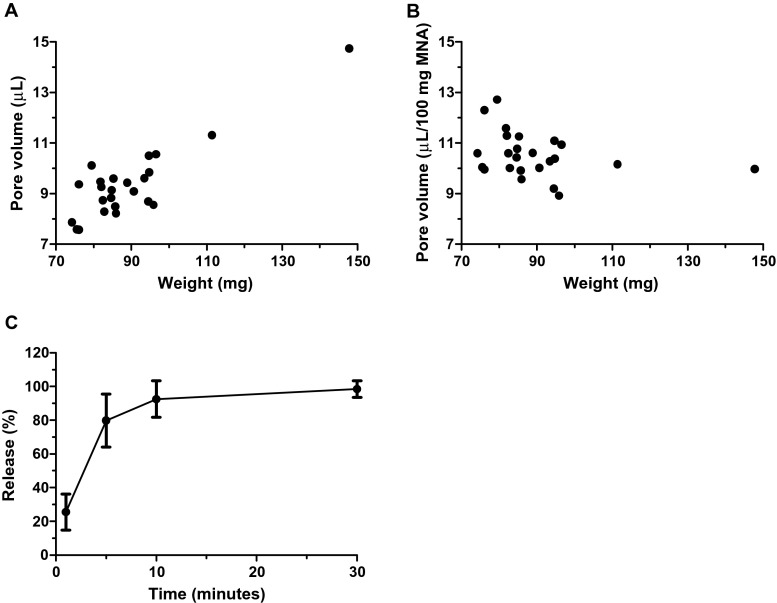
Pore volume as a function of weight of 24 individual microneedle arrays (a) and the normalized pore volume (b). Release of fluorescein (mean ± SD, n = 3) from 500 ng fluorescein loaded nanoporous microneedle arrays in PBS with a weight of ±80 mg/array (c)
Fig. 4
Fig. 4
Loading and release of fluorescently labeled nanoparticles (NPs) into nanoporous ceramic microneedle arrays (npMNAs). The amount of loaded nanoparticles into npMNAs (a), and the loading efficiency (b). The amount of released nanoparticles after 2 h in PBS at room temperature from nanoparticle-loaded npMNAs (c), and the released nanoparticles expressed in percentage (d). Results are represented as mean ± SD, n = 3
Fig. 5
Fig. 5
Six subsequent penetrations of ex vivo human skin by a ceramic nanoporous microneedle array (1–6 respectively), that contained 16 microneedles with a length of 370 μm (a) or 126 microneedles with a length of 200 μm (b). The size bar represents 1 mm

References

    1. van der Maaden K, Jiskoot W, Bouwstra J. Microneedle technologies for (trans)dermal drug and vaccine delivery. J Control Release. 2012;161:645–55. doi: 10.1016/j.jconrel.2012.01.042. - DOI - PubMed
    1. Haq MI, Smith E, John DN, Kalavala M, Edwards C, Anstey A, et al. Clinical administration of microneedles: skin puncture, pain and sensation. Biomed Microdevices. 2009;11:35–47. doi: 10.1007/s10544-008-9208-1. - DOI - PubMed
    1. Kaushik S, Hord AH, Denson DD, McAllister DV, Smitra S, Allen MG, et al. Lack of pain associated with microfabricated microneedles. Anesth Analg. 2001;92:502–4. doi: 10.1213/00000539-200102000-00041. - DOI - PubMed
    1. Kim Y-C, Park J-H, Prausnitz MR. Microneedles for drug and vaccine delivery. Adv Drug Deliv Rev. 2012;64:1547–68. doi: 10.1016/j.addr.2012.04.005. - DOI - PMC - PubMed
    1. Ball AM, Smith KM. Optimizing transdermal drug therapy. Am J Health Syst Pharm. 2008;65:1337–46. doi: 10.2146/ajhp070554. - DOI - PubMed

LinkOut - more resources