Review
. 2015 Apr 27;10(Suppl 1):31-41.
doi: 10.4137/BMI.S20066. eCollection 2015.

From "directed differentiation" to "neuronal induction": modeling neuropsychiatric disease

Affiliations
Review

From "directed differentiation" to "neuronal induction": modeling neuropsychiatric disease

Seok-Man Ho et al. Biomark Insights. .

Abstract

Aberrant behavior and function of neurons are believed to be the primary causes of most neurological diseases and psychiatric disorders. Human postmortem samples have limited availability and, while they provide clues to the state of the brain after a prolonged illness, they offer limited insight into the factors contributing to disease onset. Conversely, animal models cannot recapitulate the polygenic origins of neuropsychiatric disease. Novel methods, such as somatic cell reprogramming, deliver nearly limitless numbers of pathogenic human neurons for the study of the mechanism of neuropsychiatric disease initiation and progression. First, this article reviews the advent of human induced pluripotent stem cell (hiPSC) technology and introduces two major methods, "directed differentiation" and "neuronal induction," by which it is now possible to generate neurons for modeling neuropsychiatric disease. Second, it discusses the recent applications, and the limitations, of these technologies to in vitro studies of psychiatric disorders.

Keywords: directed differentiation; hiPSC; iNeuron; modeling neuropsychiatric disease; neuronal induction.


Figures

Figure 1
Figure 1
Generation of subtype-specific human iNeurons. (A) Ngn2 overexpression yields pure populations of glutamatergic neurons. (Adapted with permission from Zhang et al, 201349) (B) Overexpression of miR-9/9* and miR-124, together with CTIP2, DLX1, DLX2, and MYT1L, yields 80% pure populations of striatal medium spiny (GABAergic) neurons. (Adapted with permission from Victor et al, 201456) (C). Overexpression of Ascl1, Lmx1a, and Nurr1 yields 3% pure populations of dopaminergic neurons. (Adapted with permission from Caiazzo et al, 201153).
Figure 2
Figure 2
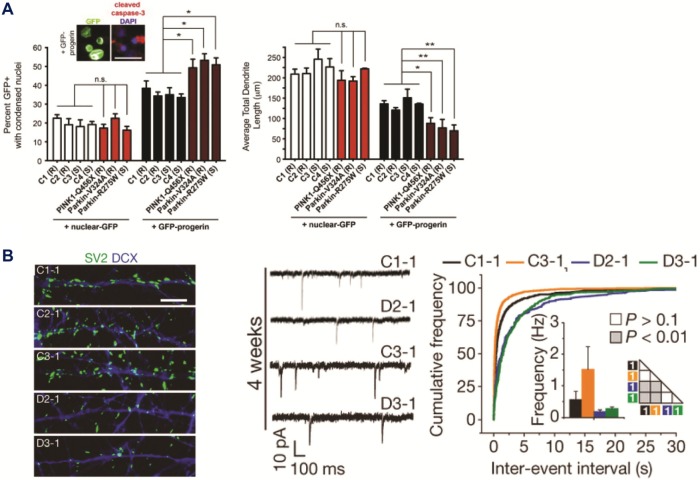
Representative cellular phenotypes recently identified through cell-based modeling of neurological diseases. (A) hiPSC-based model of Parkinson’s disease (PD) shows patient-specific cell loss, only in the condition of accelerated aging via progerin overexpression. Left: Analysis of PD patient and control hiPSC DA neurons, with and without progerin overexpression, reveals elevated cell death specifically in progerin-expressing PD neurons. Right: Quantification of total dendrite lengths, with and without progerin overexpression, shows dendrite shortening in PD hiPSC DA neurons compared to apparently healthy controls (C1–4). (Adapted with permission from Miller et al, 201425) (B) hiPSC-based models of schizophrenia. Left: Decreased synaptic density of SV2+ puncta in hiPSC neurons differentiated from hiPSC lines derived from schizophrenia patients (D2 and D3) carrying the DISC1 mutation compared to control lines. Right: Defects in the frequency of glutamatergic synaptic transmission in DISC1-mutant hiPSC neurons. (Adapted with permission from Wen et al, 201469).

References

    1. Takahashi K, Yamanaka S. Induction of pluripotent stem cells from mouse embryonic and adult fibroblast cultures by defined factors. Cell. 2006;126:663–76. - PubMed
    1. Takahashi K, Tanabe K, Ohnuki M, et al. Induction of pluripotent stem cells from adult human fibroblasts by defined factors. Cell. 2007;131:861–72. - PubMed
    1. Okita K, Nakagawa M, Hyenjong H, Ichisaka T, Yamanaka S. Generation of mouse induced pluripotent stem cells without viral vectors. Science. 2008;322:949–53. - PubMed
    1. Yu J, Hu K, Smuga-Otto K, et al. Human induced pluripotent stem cells free of vector and transgene sequences. Science. 2009;324:797–801. - PMC - PubMed
    1. Warren L, Manos PD, Ahfeldt T, et al. Highly efficient reprogramming to pluripotency and directed differentiation of human cells with synthetic modified mRNA. Cell Stem Cell. 2010;7:618–30. - PMC - PubMed

LinkOut - more resources