Review
. 2015 Feb 15;5(3):880-93.
eCollection 2015.

Chemotherapy targeting cancer stem cells

Affiliations
Review

Chemotherapy targeting cancer stem cells

Haiguang Liu et al. Am J Cancer Res. .

Abstract

Conventional chemotherapy is the main treatment for cancer and benefits patients in the form of decreased relapse and metastasis and longer overall survival. However, as the target therapy drugs and delivery systems are not wholly precise, it also results in quite a few side effects, and is less efficient in many cancers due to the spared cancer stem cells, which are considered the reason for chemotherapy resistance, relapse, and metastasis. Conventional chemotherapy limitations and the cancer stem cell hypothesis inspired our search for a novel chemotherapy targeting cancer stem cells. In this review, we summarize cancer stem cell enrichment methods, the search for new efficient drugs, and the delivery of drugs targeting cancer stem cells. We also discuss cancer stem cell hierarchy complexity and the corresponding combination therapy for both cancer stem and non-stem cells. Learning from cancer stem cells may reveal novel strategies for chemotherapy in the future.

Keywords: Side effects; biomarkers; cancer hierarchy; drug delivery system; multifunctional carrier.


Figures
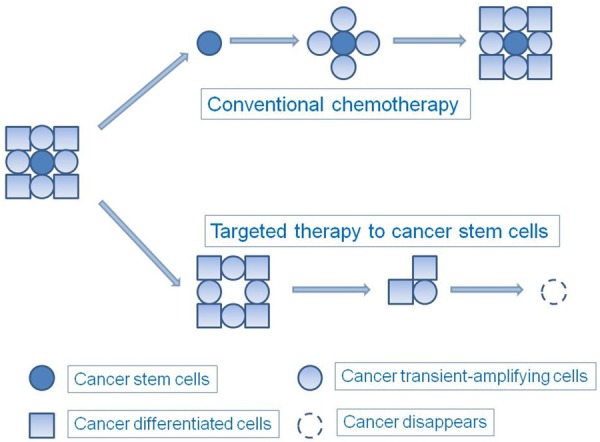
Figure 1
Figure 1
Effects of conventional chemotherapy and targeted therapy. Conventional chemotherapy initially kills most cancer cells and shrinks tumor size immediately, but the spared cancer stem cells eventually result in relapse and metastasis. Targeted therapy of cancer stem cells may not shrink the tumor size in an obvious manner at first, but the tumor may eventually disappear due to the loss of self-renewal and proliferation capacity.
Figure 2
Figure 2
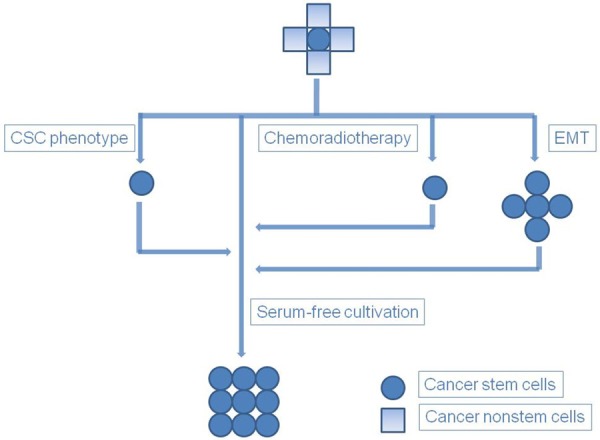
Cancer stem cell enrichment methods. Figure depicts four methods for enriching cancer stem cells (CSC): phenotypic isolation of cancer cells with specific cancer stem cell markers, conventional cytotoxic chemotherapy or radiotherapy, serum-free cultivation, and EMT. The stem-like characteristics of cancer stem cells enriched using other methods require preservation by serum-free cultivation.
Figure 3
Figure 3
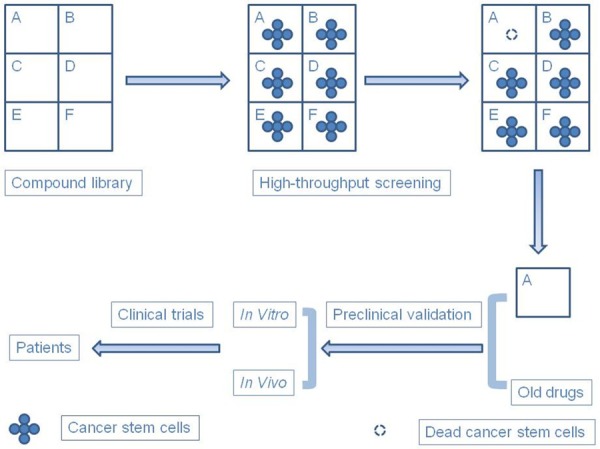
Methods for discovering new efficient drugs. There are two methods for discovering new efficient drugs: High-throughput screening, which is very useful for discovering new drugs among many compounds, and validation of old drugs targeting cancer stem cells.
Figure 4
Figure 4
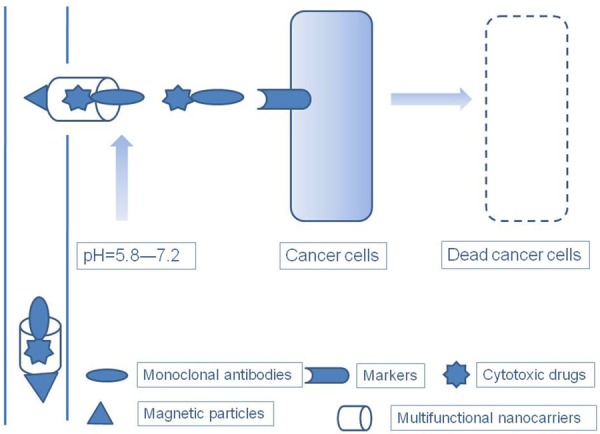
An ideal drug and drug delivery system. The ideal drug and drug delivery system should combine passive targeting aspects, e.g., enhanced permeability and retention (EPR) effect of the tumor; pH-, light-, and thermosensitive; and magnetic properties, with active targeting using monoclonal antibodies specific to cancer. Multifunctional nanocarriers are ideal carriers for chemotherapy drugs, where they adopt the tumor EPR effect, conjugate with one or more pH-, light-, and thermosensitive and magnetic particles, and load cytotoxic drugs and monoclonal antibodies targeting cancer.
Figure 5
Figure 5
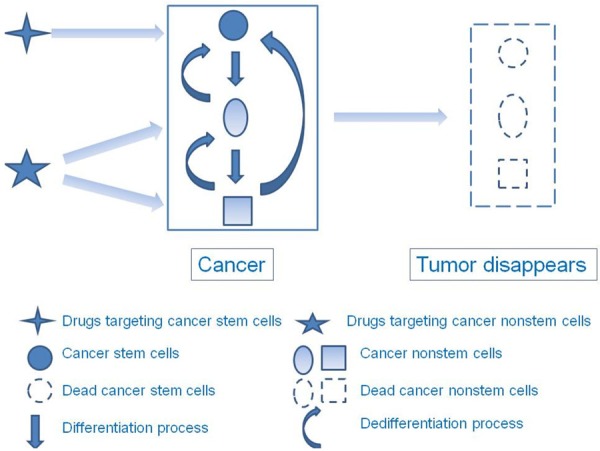
Complexity of cancer stem cell hierarchy and corresponding combination therapy. Cancer stem cells are usually at the top of the cancer hierarchy and can differentiate into transient amplifying and differentiated cancer cells. Cancer non-stem cells can also regain self-renewal and proliferation capacity through dedifferentiation under certain conditions. The complexity of cancer stem cell hierarchy indicates that the appropriate treatment strategy is combination therapy simultaneously targeting cancer stem and non-stem cells.

References

    1. Volk-Draper L, Hall K, Griggs C, Rajput S, Kohio P, DeNardo D, Ran S. Paclitaxel Therapy Promotes Breast Cancer Metastasis in a TLR4-Dependent Manner. Cancer Res. 2014;74:5421–5434. - PMC - PubMed
    1. Bu H, He X, Zhang Z, Yin Q, Yu H, Li Y. A TPGS-incorporating nanoemulsion of paclitaxel circumvents drug resistance in breast cancer. Int J Pharm. 2014;471:206–213. - PubMed
    1. Larocca A, Montefusco V, Bringhen S, Rossi D, Crippa C, Mina R, Galli M, Marcatti M, La Verde G, Giuliani N, Magarotto V, Guglielmelli T, Rota-Scalabrini D, Omedé P, Santagostino A, Baldi I, Carella AM, Boccadoro M, Corradini P, Palumbo A. Pomalidomide, cyclophosphamide, and prednisone for relapsed/refractory multiple myeloma: a multicenter phase 1/2 open-label study. Blood. 2013;122:2799–2806. - PubMed
    1. Tazawa Y, Usukubo I, Takada K, Takekuma Y, Shibayama Y, Sugawara M. Schedule-dependent cytotoxicity of Etoposide and cyclophosphamide in P-glycoprotein-expressing human leukemic K-562 cells. Biol Pharm Bull. 2014;37:1323–1329. - PubMed
    1. Chen J, Li Y, Yu TS, McKay RM, Burns DK, Kernie SG, Parada LF. A restricted cell population propagates glioblastoma growth after chemotherapy. Nature. 2012;488:522–526. - PMC - PubMed

LinkOut - more resources