Review
. 2015 Jun 4;16(6):601-12.
doi: 10.1016/j.stem.2015.05.002.

Aging-Induced Stem Cell Mutations as Drivers for Disease and Cancer

Affiliations
Review

Aging-Induced Stem Cell Mutations as Drivers for Disease and Cancer

Peter D Adams et al. Cell Stem Cell. .

Abstract

Aging is characterized by a decrease in genome integrity, impaired organ maintenance, and an increased risk of cancer, which coincide with clonal dominance of expanded mutant stem and progenitor cell populations in aging tissues, such as the intestinal epithelium, the hematopoietic system, and the male germline. Here we discuss possible explanations for age-associated increases in the initiation and/or progression of mutant stem/progenitor clones and highlight the roles of stem cell quiescence, replication-associated DNA damage, telomere shortening, epigenetic alterations, and metabolic challenges as determinants of stem cell mutations and clonal dominance in aging.


Figures

Figure 1
Figure 1
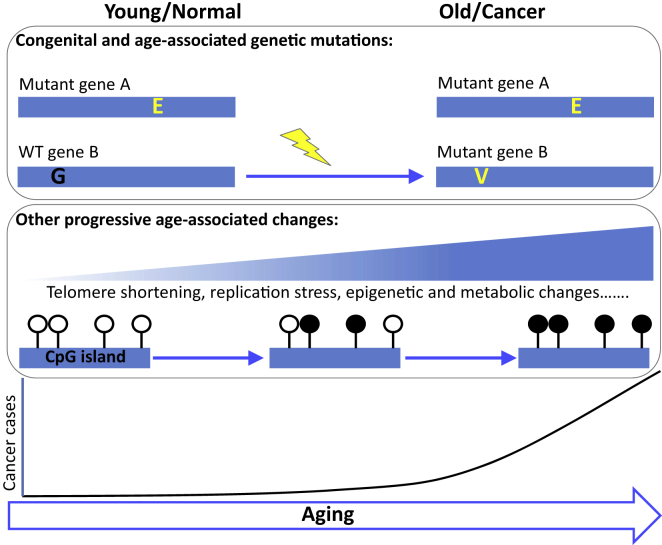
Multiple Factors Conspire to Drive Age-Associated Cancer Some congenital cancer-causing mutations are thought to be well-tolerated by young cells and tissues. Other cancer-causing mutations are acquired through aging. These congenital and acquired mutations conspire with other more progressive events, e.g., telomere shortening, replication stress, epigenetic and metabolic changes, to drive a dramatic increase in late-life cancer. Open lollipops, unmethylated CpG; filled lollipop, methylated CpG; yellow lightning bolt, genotoxic/mutagenic event.
Figure 2
Figure 2
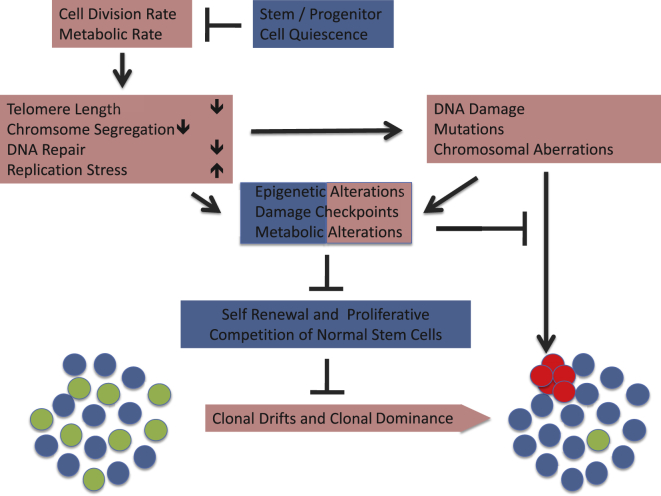
Aging-Induced Initiation and Clonal Selection of Stem and Progenitor Cell Mutations Aging-associated alterations that could contribute to the exponential increase in the initiation of DNA damage, mutations, and large chromosomal aberrations include telomere shortening and the dysregulation of components that control chromosome segregation, DNA replication, or DNA repair. There is evidence that cell division rates and metabolic activity induce these alterations, whereas stem and progenitor cell quiescence can prevent it. Genomic damages induce checkpoint responses, epigenetic alterations, and metabolic shifts that decrease the fitness of the damaged cells. These responses represent a double-edged sword. In young tissues, these responses are tumor protective by inhibiting the survival or the clonal expansion of single, individual stem and progenitor cells that acquire mutations or chromosomal aberrations. In contrast, the same responses can also limit the self-renewal and proliferative capacity of a growing number of normal stem and progenitor cells in aging tissues, which in turn promotes decreases in clone number, clonal drifts, and clonal dominance of mutant stem cells. Accordingly, the downregulation of damage responses/checkpoints is positively selected for both in the pool of aging stem and progenitor cells as well as in individual stem cells that acquire mutations or chromosomal aberrations. Red boxes define processes that contribute to the initiation and/or clonal dominance of mutant stem and progenitor cells, whereas processes depicted in blue boxes impair it. Epigenetic alterations, damage checkpoints, and metabolic alterations in response DNA damage and mutations have a dual role by affecting both the fitness of normal stem and progenitor cells as well as of mutants.
Figure 3
Figure 3
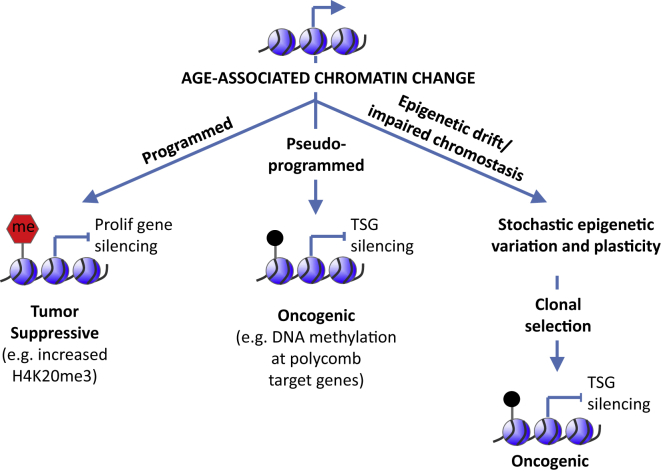
Age-Associated Chromatin Changes Exhibit Diverse Mechanisms, Functions, and Dysfunctions Some age-associated chromatin changes are tumor-suppressive programmed responses in stressed or damaged cells (left). Others are pseudo-programmed and in principle could be oncogenic (middle), tumor suppressive (not shown), or neutral (not shown). For example, bivalent gene promoters marked with H3K4me3 and H3K27me3 persist from ES cells into adult stem cells and facilitate developmental transitions. However, in adult tissues, bivalent promoters are, perhaps inadvertently, DNA methylated and silenced, thereby blocking differentiation. By this model, bivalent promoters are antagonistic pleiotropic—they facilitate developmental transitions in ES cells and young stem cells but can be precursors to self-renewing, non-differentiated cancer stem cells in old tissues. Other age-associated chromatin changes reflect epigenetic drift or failed chromostasis of the dynamic epigenome (right). Such drift is not inherently oncogenic or tumor suppressive but leads to stochastic epigenetic mosaicism and cell-to-cell variation, which can be a substrate for clonal selection of neoplastic cells.

References

    1. Alexandrov L.B., Nik-Zainal S., Wedge D.C., Aparicio S.A., Behjati S., Biankin A.V., Bignell G.R., Bolli N., Borg A., Børresen-Dale A.L., Australian Pancreatic Cancer Genome Initiative. ICGC Breast Cancer Consortium. ICGC MMML-Seq Consortium. ICGC PedBrain Signatures of mutational processes in human cancer. Nature. 2013;500:415–421. - PMC - PubMed
    1. Amcheslavsky A., Jiang J., Ip Y.T. Tissue damage-induced intestinal stem cell division in Drosophila. Cell Stem Cell. 2009;4:49–61. - PMC - PubMed
    1. Armitage P., Doll R. The age distribution of cancer and a multi-stage theory of carcinogenesis. Br. J. Cancer. 1954;8:1–12. - PMC - PubMed
    1. Baker D.J., Jeganathan K.B., Cameron J.D., Thompson M., Juneja S., Kopecka A., Kumar R., Jenkins R.B., de Groen P.C., Roche P., van Deursen J.M. BubR1 insufficiency causes early onset of aging-associated phenotypes and infertility in mice. Nat. Genet. 2004;36:744–749. - PubMed
    1. Baker D.J., Dawlaty M.M., Wijshake T., Jeganathan K.B., Malureanu L., van Ree J.H., Crespo-Diaz R., Reyes S., Seaburg L., Shapiro V. Increased expression of BubR1 protects against aneuploidy and cancer and extends healthy lifespan. Nat. Cell Biol. 2013;15:96–102. - PMC - PubMed

Publication types