


Elemental Constituents of Particulate Matter and Newborn's Size in Eight European Cohorts
- PMID: 26046983
- PMCID: PMC4710606
- DOI: 10.1289/ehp.1409546
Elemental Constituents of Particulate Matter and Newborn's Size in Eight European Cohorts
Abstract
Background: The health effects of suspended particulate matter (PM) may depend on its chemical composition. Associations between maternal exposure to chemical constituents of PM and newborn's size have been little examined.
Objective: We aimed to investigate the associations of exposure to elemental constituents of PM with term low birth weight (LBW; weight < 2,500 g among births after 37 weeks of gestation), mean birth weight, and head circumference, relying on standardized fine-scale exposure assessment and with extensive control for potential confounders.
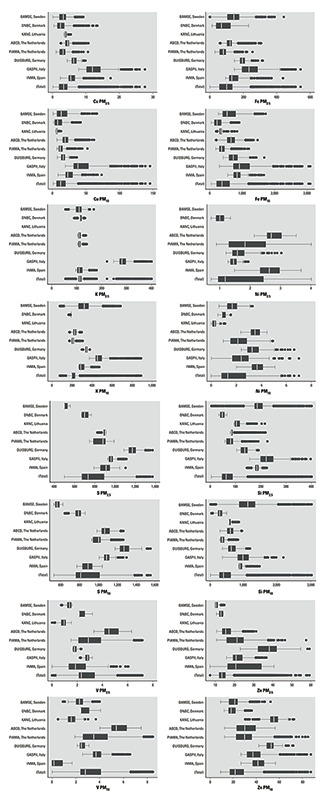
Methods: We pooled data from eight European cohorts comprising 34,923 singleton births in 1994-2008. Annual average concentrations of elemental constituents of PM ≤ 2.5 and ≤ 10 μm (PM2.5 and PM10) at maternal home addresses during pregnancy were estimated using land-use regression models. Adjusted associations between each birth measurement and concentrations of eight elements (copper, iron, potassium, nickel, sulfur, silicon, vanadium, and zinc) were calculated using random-effects regression on pooled data.
Results: A 200-ng/m3 increase in sulfur in PM2.5 was associated with an increased risk of LBW (adjusted odds ratio = 1.36; 95% confidence interval: 1.17, 1.58). Increased nickel and zinc in PM2.5 concentrations were also associated with an increased risk of LBW. Head circumference was reduced at higher exposure to all elements except potassium. All associations with sulfur were most robust to adjustment for PM2.5 mass concentration. All results were similar for PM10.
Conclusion: Sulfur, reflecting secondary combustion particles in this study, may adversely affect LBW and head circumference, independently of particle mass.
Citation: Pedersen M, Gehring U, Beelen R, Wang M, Giorgis-Allemand L, Andersen AM, Basagaña X, Bernard C, Cirach M, Forastiere F, de Hoogh K, Gražulevičienė R, Gruzieva O, Hoek G, Jedynska A, Klümper C, Kooter IM, Krämer U, Kukkonen J, Porta D, Postma DS, Raaschou-Nielsen O, van Rossem L, Sunyer J, Sørensen M, Tsai MY, Vrijkotte TG, Wilhelm M, Nieuwenhuijsen MJ, Pershagen G, Brunekreef B, Kogevinas M, Slama R. 2016. Elemental constituents of particulate matter and newborn's size in eight European cohorts. Environ Health Perspect 124:141-150; http://dx.doi.org/10.1289/ehp.1409546.
Conflict of interest statement
The authors declare they have no actual or potential competing financial interests.
Figures
References
-
- Basu R, Harris M, Sie L, Malig B, Broadwin R, Green R. Effects of fine particulate matter and its constituents on low birth weight among full-term infants in California. Environ Res. 2014;128:42–51. - PubMed
-
- Bellinger DC. Teratogen update: lead and pregnancy. Birth Defects Res A Clin Mol Teratol. 2005;73:409–420. - PubMed
Publication types
MeSH terms
Substances
LinkOut - more resources
Full Text Sources
Other Literature Sources
Miscellaneous