. 2015 Jun 6:13:184.
doi: 10.1186/s12967-015-0542-9.

Combined genetic effects of EGLN1 and VWF modulate thrombotic outcome in hypoxia revealed by Ayurgenomics approach

Affiliations

Combined genetic effects of EGLN1 and VWF modulate thrombotic outcome in hypoxia revealed by Ayurgenomics approach

Shilpi Aggarwal et al. J Transl Med. .

Abstract

Background: Extreme constitution "Prakriti" types of Ayurveda exhibit systemic physiological attributes. Our earlier genetic study has revealed differences in EGLN1, key modulator of hypoxia axis between Prakriti types. This was associated with differences in high altitude adaptation and susceptibility to high altitude pulmonary edema (HAPE). In this study we investigate other molecular differences that contribute to systemic attributes of Prakriti that would be relevant in predictive marker discovery.

Methods: Genotyping of 96 individuals of the earlier cohort was carried out in a panel of 2,800 common genic SNPs represented in Indian Genomic Variation Consortium (IGVC) panel from 24 diverse populations. Frequency distribution patterns of Prakriti differentiating variations (FDR correction P < 0.05) was studied in IGVC and 55 global populations (HGDP-CEPH) panels. Genotypic interactions between VWF, identified from the present analysis, and EGLN1 was analyzed using multinomial logistic regression in Prakriti and Indian populations from contrasting altitudes. Spearman's Rank correlation was used to study this genotypic interaction with respect to altitude in HGDP-CEPH panel. Validation of functional link between EGLN1 and VWF was carried out in a mouse model using chemical inhibition and siRNA studies.

Result: Significant differences in allele frequencies were observed in seven genes (SPTA1, VWF, OLR1, UCP2, OR6K3, LEPR, and OR10Z1) after FDR correction (P < 0.05). A non synonymous variation (C/T, rs1063856) associated with thrombosis/bleeding susceptibility respectively, differed significantly between Kapha (C-allele) and Pitta (T-allele) constitution types. A combination of derived EGLN1 allele (HAPE associated) and ancestral VWF allele (thrombosis associated) was significantly high in Kapha group compared to Pitta (p < 10(-5)). The combination of risk-associated Kapha alleles was nearly absent in natives of high altitude. Inhibition of EGLN1 using (DHB) and an EGLN1 specific siRNA in a mouse model lead to a marked increase in vWF levels as well as pro-thrombotic phenotype viz. reduced bleeding time and enhanced platelet count and activation.

Conclusion: We demonstrate for the first time a genetic link between EGLN1 and VWF in a constitution specific manner which could modulate thrombosis/bleeding susceptibility and outcomes of hypoxia. Integration of Prakriti in population stratification may help assemble common variations in key physiological axes that confers differences in disease occurrence and patho-phenotypic outcomes.


Figures
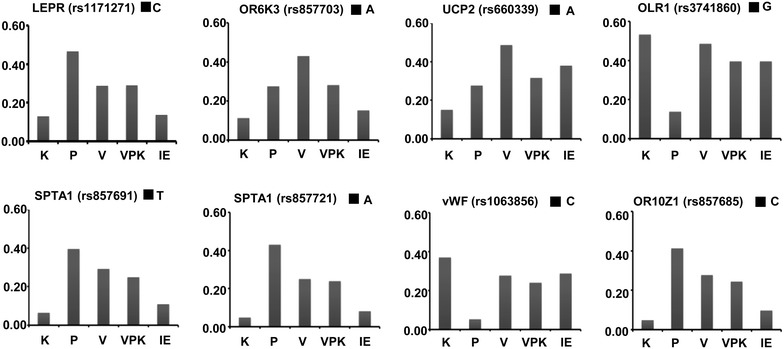
Figure 1
Figure 1
Representation of allele frequencies of common variations amongst extreme constitution types. A representative set of SNPs that show significant difference between the constitution types Kapha (K), Pitta (P), Vata (V) and differ from the VPK/IE pool are depicted. The gene and SNP with the alleles are given in each panel. IE represents individuals with heterogeneous phenotypes from Indo-European populations and VPK represents individuals of different constitution types pooled into a single group.
Figure 2
Figure 2
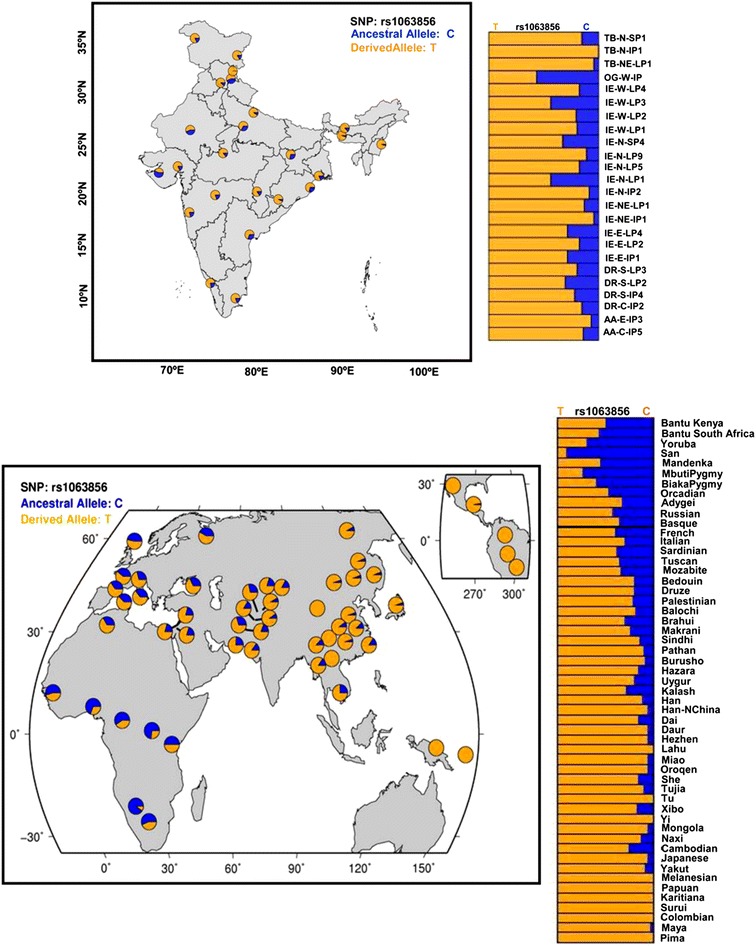
Distribution of ancestral ‘C’ allele (rs1063856) frequency of VWF gene associated with thrombosis in diverse IGVC and HGDP-CEPH populations. a Frequency in the 24 IGV populations. TB-N-IP1, a population from high altitude has fixation for the derived allele. b Spatial frequency map of rs1063856 in the HGDP-CEPH panel of 55 populations retrieved from HGDP selection browser. There is a clinal variation in the frequency of derived allele as populations moved out of Africa.
Figure 3
Figure 3
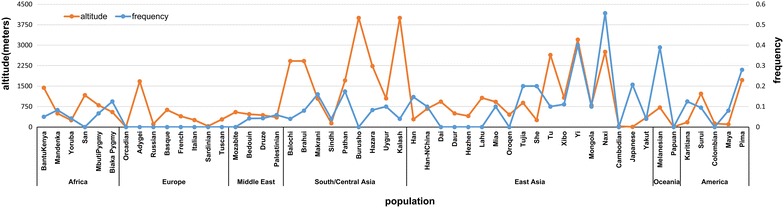
Distribution of frequency of homozygous genotype scores (4) for protective alleles at both loci EGLN1. rs480902 and VWF rs1063856 in diverse HGDP-CEPH populations from different altitudes. Diverse populations especially from East Asia residing at high altitude selectively retain the combination of ancestral allele of EGLN1 and derived allele of VWF.
Figure 4
Figure 4
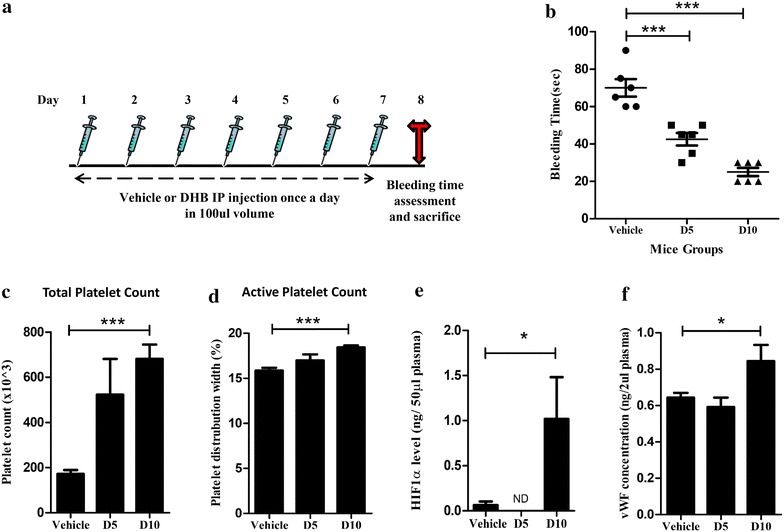
Effect of chemical inhibition of PHD or EGLN in mouse on various blood parameters. a Schematic representation of DHB experiment protocol. PHD inhibition was done by giving DHB (ethyl-3, 4, dihydroxybenzoic acid) treatment in mice. DHB was administered from day 1 to 7. On day 8 mice tail bleeding assay was performed. b Decrease in tail bleeding time of mice treated with DHB in a dose dependent manner. c, d PHD inhibition in mice by chemical DHB treatment leads to increase in total platelet count and its distribution width (considered here as active platelet parameter). Both parameters were assessed through automatic hematology analyzer in mouse whole blood (anticoagulated) as described in methods. e, f ELISA for estimation of HIF-1α and VWF antigen levels in mouse plasma after PHD inhibition. ND not detectable. Data shown as mean ± SEM. *p ≤ 0.05, ***p ≤ 0.001 (n = 6 per group).
Figure 5
Figure 5
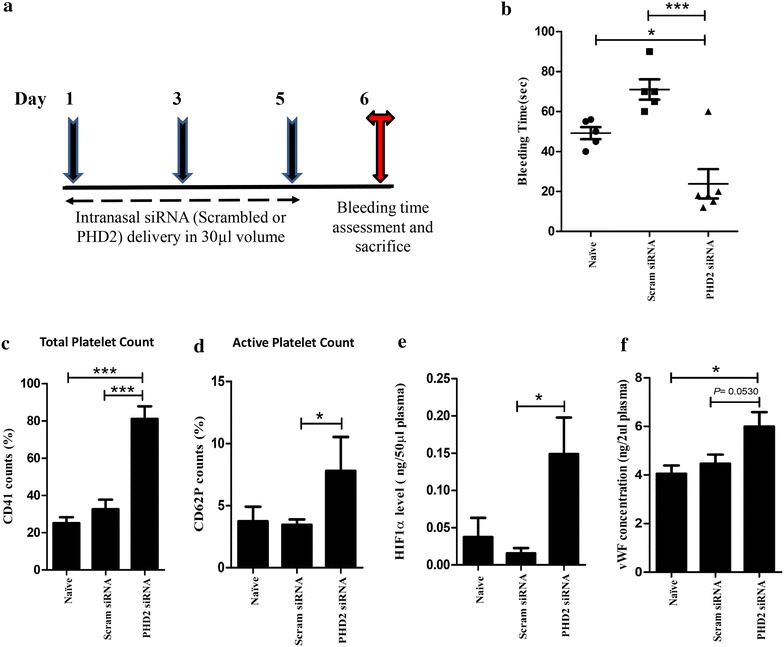
Knockdown of PHD2 by siRNA in mice leads to pro-thrombotic phenotype. a Schematic representation of siRNA experiment protocol. Scrambled or PHD2 siRNA was given intra-nasally to mice on day 1, 3 and 5. On day 6 mice were subjected to tail bleeding assay. b Tail bleeding time (in seconds) measured in mice treated with siRNA (Scrambled or PHD2) or in untreated (naïve) mice groups as described in methods. c, d Total and active platelet count assessed in mouse whole blood via flow cytometry. CD62P and CD-41 antibody were used to label total and active platelets respectively e, f ELISA for estimation of VWF and HIF-1α antigen levels in mouse plasma. Data shown as mean ± SEM. *p ≤ 0.05, ***p ≤ 0.001 (n = 5–6 per group).

References

    1. The International HapMap Project Nature. 2003;426:789–796. doi: 10.1038/nature02168. - DOI - PubMed
    1. Abecasis GR, Auton A, Brooks LD, DePristo MA, Durbin RM, Handsaker RE, et al. An integrated map of genetic variation from 1,092 human genomes. Nature. 2012;491:56–65. doi: 10.1038/nature11632. - DOI - PMC - PubMed
    1. Rosenberg NA, Pritchard JK, Weber JL, Cann HM, Kidd KK, Zhivotovsky LA, et al. Genetic structure of human populations. Science. 2002;298:2381–2385. doi: 10.1126/science.1078311. - DOI - PubMed
    1. Barbujani G, Magagni A, Minch E, Cavalli-Sforza LL. An apportionment of human DNA diversity. Proc Natl Acad Sci USA. 1997;94:4516–4519. doi: 10.1073/pnas.94.9.4516. - DOI - PMC - PubMed
    1. Witherspoon DJ, Wooding S, Rogers AR, Marchani EE, Watkins WS, Batzer MA, et al. Genetic similarities within and between human populations. Genetics. 2007;176:351–359. doi: 10.1534/genetics.106.067355. - DOI - PMC - PubMed

Publication types

MeSH terms

Substances