. 2015 Jun 16;112(24):7599-604.
doi: 10.1073/pnas.1413484112. Epub 2015 Jun 5.

Transgenic songbirds with suppressed or enhanced activity of CREB transcription factor

Affiliations

Transgenic songbirds with suppressed or enhanced activity of CREB transcription factor

Kentaro Abe et al. Proc Natl Acad Sci U S A. .

Abstract

Songbirds postnatally develop their skill to utter and to perceive a vocal signal for communication. How genetic and environmental influences act in concert to regulate the development of such skill is not fully understood. Here, we report the phenotype of transgenic songbirds with altered intrinsic activity of cAMP response element-binding protein (CREB) transcription factor. By viral vector-mediated modification of genomic DNA, we established germ line-transmitted lines of zebra finches, which exhibited enhanced or suppressed activity of CREB. Although intrinsically acquired vocalizations or their hearing ability were not affected, the transgenic birds showed reduced vocal learning quality of their own songs and impaired audio-memory formation against conspecific songs. These results thus demonstrate that appropriate activity of CREB is necessary for the postnatal acquisition of learned behavior in songbirds, and the CREB transgenic birds offer a unique opportunity to separately manipulate both genetic and environmental factors that impinge on the postnatal song learning.

Keywords: CREB; postnatal development; songbird; transgenic animal; vocal learning.


Conflict of interest statement

The authors declare no conflict of interest.

Figures
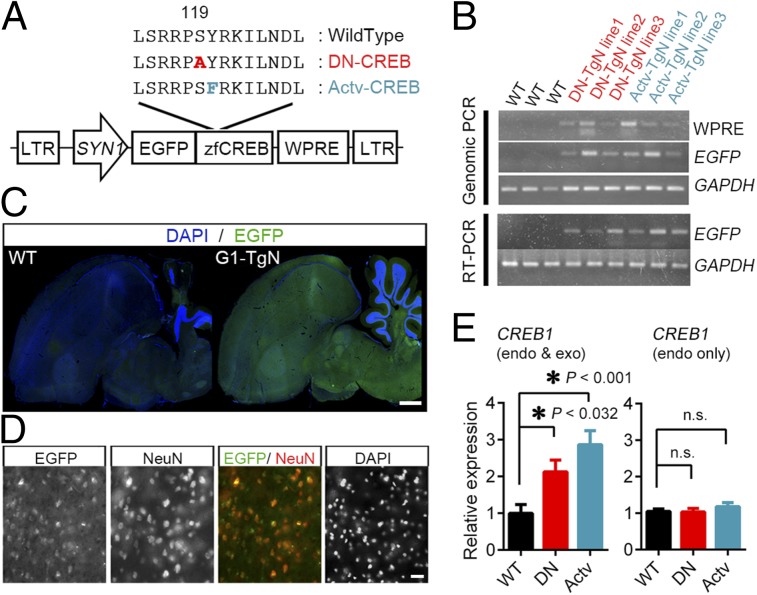
Fig. 1.
Fig. 1.
Generation of the transgenic zebra finches with modified CREB activity. (A) Schematics of the transgenes used to generate transgenic zebra finches. SYN1, human synapsin 1 promoter; WPRE, woodchuck hepatitis virus posttranscriptional regulatory element. (B) PCR analysis of genome integration and expression of transgenes. Genome DNA (Upper) and total RNA (Lower) of WT and transgenic line (TgN) were collected from an adult bird from three transgenic lines for each. (C) Images of sagittal sections from WT and G1-TgN birds immunostained against EGFP showing the expression of transgene in G1-TgN birds. (Scale bar, 1 mm.) See Fig. S1A for the anatomical profiles. (D) High-magnification image of nidopallium, showing signals of EGFP (green), and Neu-N (red; neuronal nucleus marker), and DAPI. (Scale bar, 20 μm.) (E) Quantitative RT-PCR analysis of RNA collected from WT and the transgenic birds. Data from primer sets that amplify endogenous CREB1 (Right) and endogenous and exogenous CREB (Left) are shown. See Table S1 for used primers. Bar graph shows the mean ± SEM of relative expression values normalized to the WT. *P < 0.05, n.s. P > 0.5, Dunnett’s post hoc test.
Fig. 2.
Fig. 2.
Transgenic zebra finches show misregulated CREB-mediated gene transcription. (A) Schematics of the lentivirus (LV)-based transcription reporter constructs. A constitutive human phosphoglycerate kinase (PGK1) promoter expresses an infection reference gene [flag-tagged Histone-2B (H2B-flag)]. In the other direction, a minimal promoter expresses a reporter gene [turboGFP fused to PEST sequence (tbGFP-PEST)], whose expression is influenced by the presence of CREB binding sequence (CRE), in the LV-CREB-reporter. (B) HEK293T cells transfected either with LV-CREB-reporter or LV-Control-reporter at multiplicities of infection (MOIs) of 1, 0.1, and 0.01, and were treated with vehicle (0.1% DMSO) or 100 μM forskolin to stimulate the cAMP-dependent activation of CREB. Each reporter activity was quantified by dividing the amount of tbGFP-PEST by the amount of H2B-flag, both of which were quantified by quantitative RT-PCR. Stimulus-dependent changes in CREB activity were calculated by dividing the reporter activity of LV-CREB-reporter by those of LV-Control-reporter. *P < 0.0001 against each vehicle-treated cell. Bar graph shows mean ± SEM; n = 4 independent experiments. (C) Activity of CREB-mediated gene transcription in transgenic birds. LV-CREB-reporter and LV-Control-reporter were injected into the striatum and the reporter activities were quantified for each subject. WT, n = 10; DN, n = 6; Actv, n = 5 birds. Bar graphs indicate mean ± SEM. *P < 0.05, Dunnett’s post hoc test. (D) Quantitative RT-PCR analysis of endogenous RNA collected from WT and transgenic birds (n = 11 birds for each genotype). Unpaired t test; bar graph shows mean ± SEM of the absolute log2 value of relative amount of expression against WT, comparing gene with (n = 47) and without (n = 32) CREs. See Fig. S5 and Table S1 for details.
Fig. 3.
Fig. 3.
Deficits in auditory memory formation in transgenic zebra finches. (A) Experimental timeline (Upper) and the schematics of the experiment of one training block (Lower). (B and C) Results of the auditory conditioning experiments. Behavioral reaction against control song stimulus (Cont) (dotted lines) and unconditioned stimulus (US) (solid lines; B) or conditioned song stimulus (CS) (solid lines; C) are shown. Change in call behavior number after the presentation of stimuli (Cont, US, and CS) are normalized and shown for each genotype (WT, Left; DN, Middle; Actv, Right). Mean ± SEM are shown. Asterisks indicate a significant difference in the call response before and after the presentation of each stimulus; P < 0.05, Student’s paired t test; WT, n = 25; DN, n = 25; Actv, n = 25. See also Fig. S6 for the raw number of the call behavior, and the experiment performed with another set of song stimuli.
Fig. 4.
Fig. 4.
Acquisition of tutor’s song in transgenic zebra finches. (A, Top) Experimental timeline. (Bottom) Schematics of the experiment. Juvenile male birds were moved from their home cages and kept in a soundproof chamber with a live male finch (tutor). The same tutor bird was used multiple times for comparisons. (B) Examples of the sonograph of the tutor bird’s song (Tutor’s song) and that of the 140-dph birds of different genotype, reared with the same tutor (Tutee’s song). (C) Similarity score of tutee’s songs at 140 dph, calculated from the similarity of each syllable. (D) Developmental changes in the similarity score. (E and F) Similarity score of tutee’s songs calculated from the similarity of the entire motif. *P < 0.001, one-way ANOVA, Dunnett’s post hoc test, n.s., P > 0.67 against WT. Summarized values from 85 tutees (WT, n = 39; DN, n = 23; Actv, n = 23) tutored by five tutors are shown. Boxes and whiskers show the respective median and the 25th to 75th and 10th to 90th percentiles. Line graphs shows mean ± SD.
Fig. 5.
Fig. 5.
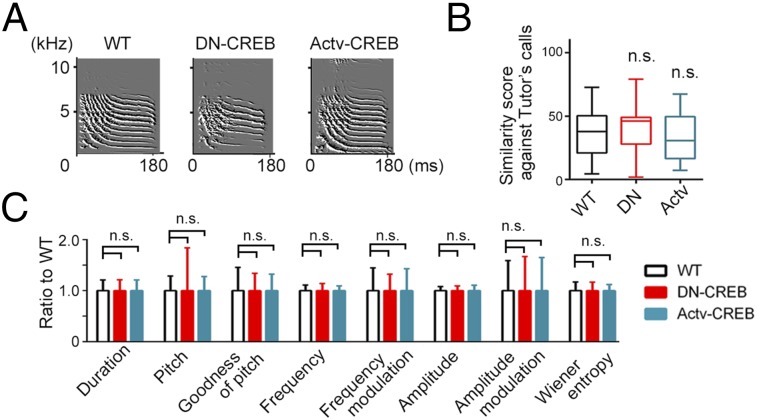
Call vocalization in transgenic zebra finches. (A) Examples of the sonograph of the calls of the 140-dph birds of different genotype. (B) Similarity scores between tutor’s and tutee’s call. (C) The differences of acoustic features of calls between the genotype. Summarized values from 85 tutees (WT, n = 39; DN, n = 23; Actv, n = 23) tutored by five tutors are shown. Boxes and whiskers show the respective median and the 25th to 75th and 10th to 90th percentiles. Line graphs shows mean ± SD; n.s., P > 0.15 against WT, Kruskal–Wallis test.

References

    1. Doupe AJ, Kuhl PK. Birdsong and human speech: Common themes and mechanisms. Annu Rev Neurosci. 1999;22:567–631. - PubMed
    1. Clayton DF. The genomics of memory and learning in songbirds. Annu Rev Genomics Hum Genet. 2013;14:45–65. - PubMed
    1. Konishi M. The role of auditory feedback in the control of vocalization in the white-crowned sparrow. Z Tierpsychol. 1965;22(7):770–783. - PubMed
    1. Marler P. A comparative approach to vocal learning: Song development in white-crowned sparrows. J Comp Physiol Psychol. 1970;71(2, Pt.2):1–25.
    1. Slater PJB. Bird song learning: Causes and consequences. Ethol Ecol Evol. 1989;1:19–46.

Publication types

Substances