Review
. 2015 Jul;18(4):339-45.
doi: 10.1097/MCO.0000000000000188.

You are what you eat: O-linked N-acetylglucosamine in disease, development and epigenetics

Affiliations
Review

You are what you eat: O-linked N-acetylglucosamine in disease, development and epigenetics

Stéphanie Olivier-Van Stichelen et al. Curr Opin Clin Nutr Metab Care. 2015 Jul.

Abstract

Purpose of review: The O-linked N-acetylglucosamine (O-GlcNAc) modification is both responsive to nutrient availability and capable of altering intracellular cellular signalling. We summarize data defining a role for O-GlcNAcylation in metabolic homeostasis and epigenetic regulation of development in the intrauterine environment.

Recent findings: O-GlcNAc transferase (OGT) catalyzes nutrient-driven O-GlcNAc addition and is subject to random X-inactivation. OGT plays key roles in growth factor signalling, stem cell biology, epigenetics and possibly imprinting. The O-GlcNAcase, which removes O-GlcNAc, is subject to tight regulation by higher order chromatin structure. O-GlcNAc cycling plays an important role in the intrauterine environment wherein OGT expression is an important biomarker of placental stress.

Summary: Regulation of O-GlcNAc cycling by X-inactivation, epigenetic regulation and nutrient-driven processes makes it an ideal candidate for a nutrient-dependent epigenetic regulator of human disease. In addition, O-GlcNAc cycling influences chromatin modifiers critical to the regulation and timing of normal development including the polycomb repression complex and the ten-eleven translocation proteins mediating DNA methyl cytosine demethylation. The pathway also impacts the hypothalamic-pituitary-adrenal axis critical to intrauterine programming influencing disease susceptibility in later life.


Conflict of interest statement

Conflicts of interest

None

Figures
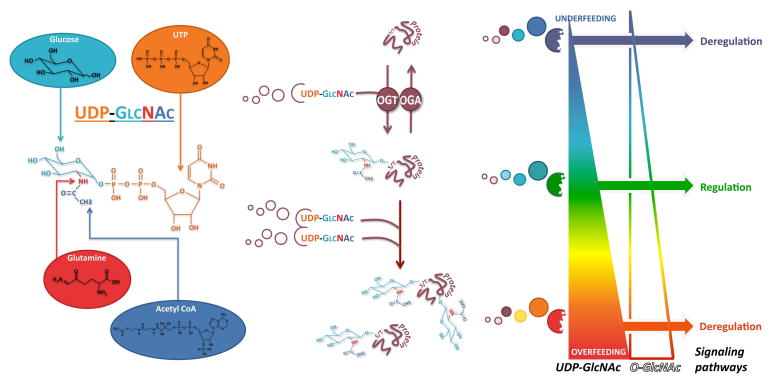
Figure 1
Figure 1. The Hexosamine Signaling Pathway terminating in dynamic O-GlcNAc cycling
O-GlcNAc cycling is a nutrient-dependent modification capable of generating a graded signaling output to a multitude of simultaneous targets. Directly supplied by the breakdown of food, 2 to 3% of glucose entering cells is driven to the Hexosamine Biosynthetic Pathway to generate UDP-GlcNAc using other nutrient derived precursors. The breakdown of foods to produce metabolites is represented by the stylized bubbles. O-GlcNAc Transferase (OGT) uses the varying levels of UDP-GlcNAc to O-GlcNAcylate serine or threonine residue of diverse intracellular proteins (nuclear, cytoplasmic or mitochondrial). The O-GlcNAcase (OGA) hydrolyzes the GlcNAc moiety and creates a dynamic posttranslational protein modification. This, in turn, impacts canonic phosphorylation-dependent signaling cascades, alters protein stability, and may cause direct enzyme activation. Thus, levels of food-derived metabolites are integrated, amplified and transduced by the Hexosamine signaling pathway.
Figure 2
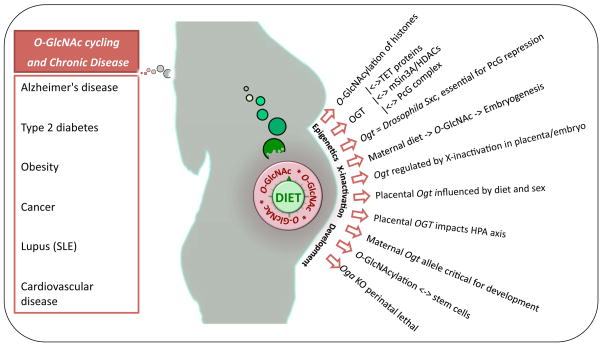
Figure 2. Diet-responsive O-GlcNAcylation is linked to the Pathophysiology of Human disease and may influence Disease Susceptibility in the Developing Fetus and influence its Germline
Dietary metabolites act through O-GlcNAc cycling to impact epigenetics, X-inactivation and development through O-GlcNAcylation. This diagram represents some of the major recent discoveries in these different fields. The breakdown of foods to produce metabolites is represented by the stylized bubbles. O-GlcNAc cycling in response to nutrient flux may impact chronic diseases (panel on left). The epigenetic factors are also particularly important in the intrauterine environment where maternal-fetal communication occurs during embryonic development. Thus, imbalanced O-GlcNAcylation is not only associated with disease in adulthood. By acting in the intrauterine environment, Imbalanced O-GlcNAc cycling may influence disease susceptibility in subsequent generations. (Abbreviations: SLE- Systemic Lupus Erythematosus, PcG- Polycomb Group, OGT- O-GlcNAc Transferase, Sxc-Super Sex Combs.)

References

    1. Hanover JA, Krause MW, Love DC. Bittersweet memories: linking metabolism to epigenetics through O-GlcNAcylation. Nat Rev Mol Cell Biol. 2012;13:312–21. - PubMed
    1. Hart GW. Three décades of research on O-GlcNAcylation- a major nutrient sensor that régulâtes signaling, transcription and cellular metabolism. Front Endocrinol. 2014;5:183–190. - PMC - PubMed
    1. Bond MR, Hanover JA. A Little Sugar goes a Long Way: The Cell Biology of O-GlcNAc. J Cell Biol. 2015;208:869–880. - PMC - PubMed
    1. Medford HM, Chatham JC, Marsh SA. Chronic ingestion of a Western diet increases O-linked-β-N-acetylglucosamine (O-GlcNAc) protein modification in the rat heart. Life Sci. 2012;90:883–8. - PMC - PubMed
    1. Ghosh SK, Bond MR, Love DC, Ashwell GG, Krause MW, Hanover JA. Disruption of O-GlcNAc Cycling in C. elegans Perturbs Nucleotide Sugar Pools and Complex Glycans. Front Endocrinol. 2014;5:197–205. - PMC - PubMed

Publication types

MeSH terms

Substances