


Post-zygotic Point Mutations Are an Underrecognized Source of De Novo Genomic Variation
- PMID: 26054435
- PMCID: PMC4571017
- DOI: 10.1016/j.ajhg.2015.05.008
Post-zygotic Point Mutations Are an Underrecognized Source of De Novo Genomic Variation
Abstract
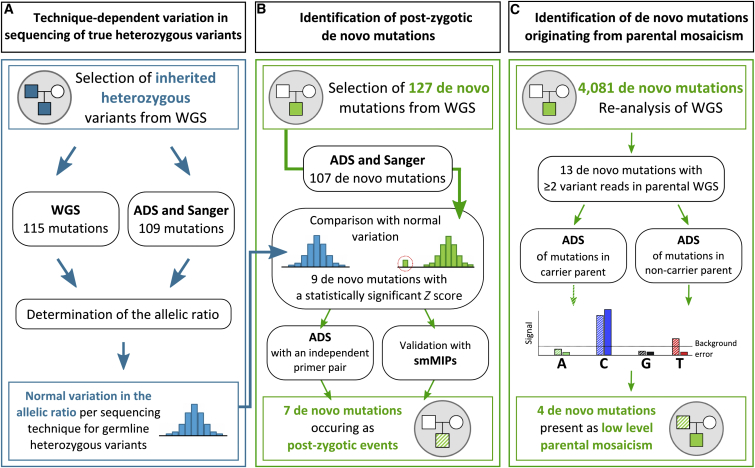
De novo mutations are recognized both as an important source of genetic variation and as a prominent cause of sporadic disease in humans. Mutations identified as de novo are generally assumed to have occurred during gametogenesis and, consequently, to be present as germline events in an individual. Because Sanger sequencing does not provide the sensitivity to reliably distinguish somatic from germline mutations, the proportion of de novo mutations that occur somatically rather than in the germline remains largely unknown. To determine the contribution of post-zygotic events to de novo mutations, we analyzed a set of 107 de novo mutations in 50 parent-offspring trios. Using four different sequencing techniques, we found that 7 (6.5%) of these presumed germline de novo mutations were in fact present as mosaic mutations in the blood of the offspring and were therefore likely to have occurred post-zygotically. Furthermore, genome-wide analysis of "de novo" variants in the proband led to the identification of 4/4,081 variants that were also detectable in the blood of one of the parents, implying parental mosaicism as the origin of these variants. Thus, our results show that an important fraction of de novo mutations presumed to be germline in fact occurred either post-zygotically in the offspring or were inherited as a consequence of low-level mosaicism in one of the parents.
Copyright © 2015 The American Society of Human Genetics. Published by Elsevier Inc. All rights reserved.
Figures
References
-
- Hoischen A., van Bon B.W.M., Gilissen C., Arts P., van Lier B., Steehouwer M., de Vries P., de Reuver R., Wieskamp N., Mortier G. De novo mutations of SETBP1 cause Schinzel-Giedion syndrome. Nat. Genet. 2010;42:483–485. - PubMed
Publication types
MeSH terms
Grants and funding
LinkOut - more resources
Full Text Sources
Other Literature Sources
