Review
. 2015 Jul;23(7):1345-52.
doi: 10.1002/oby.21133. Epub 2015 Jun 7.

Shaping fat distribution: New insights into the molecular determinants of depot- and sex-dependent adipose biology

Affiliations
Review

Shaping fat distribution: New insights into the molecular determinants of depot- and sex-dependent adipose biology

Susan K Fried et al. Obesity (Silver Spring). 2015 Jul.

Abstract

Objective: To review recent advances in understanding the cellular mechanisms that regulate fat distribution.

Methods: In this review, new insights into depot and sex differences in the developmental origins and growth of adipose tissues as revealed by studies that use new methods, including lineage tracing, are highlighted.

Results: Variations in fat distribution during normal growth and in response to alterations in nutritional or hormonal status are driven by intrinsic differences in cells found in each adipose depot. Adipose progenitor cells and preadipocytes in different anatomical adipose tissues derive from cell lineages that determine their capacity for proliferation and differentiation. As a result, rates of hypertrophy and hyperplasia during growth and remodeling vary among depots. The metabolic capacities of adipose cells are also determined by variations in the expression of key transcription factors and non-coding RNAs. These developmental events are influenced by sex chromosomes and hormonal and nutrient signals that determine the adipogenic, metabolic, and functional properties of each depot.

Conclusions: These new developments in the understanding of fat distribution provide a sound basis for understanding the association of body shape and health in men and women with and without obesity.


Conflict of interest statement

The authors declare no conflict of interest.

Figures
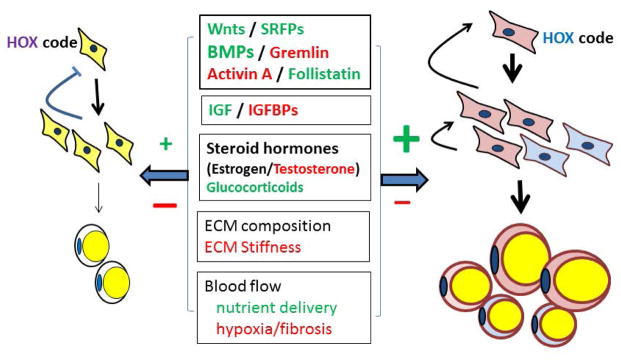
Figure 1
Figure 1. Simplified model of the depot-dependent factors that influence the proliferation and differentiation of adipocytes
The development of two theoretical depots is illustrated. The color of the adipose progenitor cell signifies its lineage. Within a depot, paracrine interactions create an environment that promotes or inhibits the differentiation and progression of these cells through the adipogenic program (as reviewed well by Macdougal (78)). These local factors are produced by the adipose progenitors and preadipocytes as well as other cell types present within a depot (e.g. mesothelial cells in visceral only, immune cells, endothelial) as well as the mature adipocyte itself. Factors for which there is strongest evidence as local effectors of adipogenesis and tissue remodeling include members of the TGFβ superfamily (BMPs, activins, their receptors and antagonists (23, 79) and well as insulin, IGFs and steroids (locally or systemically produced (not illustrated)). All of the cells within the tissue secrete components of the extracellular matrix which modulates the activity of growth factors and cytokines/chemokines. Physiological effectors such as blood flow and innervation also modulate the activity of all of these processes in a depot-dependent manner. Red font indicates inhibitory effect. Green font indicates stimulatory effect.
Figure 2
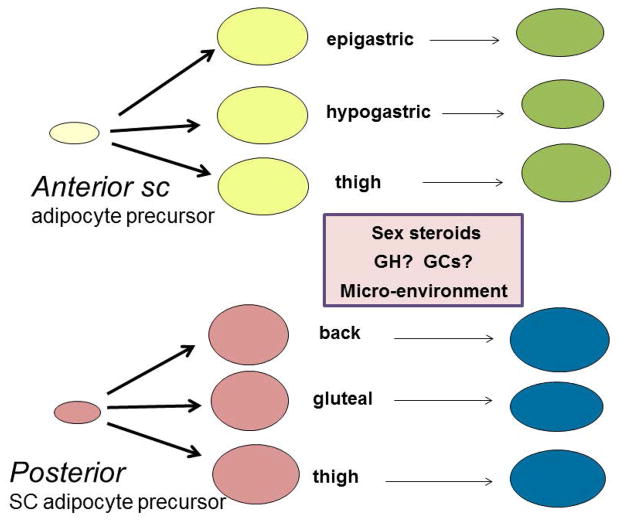
Figure 2. Different types of ‘white’ subcutaneous adipocytes
The scheme illustrates that adipose progenitors isolated from different subcutaneous adipose depots retain their properties, likely dictated by the expression of different HOX genes and other developmental transcription factors that reflect the anterior or posterior anatomical origins. As they differentiate, their phenotype is influenced by the local microenvironment of the issue as well as exposure to paracrine and endocrine factors.

References

    1. Knittle JL, Timmers K, Ginsberg-Fellner F, Brown RE, Katz DP. The growth of adipose tissue in children and adolescents. Cross-sectional and longitudinal studies of adipose cell number and size. J Clin Invest. 1979;63(2):239–46. - PMC - PubMed
    1. Spalding KL, Arner E, Westermark PO, et al. Dynamics of fat cell turnover in humans. Nature. 2008;453(7196):783–7. - PubMed
    1. Lee MJ, Wu Y, Fried SK. Adipose tissue heterogeneity: implication of depot differences in adipose tissue for obesity complications. Mol Aspects Med. 2013;34(1):1–11. - PMC - PubMed
    1. Karpe F, Pinnick KE. Biology of upper-body and lower-body adipose tissue--link to whole-body phenotypes. Nat Rev Endocrinol. 2015;11(2):90–100. - PubMed
    1. Wernstedt AI, Tao C, Morley TS, et al. Adipocyte inflammation is essential for healthy adipose tissue expansion and remodeling. Cell Metab. 2014;20(1):103–18. - PMC - PubMed

Publication types