Review
. 2015 Sep;12(9):497-506.
doi: 10.1038/nrgastro.2015.90. Epub 2015 Jun 9.

Novel players in coeliac disease pathogenesis: role of the gut microbiota

Affiliations
Review

Novel players in coeliac disease pathogenesis: role of the gut microbiota

Elena F Verdu et al. Nat Rev Gastroenterol Hepatol. 2015 Sep.

Abstract

Several studies point towards alteration in gut microbiota composition and function in coeliac disease, some of which can precede the onset of disease and/or persist when patients are on a gluten-free diet. Evidence also exists that the gut microbiota might promote or reduce coeliac-disease-associated immunopathology. However, additional studies are required in humans and in mice (using gnotobiotic technology) to determine cause-effect relationships and to identify agents for modulating the gut microbiota as a therapeutic or preventative approach for coeliac disease. In this Review, we summarize the current evidence for altered gut microbiota composition in coeliac disease and discuss how the interplay between host genetics, environmental factors and the intestinal microbiota might contribute to its pathogenesis. Moreover, we highlight the importance of utilizing animal models and long-term clinical studies to gain insight into the mechanisms through which host-microbial interactions can influence host responses to gluten.


Figures
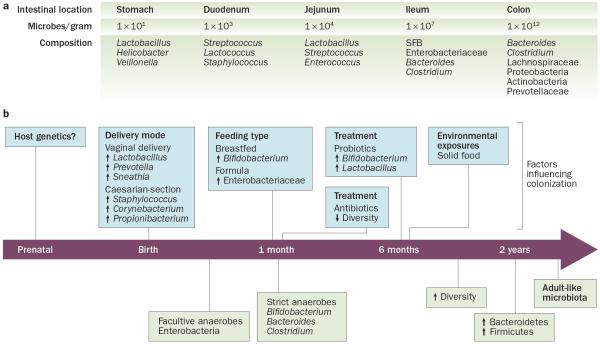
Figure 1
Figure 1
Development of the gut microbiota. The composition and density of the microbiota varies along the length of the intestine as well as with age. a | Differences in microbial composition and density are observed along the length of the gastrointestinal tract, with much lower densities and greater variability in the proximal intestine. b | The gut microbiota fluctuates over the first 2–3 years of life, with high interindividual variability and low diversity, but becomes more stable over time. Immediately after birth, the neonatal intestine is colonized by facultative anaerobes and is dominated by Enterobacteriaceae. After the introduction of solid food, the gut microbiota continues to mature and the diversification of Bacteroides and Clostridium rapidly increases, whereas the proportion of Bifidobacterium stabilizes. By 2 years of age, the gut microbiota is dominated by members belonging to the Firmicutes and Bacteroidetes phyla and begins to resemble that of an adult-like microbiota. A number of factors, such as host genetics, birth delivery mode, diet, antibiotic or probiotic treatment and infections can influence the developing gut microbiota. Whether and how these host or environmentally triggered changes in gut microbiota also affect risk of inflammatory disease, including coeliac disease, remains controversial. Abbreviation: SFB, segmented filamentous bacteria.
Figure 2
Figure 2
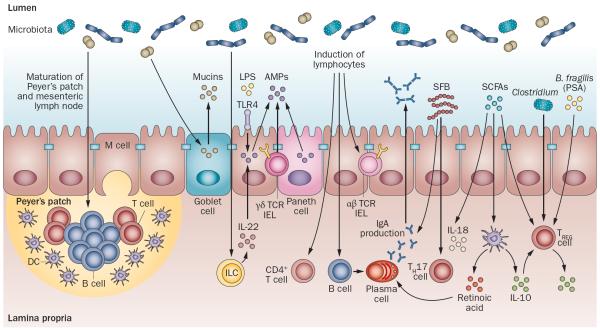
Gut microbiota shapes host immunity. The gut microbiota induces maturation of the gastrointestinal lymphoid tissue (Peyer's patches, MLN). Signals from the microbiota induce production of AMPs, such as RegIIIγ, from Paneth cells, γδTCR+ IELs and epithelial cells. Microbial signals can also stimulate the development of ILC subsets, including IL-22-producing ILCs. Flagellin or LPS can stimulate AMP production from epithelial cells via IL-22 or TLR4, respectively. The gut microbiota also stimulates the release of mucins from goblet cells, and microbes influence the development of T-cell subsets, including CD4+ T cells, αβTCR+ IELs, and are critical for the induction of IgA-producing plasma cells. SFB are potent inducers of TH17 cells, whereas Clostridium, PSA derived from Bacteroides fragilis, and SCFAs stimulate TREG -cell differentiation. SCFAs can also promote IL-18 production from epithelial cells and promote IL-10 and retinoic acid production from DCs, which in turn promotes differentiation of TREG cells and IgA-producing plasma cells. Abbreviations: AMP, antimicrobial peptide; DC, dendritic cell; FasL, Fas ligand; IEL, intraepithelial lympocytes; ILC, innate lymphoid cell; LPS, lipopolysaccharide; MLN, mesenteric lymph node; NKG2D, NKG2-D type II integral membrane protein; PSA, polysaccharide A; SCFA, short-chain fatty acid; SFB, segmented filamentous bacteria; TCR, T-cell receptor; TH17 cell, type 17 T helper cell; TREG cell, regulatory T cell.
Figure 3
Figure 3
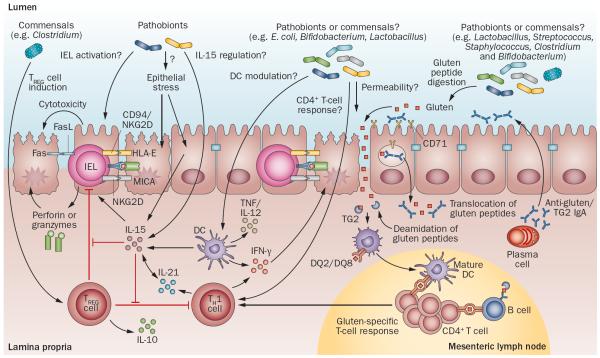
Potential microbial modulation of coeliac disease pathogenesis. Gluten peptides in the small intestinal lumen translocate the epithelial barrier, via transcellular or paracellular mechanisms and are deamidated by tissue TG2 in the lamina propria. Deamidated gliadin peptides are taken up by lamina propria DCs, inducing a proinflammatory gluten-specific CD4+ T-cell response, characterized by IFN-γ and IL-21 production, and anti-gliadin and anti-TG2 antibody production by B cells in genetically predisposed hosts. Activation of the innate immune response is also a key initial step in coeliac disease. Increased epithelial cell stress can upregulate stress molecules on epithelial cells (HLA-E, MICA/B) and induce IL-15 production from epithelial cells. IL-15 can induce IEL proliferation and activation and cytotoxic killing of epithelial cells, leading to tissue damage. IL-15 can also inhibit the regulatory effects of TREG cells and induce proinflammatory DCs. Microbes, both commensals or opportunistic pathogens (pathobionts), might contribute to the development of coeliac disease by influencing TREG-cell induction, epithelial cell stress, IEL activation or upregulation, IL-15 regulation, DC maturation and proinflammatory cytokine production, intestinal permeability modulation, gluten peptide digestion, and induction of CD4+ T-cell responses. Abbreviations: DC, dendritic cell; FasL, Fas ligand; IEL, intraepithelial lymphocyte; MICA, MHC class I polypeptide-related sequence A; NKG2D, NKG2-D type II integral membrane protein; TCR, T-cell receptor; TG2, tissue transglutaminase 2; TREG cell, regulatory T cell.
Figure 4
Figure 4
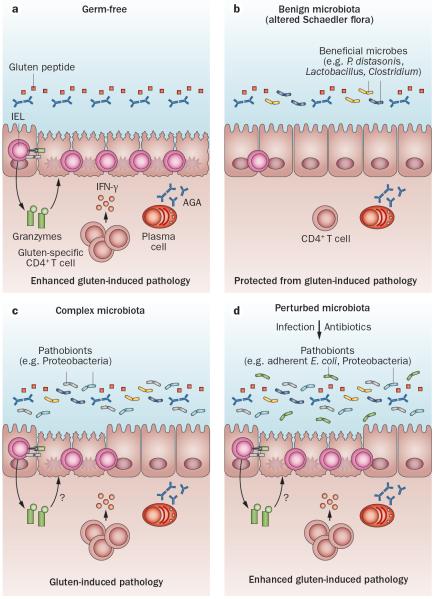
Modulation of host responses to gluten by the composition of the gut microbiota. a | In genetically susceptible hosts, the absence of bacteria can exacerbate gluten-induced immune responses, with increased IEL cytotoxicity (increased granzyme B production and NKG2D expression), increased proinflammatory gluten-specific CD4+ T-cell responses, and increased IgA AGA production. Together, this process leads to enhanced gluten-induced pathology characterized by reduced villous:crypt ratios and increased enterocyte cell death in the small intestine. b | In the presence of a limited, benign microbiota (altered Schaedler flora) that lacks any opportunistic pathogens, genetically susceptible hosts are protected from gluten-induced immune responses and pathology. c | In the presence of a complex microbiota that harbours opportunistic pathogens including Proteobacteria (Escherichia, Helicobacter), genetically susceptible hosts develop gluten-induced pathology, with increased IELs, proinflammatory gluten-specific T-cell responses and increased AGA production. However, the modulation of IEL cytotoxicity is unknown. d | Perturbation of a complex gut microbiota through antibiotic use or the presence of pathobionts can also exacerbate gluten-induced inflammation through unknown mechanisms. Abbreviations: AGA, anti-gliadin antibody; IEL, intraepithelial lymphocyte; NKG2D, NKG2-D type II integral membrane protein.

References

    1. Pabst O, Mowat A. Oral tolerance to food protein. Mucosal Immunol. 2012;5:232–239. - PMC - PubMed
    1. Sommer F, Bäckhed F. The gut microbiota—masters of host development and physiology. Nat. Rev. Microbiol. 2013;11:227–238. - PubMed
    1. Belkaid Y, Hand TW. Role of the microbiota in immunity and inflammation. Cell. 2014;157:121–141. - PMC - PubMed
    1. Catassi C, et al. Natural history of celiac disease autoimmunity in a USA cohort followed since 1974. Ann. Med. 2010;42:530–538. - PubMed
    1. Ludvigsson JF, et al. Increasing incidence of celiac disease in a North American population. Am. J. Gastroenterol. 2013;108:818–824. - PMC - PubMed

Publication types