. 2015 Jun;16(6):456-64.
doi: 10.1631/jzus.B1400256.

Influence of dietary taurine and housing density on oviduct function in laying hens

Affiliations

Influence of dietary taurine and housing density on oviduct function in laying hens

Bin Dai et al. J Zhejiang Univ Sci B. 2015 Jun.

Abstract

Experiments were conducted to study the effects of dietary taurine and housing density on oviduct function in laying hens. Green-shell laying hens were randomly assigned to a free range group and two caged groups, one with low-density and the other with high-density housing. Each group was further divided into control (C) and taurine treatment (T) groups. All hens were fed the same basic diet except that the T groups' diet was supplemented with 0.1% taurine. The experiment lasted 15 d. Survival rates, laying rates, daily feed consumption, and daily weight gain were recorded. Histological changes, inflammatory mediator levels, and oxidation and anti-oxidation levels were determined. The results show that dietary taurine supplementation and reduced housing density significantly attenuated pathophysiological changes in the oviduct. Nuclear factor-κB (NF-κB) DNA binding activity increased significantly in the high-density housing group compared with the two other housing groups and was reduced by taurine supplementation. Tumor necrosis factor-α (TNF-α) mRNA expression in the high-density and low-density C and T groups increased significantly. In the free range and low-density groups, dietary taurine significantly reduced the expression of TNF-α mRNA. Supplementation with taurine decreased interferon-γ (IFN-γ) mRNA expression significantly in the low-density groups. Interleukin 4 (IL-4) mRNA expression was significantly higher in caged hens. IL-10 mRNA expression was higher in the high-density C group than in the free range and low-density C groups. Supplementation with taurine decreased IL-10 mRNA expression significantly in the high-density group and increased superoxide dismutase (SOD) activity in the free range hens. We conclude that taurine has important protective effects against oviduct damage. Reducing housing density also results in less oxidative stress, less inflammatory cell infiltration, and lower levels of inflammatory mediators in the oviduct. Therefore, both dietary taurine and reduced housing density can ameliorate oviduct injury, enhance oviduct health, and promote egg production in laying hens.

Keywords: Inflammation; Laying hens; Oviduct injury; Rearing pattern; Taurine.


Conflict of interest statement

Compliance with ethics guidelines: Bin DAI, Yuan-shu ZHANG, Zi-li MA, Liu-hai ZHENG, Shuang-jie LI, Xin-hong DOU, Jian-sen GONG, and Jin-feng MIAO declare that they have no conflict of interest.

All institutional and national guidelines for the care and use of laboratory animals were followed.

Figures
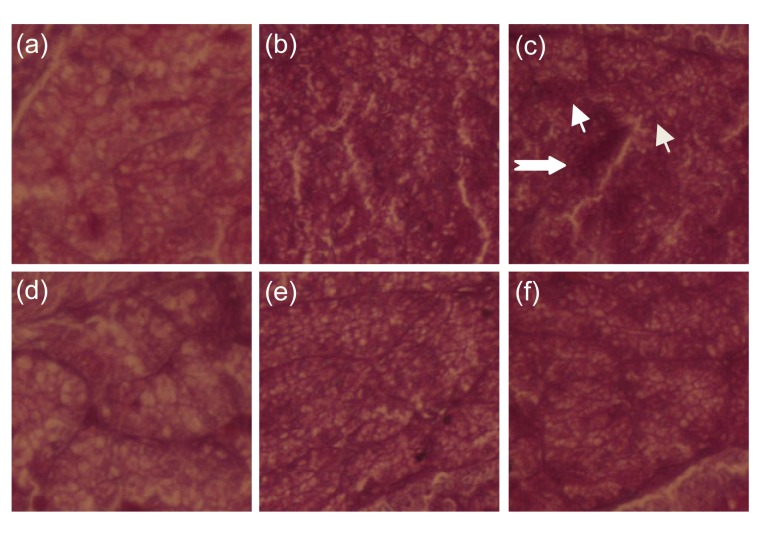
Fig. 1
Fig. 1
Histology of the oviduct in laying hens Oviduct sections are stained with hematoxylin and eosin (H&E). (a) Free range control group; (b) Low-density control group; (c) High-density control group; (d) Free range taurine treatment group; (e) Low-density taurine treatment group; (f) High-density taurine treatment group. Thin arrow: neutrophils; Thick arrow: erythrocyte. Original magnification: 200×
Fig. 2
Fig. 2
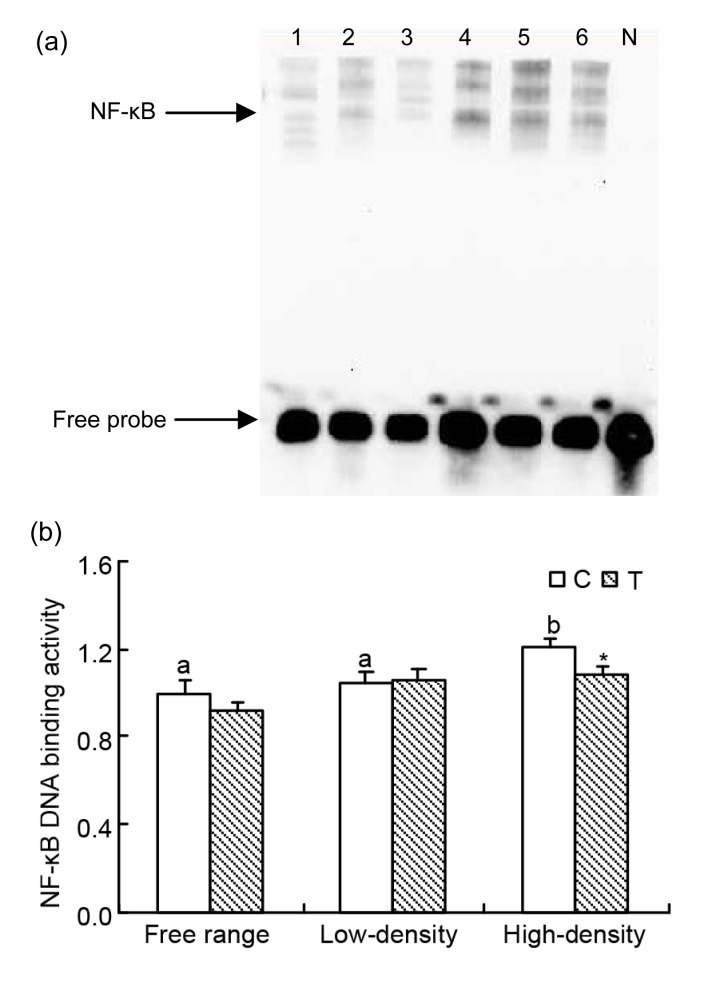
Effect of taurine on NF-κB DNA binding activity by EMSA analysis in oviduct tissue from laying hens (a) Lanes 1 and 2 are control and treatment groups in a free range environment; Lanes 3 and 4 are control and treatment groups in a low-density caged environment; Lanes 5 and 6 are control and treatment groups in a high-density caged environment; Lane N is a negative control. (b) Results of statistical analysis for NF-κB DNA binding activities. Data are presented as the mean±SEM (n=10). * Significant difference between control and treatment groups in the same rearing pattern (P<0.05). The means not sharing a common letter are significantly different for control groups (P<0.05)
Fig. 3
Fig. 3
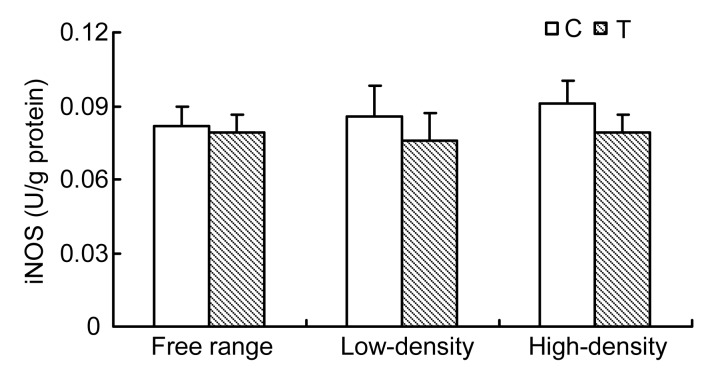
Changes in oviduct iNOS of laying hens housed in different conditions Data are presented as mean±SEM (n=10)
Fig. 4
Fig. 4
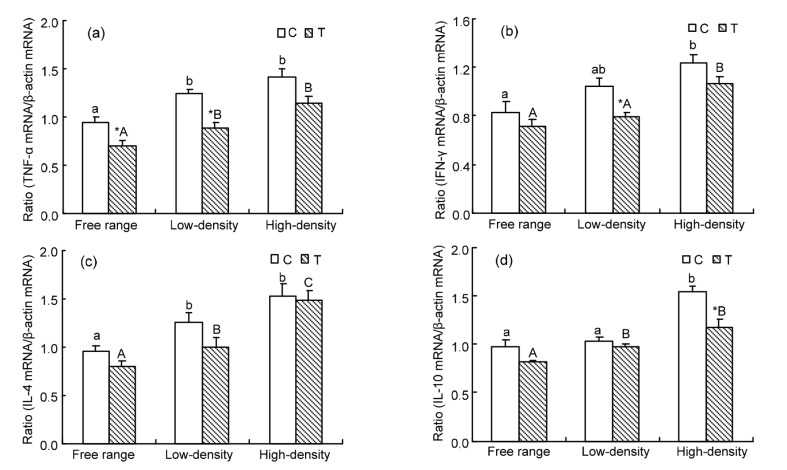
Changes in TNF-α (a), IFN-γ (b), IL-4 (c), and IL-10 (d) gene expression in oviducts of laying hens housed in different conditions The expression levels of each gene were determined by real-time RT-PCR, and the expressed RNA levels were normalized to β-actin as a ratio of the gene of interest/β-actin mRNA levels. Data are presented as mean±SEM (n=10). * Significant difference between control and treatment groups in the same rearing pattern (P<0.05). The means not sharing a common letter are significantly different (small letters for control groups and capital letters for treatment groups; P<0.05)
Fig. 5
Fig. 5
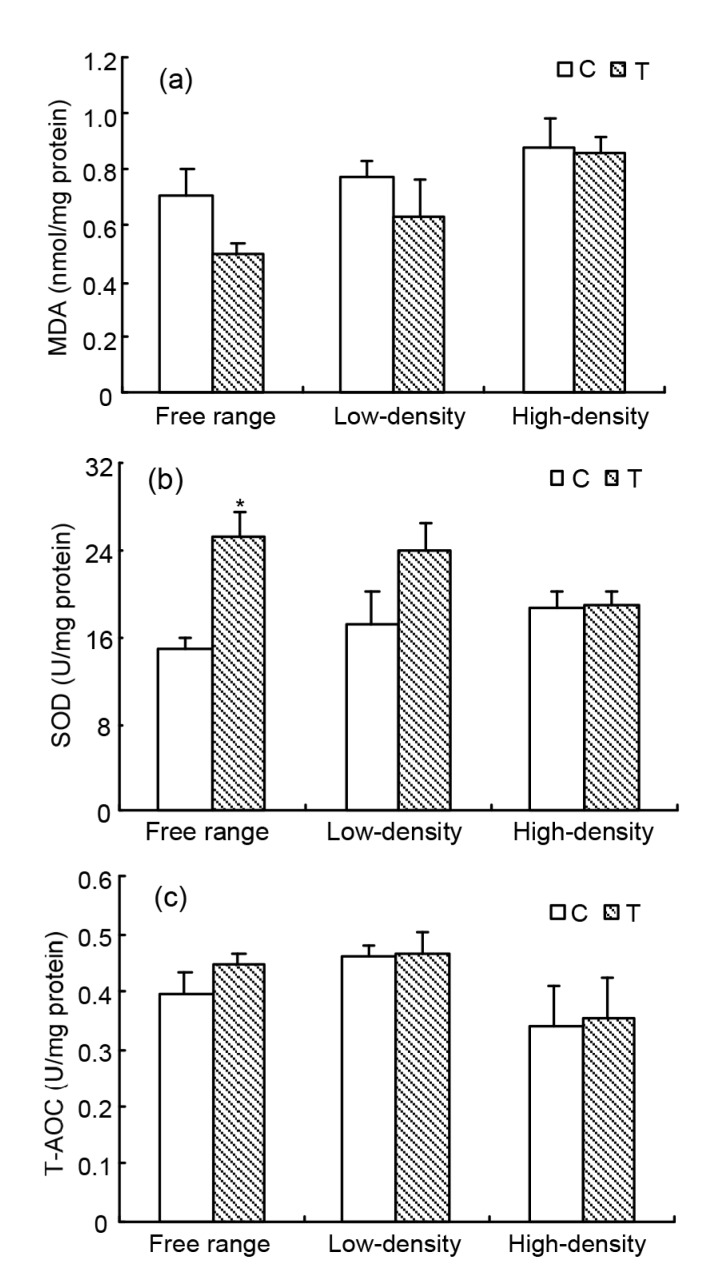
Changes in MDA (a) and T-AOC (c) levels and SOD activity (b) in the oviduct of laying hens housed in different conditions Data are presented as the mean±SEM (n=10). * Significant difference between control and treatment groups in the same rearing pattern (P<0.05)

References

    1. Bae SM, Lim W, Jeong W, et al. Hormonal regulation of beta-catenin during development of the avian oviduct and its expression in epithelial cell-derived ovarian carcinogenesis. Mol Cell Endocrinol. 2014;382(1):46–54. doi: 10.1016/j.mce.2013.09.010. - DOI - PubMed
    1. Baker RG, Hayden MS, Ghosh S. NF-κB, inflammation, and metabolic disease. Cell Metab. 2011;13(1):11–22. doi: 10.1016/j.cmet.2010.12.008. - DOI - PMC - PubMed
    1. Beshay E, Carrier S. Oxidative stress plays a role in diabetes-induced bladder dysfunction in a rat model. Urology. 2004;64(5):1062–1067. doi: 10.1016/j.urology.2004.06.021. - DOI - PubMed
    1. Buijs S, van Poucke E, van Dongen S, et al. The influence of stocking density on broiler chicken bone quality and fluctuating asymmetry. Poult Sci. 2012;91(8):1759–1767. doi: 10.3382/ps.2011-01859. - DOI - PubMed
    1. Burt D. Applications of biotechnology in the poultry industry. Worlds Poult Sci J. 2002;58(1):5–13. doi: 10.1079/WPS20020002. - DOI

Publication types