


Sugar-sweetened beverage, diet soda, and fatty liver disease in the Framingham Heart Study cohorts
- PMID: 26055949
- PMCID: PMC4827616
- DOI: 10.1016/j.jhep.2015.03.032
Sugar-sweetened beverage, diet soda, and fatty liver disease in the Framingham Heart Study cohorts
Abstract
Background & aims: Non-alcoholic fatty liver disease affects ∼30% of US adults, yet the role of sugar-sweetened beverages and diet soda on these diseases remains unknown. We examined the cross-sectional association between intake of sugar-sweetened beverages or diet soda and fatty liver disease in participants of the Framingham Offspring and Third Generation cohorts.
Methods: Fatty liver disease was defined using liver attenuation measurements generated from computed tomography in 2634 participants. Alanine transaminase concentration, a crude marker of fatty liver disease, was measured in 5908 participants. Sugar-sweetened beverage and diet soda intake were estimated using a food frequency questionnaire. Participants were categorized as either non-consumers or consumers (3 categories: 1 serving/month to <1 serving/week, 1 serving/week to <1 serving/day, and ⩾1 serving/day) of sugar-sweetened beverages or diet soda.
Results: After adjustment for age, sex, smoking status, Framingham cohort, energy intake, alcohol, dietary fiber, fat (% energy), protein (% energy), diet soda intake, and body mass index, the odds ratios of fatty liver disease were 1, 1.16 (0.88, 1.54), 1.32 (0.93, 1.86), and 1.61 (1.04, 2.49) across sugar-sweetened beverage consumption categories (p trend=0.04). Sugar-sweetened beverage consumption was also positively associated with alanine transaminase levels (p trend=0.007). We observed no significant association between diet soda intake and measures of fatty liver disease.
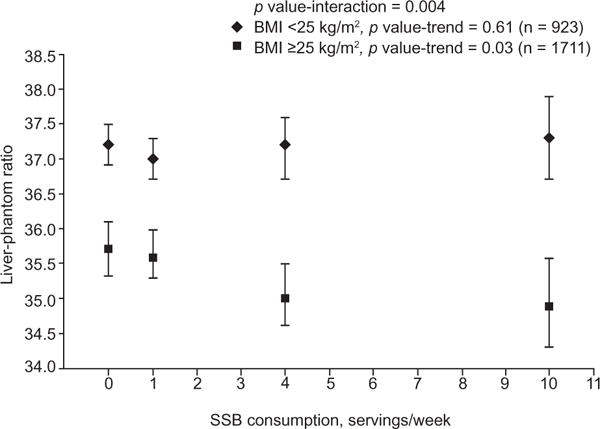
Conclusion: In conclusion, we observed that regular sugar-sweetened beverage consumption was associated with greater risk of fatty liver disease, particularly in overweight and obese individuals, whereas diet soda intake was not associated with measures of fatty liver disease.
Keywords: Alanine transaminase; Diet soda; Fatty liver disease; Sugar-sweetened beverages.
Copyright © 2015 European Association for the Study of the Liver. All rights reserved.
Conflict of interest statement
The authors who have taken part in this study declared that they do not have anything to disclose regarding funding or conflict of interest with respect to this manuscript.
Figures
Comment in
-
Sugar sweetened beverages and fatty liver disease: Rising concern and call to action.J Hepatol. 2015 Aug;63(2):306-8. doi: 10.1016/j.jhep.2015.05.021. Epub 2015 May 30. J Hepatol. 2015. PMID: 26036988 No abstract available.
-
NAFLD: Sugary drinks and fatty liver--a bitter-sweet relationship.Nat Rev Gastroenterol Hepatol. 2015 Aug;12(8):430. doi: 10.1038/nrgastro.2015.108. Epub 2015 Jun 23. Nat Rev Gastroenterol Hepatol. 2015. PMID: 26100370 No abstract available.
References
-
- Chalasani N, Younossi Z, Lavine JE, Diehl AM, Brunt EM, Cusi K, et al. The diagnosis and management of non-alcoholic fatty liver disease: practice Guideline by the American Association for the Study of Liver Diseases, American College of Gastroenterology, and the American Gastroenterological Association. Hepatology. 2012;55:2005–2023. - PubMed
-
- Angulo P. Nonalcoholic fatty liver disease. N Engl J Med. 2002;346:1221–1231. - PubMed
-
- Targher G, Day CP, Bonora E. Risk of cardiovascular disease in patients with nonalcoholic fatty liver disease. N Engl J Med. 2010;363:1341–1350. - PubMed
-
- McCullough AJ. The clinical features, diagnosis and natural history of nonalcoholic fatty liver disease. Clin Liver Dis. 2004;8:521–533, viii. - PubMed
Publication types
MeSH terms
Substances
Grants and funding
LinkOut - more resources
Full Text Sources
Other Literature Sources
Medical
