


Workable male sterility systems for hybrid rice: Genetics, biochemistry, molecular biology, and utilization
- PMID: 26055995
- PMCID: PMC4883997
- DOI: 10.1186/s12284-014-0013-6
Workable male sterility systems for hybrid rice: Genetics, biochemistry, molecular biology, and utilization
Abstract
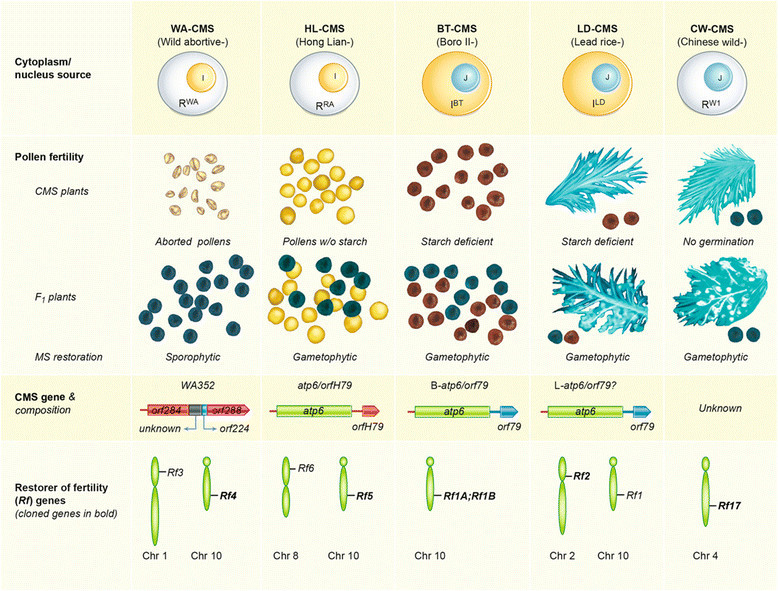
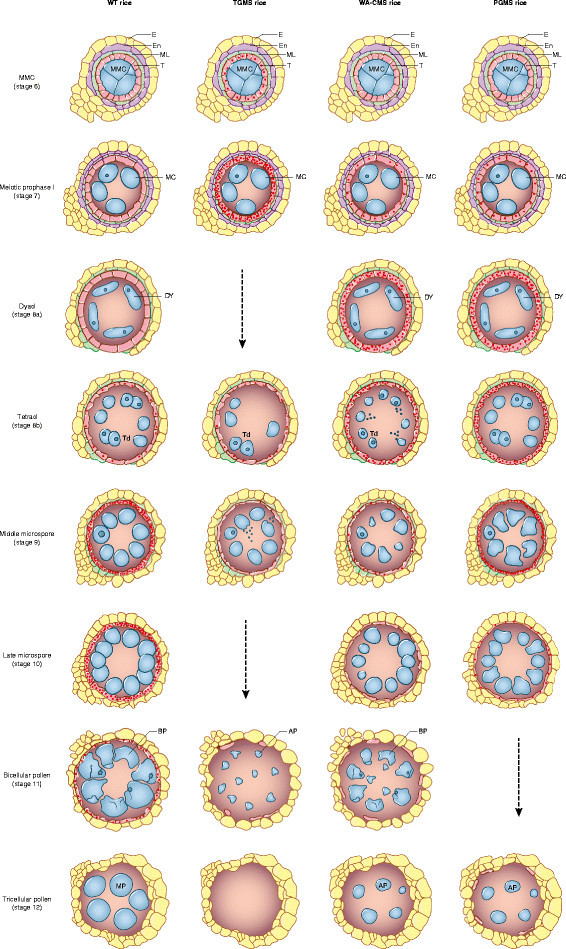
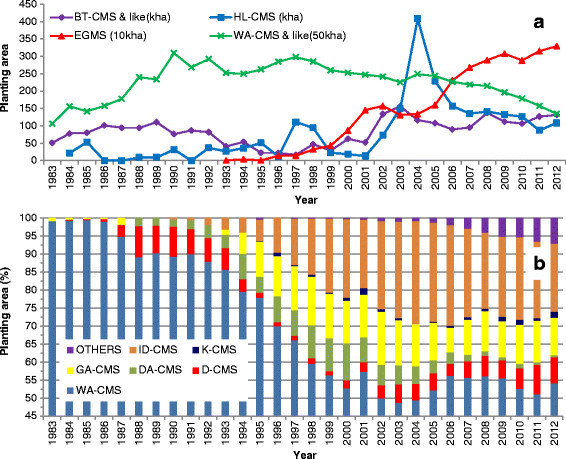
The exploitation of male sterility systems has enabled the commercialization of heterosis in rice, with greatly increased yield and total production of this major staple food crop. Hybrid rice, which was adopted in the 1970s, now covers nearly 13.6 million hectares each year in China alone. Various types of cytoplasmic male sterility (CMS) and environment-conditioned genic male sterility (EGMS) systems have been applied in hybrid rice production. In this paper, recent advances in genetics, biochemistry, and molecular biology are reviewed with an emphasis on major male sterility systems in rice: five CMS systems, i.e., BT-, HL-, WA-, LD- and CW- CMS, and two EGMS systems, i.e., photoperiod- and temperature-sensitive genic male sterility (P/TGMS). The interaction of chimeric mitochondrial genes with nuclear genes causes CMS, which may be restored by restorer of fertility (Rf) genes. The PGMS, on the other hand, is conditioned by a non-coding RNA gene. A survey of the various CMS and EGMS lines used in hybrid rice production over the past three decades shows that the two-line system utilizing EGMS lines is playing a steadily larger role and TGMS lines predominate the current two-line system for hybrid rice production. The findings and experience gained during development and application of, and research on male sterility in rice not only advanced our understanding but also shed light on applications to other crops.
Figures
References
-
- Ahmadikhah A, Karlov GI. Molecular mapping of the fertility-restoration gene Rf4 for WA-cytoplasmic male sterility in rice. Plant Breeding. 2006;125:363–367. doi: 10.1111/j.1439-0523.2006.01246.x. - DOI
-
- Akagi H, Nakamura A, Yokozeki-Misono Y, Inagaki A, Takahashi H, Mori K, Fujimura T. Positional cloning of the rice Rf-1 gene, a restorer of BT-type cytoplasmic male sterility that encodes a mitochondria-targeting PPR protein. Theor Appl Genet. 2004;108:1449–1457. doi: 10.1007/s00122-004-1591-2. - DOI - PubMed
LinkOut - more resources
Full Text Sources
Other Literature Sources
Research Materials
Miscellaneous
