


User preference for a portable syringe pump for iloprost infusion
- PMID: 26056502
- PMCID: PMC4447001
- DOI: 10.2147/PROM.S81473
User preference for a portable syringe pump for iloprost infusion
Abstract
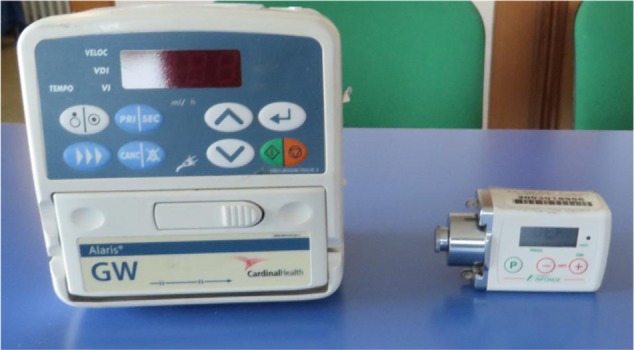
Purpose: Administration of intravenous iloprost - a first-line European League Against Rheumatism (EULAR)-recommended choice for the treatment of scleroderma (SSc)-related digital vasculopathy - requires repeated treatment cycles of 6 hours per day in a hospital setting. During the infusion, patient mobility is considerably restricted due to the size and fixity of traditional syringe pumps. The aim of this study was to evaluate the satisfaction level of patients and nurses, after the introduction of a new portable syringe pump (Infonde(®), Italfarmaco S.p.A., Milan, Italy) at the Department of Rheumatology, Magenta Hospital, Milan, Italy.
Patients and methods: Thirty-four consecutive SSc patients receiving stable therapy with iloprost, previously administered with a fixed pump, were treated using the portable Infonde(®) pump. Patients (n=34) and nurses (n=4) were asked to answer a nine- and six-item questionnaire, respectively, to assess the satisfaction of the administration comparing the new device versus the previous one. The health care staff of the ward developed the questionnaire, and the response scores ranged from 0 (fixed device better) to 10 (portable device better); thus a score >5 indicates a preference for Infonde(®).
Results: Patients' answers indicated a preference towards the new portable syringe pump, versus the previous fixed pump. Questionnaires administered to patients generated a total of 306 responses, with over 95% of the responses in the range 8-10, of which 89% had a score equal to 10. The responses of nurses showed a score equal to 10 in 100% cases. No significant adverse events were recorded, indicating no change in the tolerability profile of the drug.
Conclusion: Iloprost administration with Infonde(®) pump was preferred by both patients and health care professionals, and was well tolerated. The possibility to perform daily activities and the freedom of movement suggest a positive impact of Infonde(®) on the treatment, with a potential favorable effect on the quality of life of patients during the many hours spent receiving the infusion.
Keywords: Raynaud’s phenomenon; delivery device; quality of life; scleroderma.
Figures
References
-
- Gabrielli A, Avvedimento EV, Krieg T. Scleroderma. N Engl J Med. 2009;360:1989–2003. - PubMed
-
- Galluccio F, Matucci-Cerinic M. Two faces of the same coin: Raynaud phenomenon and digital ulcers in systemic sclerosis. Autoimmun Rev. 2011;10:241–243. - PubMed
-
- LeRoy EC, Medsger TA. Raynaud’s phenomenon: a proposal for classification. Clin Exp Rheumatol. 1992;10:485–488. - PubMed
-
- Herrick AL. Pathogenesis of Raynaud’s phenomenon. Rheumatology. 2005;44:587–596. - PubMed
-
- Kowal-Bielecka O, Landewé R, Avouac J, et al. EUSTAR Co-Authors EULAR recommendations for the treatment of systemic sclerosis: a report from the EULAR Scleroderma Trials and Research group (EUSTAR) Ann Rheum Dis. 2009;68:620–628. - PubMed
LinkOut - more resources
Full Text Sources
