. 2015 Jul 14;113(2):282-9.
doi: 10.1038/bjc.2015.195. Epub 2015 Jun 9.

Tumour-suppressive microRNA-144-5p directly targets CCNE1/2 as potential prognostic markers in bladder cancer

Affiliations

Tumour-suppressive microRNA-144-5p directly targets CCNE1/2 as potential prognostic markers in bladder cancer

R Matsushita et al. Br J Cancer. .

Abstract

Background: Analysis of a microRNA (miRNA) expression signature of bladder cancer (BC) by deep-sequencing revealed that clustered miRNAs microRNA (miR)-451a, miR-144-3p, and miR-144-5p were significantly downregulated in BC tissues. We hypothesised that these miRNAs function as tumour suppressors in BC. The aim of this study was to investigate the functional roles of these miRNAs and their modulation of cancer networks in BC cells.

Methods: The functional studies of BC cells were performed using transfection of mature miRNAs. Genome-wide gene expression analysis, in silico analysis, and dual-luciferase reporter assays were applied to identify miRNA targets. The association between miR-144-5p levels and expression of the target genes was determined, and overall patient survival as a function of target gene expression was estimated by the Kaplan-Meier method.

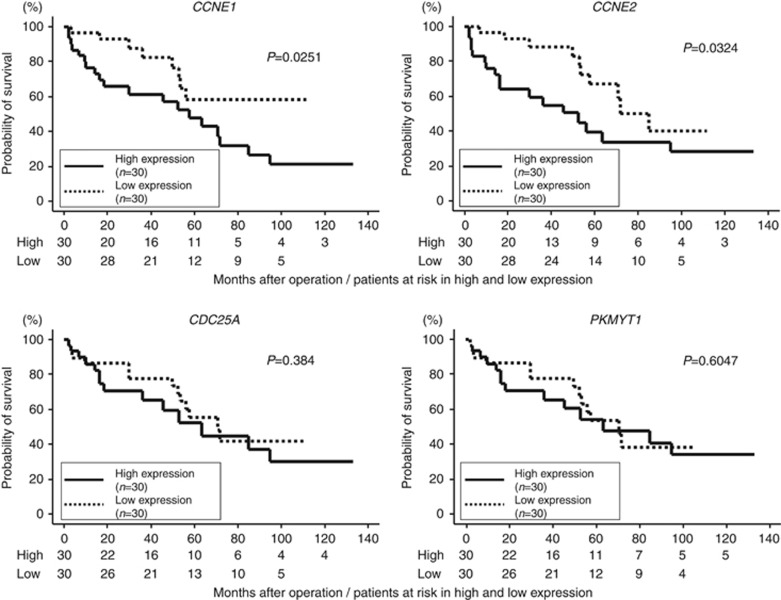
Results: Gain-of-function studies showed that miR-144-5p significantly inhibited cell proliferation by BC cells. Four cell cycle-related genes (CCNE1, CCNE2, CDC25A, and PKMYT1) were identified as direct targets of miR-144-5p. The patients with high CCNE1 or CCNE2 expression had lower overall survival probabilities than those with low expression (P=0.025 and P=0.032).

Conclusion: miR-144-5p functions as tumour suppressor in BC cells. CCNE1 and CCNE2 were directly regulated by miR-144-5p and might be good prognostic markers for survival of BC patients.


Figures
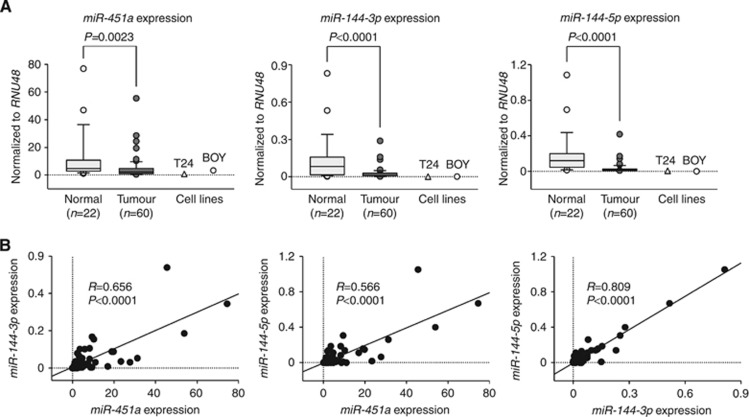
Figure 1
Figure 1
The expression levels of miR-451a, miR-144-3p, and miR-144-5p. (A) qRT–PCR showed that the expression levels of miR-451a, miR-144-3p, and miR-144-5p were significantly lower in BC tissues and BC cell lines (T24 and BOY) than in non-BC tissues. (B) The correlated expression of miR-451a, miR-144-3p, and miR-144-5p. The correlation coefficients 0.656, 0.566, and 0.809 with P<0.0001 indicated that miR-451a, miR-144-3p, and miR-144-5p expression levels were highly correlated with each other.
Figure 2
Figure 2
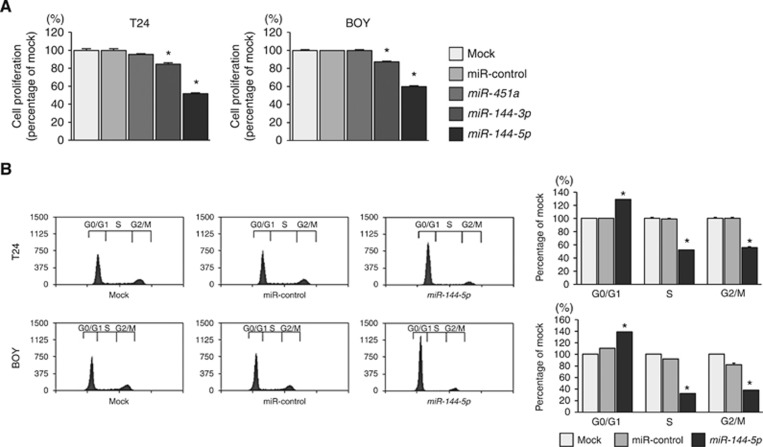
Effects of miR-451a, miR-144-3p, and miR-144-5p transfection on the functionality of BC cell lines. (A) The XTT assay showed significant inhibition of cell proliferation in miR-144-3p and miR-144-5p transfectants in comparison with mock or miR-control transfectants. *P<0.0001. (B) Flow cytometric analysis of cell cycle phase distribution in mock, miR-control, or miR-144-5p transfectants. The bar charts represent the percentage of mock in G0/G1, S, and G2/M phases. In miR-144-5p transfectants, the fraction of cells in the G0/G1 phase was significantly larger compared with mock or miR-control transfectants. *P<0.0001.
Figure 3
Figure 3
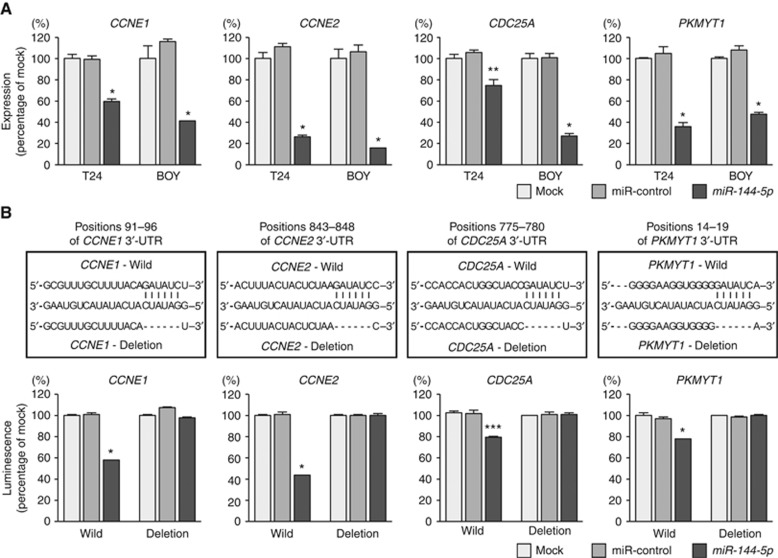
Direct regulation of CCNE1, CCNE2, CDC25A, and PKMYT1 by miR-144-5p. (A) The expression of CCNE1, CCNE2, CDC25A, and PKMYT1 were significantly repressed in miR-144-5p transfectants in comparison with mock or miR-control transfectants. GUSB was used as an internal control. *P<0.0001; **P=0.0022. (B) miR-144-5p binding sites in the 3′-UTRs of CCNE1, CCNE2, CDC25A, and PKMYT1 mRNAs. Dual-luciferase reporter assays using vectors encoding putative miR-144-5p target sites for wild-type or deleted regions. Normalised data were calculated as ratios of Renilla/firefly-luciferase activities. The luminescence intensity was significantly reduced by co-transfection with miR-144-5p and the vector carrying the wild-type, whereas transfection with the deletion vector blocked the decrease in luminescence. These data suggested that miR-144-5p bound directly to specific site in the 3′-UTRs of CCNE1, CCNE2, CDC25A, and PKMYT1 mRNAs. *P<0.0001; ***P=0.0002.
Figure 4
Figure 4
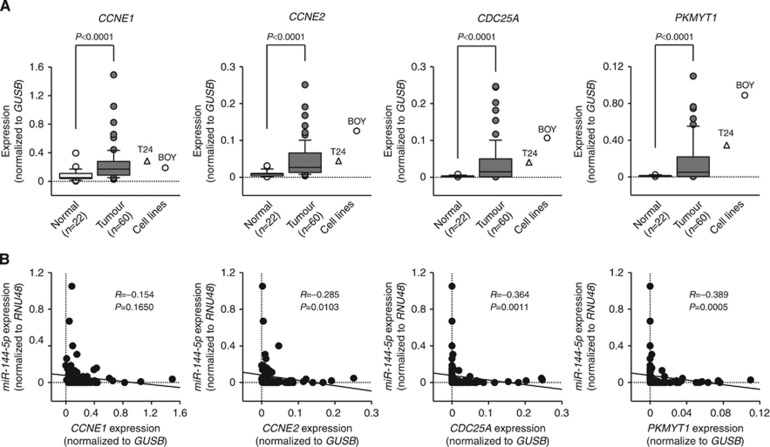
Expression levels of four miR-144-5p target genes. (A) The expression levels of CCNE1, CCNE2, CDC25A, and PKMYT1 were significantly upregulated in BC tissues and BC cell lines in comparison with the normal bladder tissues. (B) The correlated expression levels between miR-144-5p and CCNE1, CCNE2, CDC25A, and PKMYT1. Expression levels of miR-144-5p and CCNE2 or CDC25A or PKMYT1 were significantly negatively correlated with each other.
Figure 5
Figure 5
Kaplan–Meier survival plots for high and low expression groups for CCNE1, CCNE2, CDC25A, and PKMYT1 determined for 60 patients. Overall survival was significantly prolonged in patients with low CCNE1 and CCNE2 expression vs patients with high expression (P=0.0251 and P=0.0324, respectively).

References

    1. Bou Kheir T, Futoma-Kazmierczak E, Jacobsen A, Krogh A, Bardram L, Hother C, Gronbaek K, Federspiel B, Lund AH, Friis-Hansen L. miR-449 inhibits cell proliferation and is down-regulated in gastric cancer. Mol Cancer. 2011;10:29. - PMC - PubMed
    1. Brunetto E, Ferrara AM, Rampoldi F, Talarico A, Cin ED, Grassini G, Spagnuolo L, Sassi I, Ferro A, Cuorvo LV, Barbareschi M, Piccinin S, Maestro R, Pecciarini L, Doglioni C, Cangi MG. CDC25A protein stability represents a previously unrecognized target of HER2 signaling in human breast cancer: implication for a potential clinical relevance in trastuzumab treatment. Neoplasia. 2013;15:579–590. - PMC - PubMed
    1. Cai J, Liu X, Cheng J, Li Y, Huang X, Li Y, Ma X, Yu H, Liu H, Wei R. MicroRNA-200 is commonly repressed in conjunctival MALT lymphoma, and targets cyclin E2. Graefes Arch Clin Exp Ophthalmol. 2012;250:523–531. - PubMed
    1. Chiyomaru T, Enokida H, Tatarano S, Kawahara K, Uchida Y, Nishiyama K, Fujimura L, Kikkawa N, Seki N, Nakagawa M. miR-145 and miR-133a function as tumour suppressors and directly regulate FSCN1 expression in bladder cancer. Br J Cancer. 2010;102:883–891. - PMC - PubMed
    1. Chiyomaru T, Seki N, Inoguchi S, Ishihara T, Mataki H, Matsushita R, Goto Y, Nishikawa R, Tatarano S, Itesako T, Nakagawa M, Enokida H. Dual regulation of receptor tyrosine kinase genes EGFR and c-Met by the tumor-suppressive microRNA-23b/27b cluster in bladder cancer. Int J Oncol. 2015;46:487–496. - PMC - PubMed

Publication types