. 2015 Jun 5;13(6):3625-39.
doi: 10.3390/md13063625.

Activation of RAF1 (c-RAF) by the Marine Alkaloid Lasonolide A Induces Rapid Premature Chromosome Condensation

Affiliations

Activation of RAF1 (c-RAF) by the Marine Alkaloid Lasonolide A Induces Rapid Premature Chromosome Condensation

Rozenn Jossé et al. Mar Drugs. .

Abstract

Lasonolide A (LSA), a potent antitumor polyketide from the marine sponge, Forcepia sp., induces rapid and reversible protein hyperphosphorylation and premature chromosome condensation (PCC) at nanomolar concentrations independent of cyclin-dependent kinases. To identify cellular targets of LSA, we screened 2951 shRNAs targeting a pool of human kinases and phosphatases (1140 RefSeqs) to identify genes that modulate PCC in response to LSA. This led to the identification of RAF1 (C-RAF) as a mediator of LSA-induced PCC, as shRNAs against RAF1 conferred resistance to LSA. We found that LSA induced RAF1 phosphorylation on Serine 338 within minutes in human colorectal carcinoma HCT-116, ovarian carcinoma OVCAR-8, and Burkitt's lymphoma CA46 cell lines. RAF1 depletion by siRNAs attenuated LSA-induced PCC in HCT-116 and OVCAR-8 cells. Furthermore, mouse embryonic fibroblasts (MEF) with homozygous deletion in Raf1, but not deletion in the related kinase Braf, were resistant to LSA-induced PCC. Complementation of Raf1-/- MEFs with wild-type human RAF1, but not with kinase-dead RAF1 mutant, restored LSA-induced PCC. Finally, the Raf inhibitor sorafenib, but not the MEK inhibitor AZD6244, effectively suppressed LSA-induced PCC. Our findings implicate a previously unknown, MAPK-independent role of RAF1 in chromatin condensation and potent activation of this pathway by LSA.

Keywords: c-raf; chromosome condensation; lasonolide A; myosin phosphatase; shRNA.


Figures
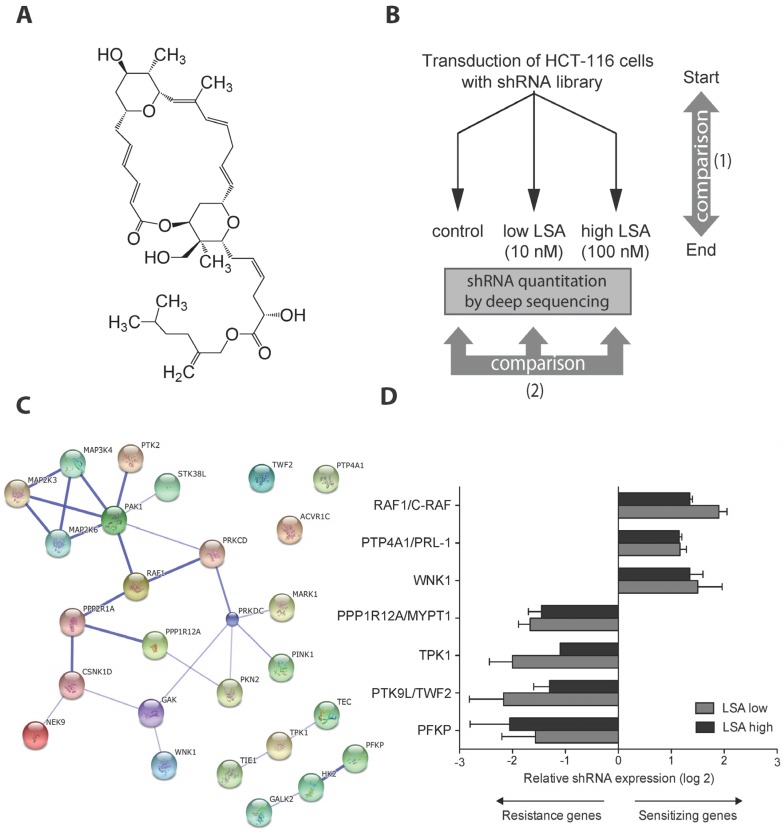
Figure 1
Figure 1
shRNA screen for genetic determinants of lasonolide A (LSA) sensitivity. (A) Chemical structure of LSA; (B) Scheme of the shRNA screen aiming to identify genes that modulate LSA sensitivity. A pooled retroviral shRNA library directed against kinases and phosphatases was transduced into HCT-116 colorectal cancer cells. Cells were cultured in the absence (control) or presence of LSA at two concentrations, 10 nM for 24 days or 100 nM for 14 days, respectively. Library compositions in starting and end samples were deconvoluted by deep sequencing to identify shRNAs that selectively dropped out or enriched in the LSA-treated samples; (C) Top candidates are enriched in known protein-protein interactions as determined by STRING; (D) shRNAs that enriched and dropped out selectively in the LSA treated samples. Results are expressed as the difference between the log2 ratio of (LSA/start) and the log2 ratio of (control/start). LSA low and high indicates the 10 nM and 100 nM treatment conditions, respectively. Genes whose shRNAs enriched with LSA treatment are potentially associated with LSA sensitivity, while genes whose shRNAs depleted with LSA treatment are potentially associated with resistance.
Figure 2
Figure 2
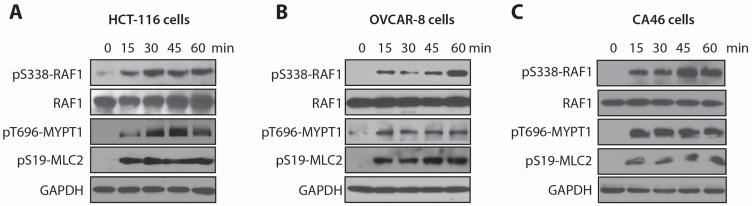
RAF1 and MYPT1, two candidates identified in the shRNA screen, are rapidly phosphorylated in response to LSA. (AC) Time course induction of RAF1 and MYPT1 phosphorylation by LSA in HCT-116 colorectal cancer cells (A), OVCAR-8 ovarian cancer cells (B) and CA46 Burkitt’s lymphoma cells (C). Cells were exposed to 100 nM LSA for the indicated times. RAF1 activation was evaluated by its phosphorylation on S338. MYPT1 inhibition was evaluated by its inhibitory phosphorylation on T696 and by MLC2 phosphorylation on S19 due to its MYPT1-mediated dephosphorylation on Ser19.
Figure 3
Figure 3
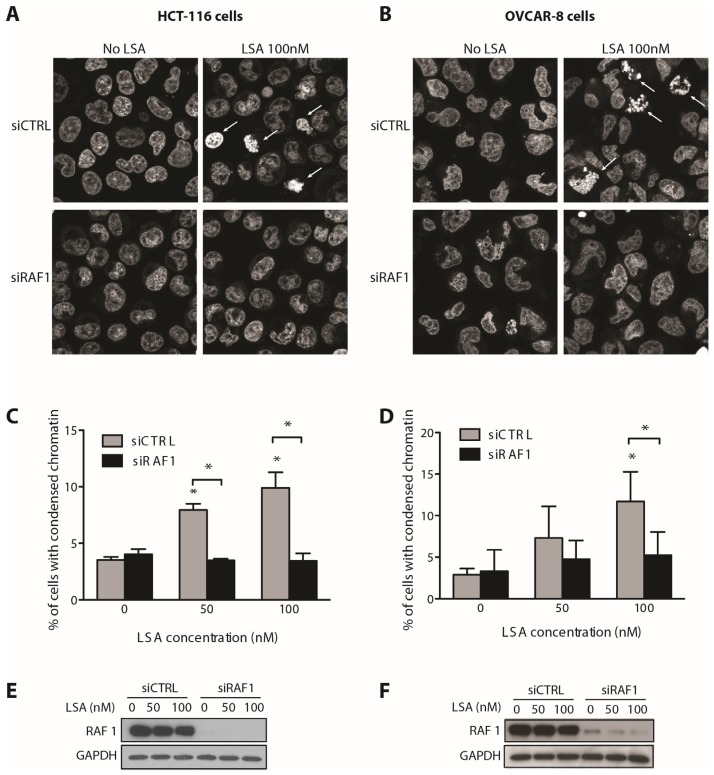
RAF1 is functionally required for LSA-induced premature chromosome condensation (PCC). (A,B) Representative images of PCC induced by LSA (100 nM, 30 min) in HCT-116 (A) and OVCAR-8 (B) cells. Cells were transduced with control or RAF1 siRNA 3 days prior to LSA treatment (100 nM, 30 min). Arrows indicate cells with PCC. DNA is visualized using propidium iodide; (C,D) Quantification of PCC induced by LSA (50 or 100 nM, 30 min) in HCT-116 (C) and OVCAR-8 (D) cells (results are mean ± SD of 3 independent experiments. * p < 0.01); (E,F) Immunoblots confirming knockdown of RAF1 in HCT-116 (E) and OVCAR-8 (F) cells.
Figure 4
Figure 4
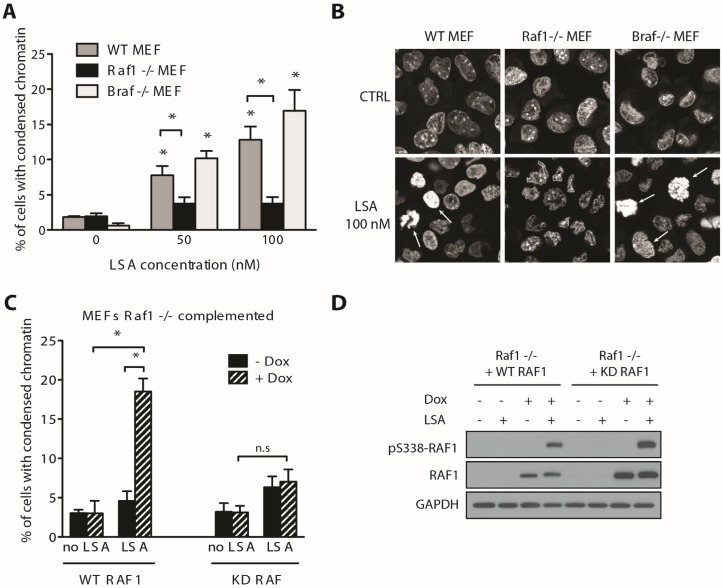
LSA-induced PCC requires RAF1 kinase activity but is not dependent on BRAF. (A) Relative PCC induced by LSA (100 nM, 30 min) in WT, Raf1−/− and Braf−/− mouse embryonic fibroblasts (MEFs). Results are the mean ± SD of 3 independent experiments. * p < 0.01; (B) Representative images of PCC induced by LSA in WT, Raf1−/− and Braf−/− MEFs. Arrows indicate cells counted as PCC. DNA is visualized using propidium iodide; (C) Chromatin condensation induced by LSA (100 nM, 30 min) in Raf1−/− MEFs complemented with tetracycline-inducible WT or kinase dead (KD) human RAF1 cDNA. Cells were induced with doxycycline (Dox, 1 μg/mL for 24 h) prior to LSA treatment. Results are mean ± SD of 3 independent experiments. * p < 0.01; (D) Immunoblotting confirming the induction of WT or KD RAF1 by doxycycline.
Figure 5
Figure 5
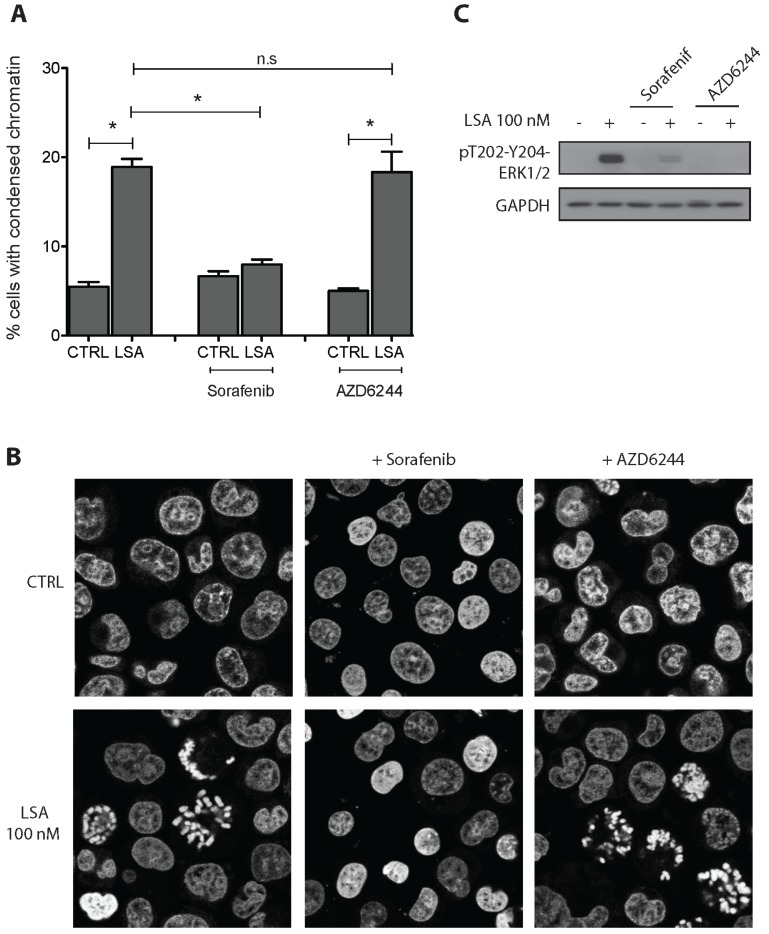
Pharmacological inhibition of RAF1, but not MEK1/2, reduced LSA-induced PCC. (A) PCC induced by LSA (100 nM) in HCT-116 cells pre-treated for 1 h with 10 μM of sorafenib or AZD6244 and then co-treated with LSA for 30 min. Results are the mean ± SD of 3 independent experiments. * p < 0.01; (B) Representative images of PCC induced by LSA with or without pre-treatment with sorafenib or AZD6244. DNA is visualized using propidium iodide; (C) Immunoblotting confirming the inhibition of ERK1/2 phosphorylation by AZD6244.
Figure 6
Figure 6
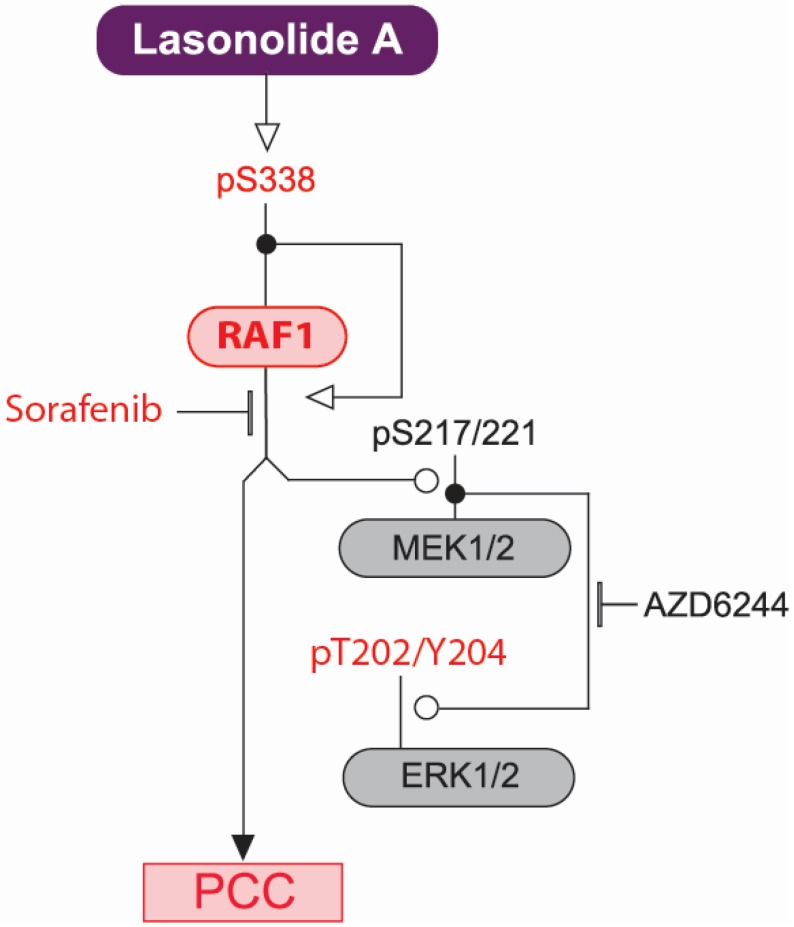
Proposed pathway of the major role of RAF1 in LSA-induced PCC. In red are the phosphorylation sites induced in response to LSA exposure. Annotations are derived from the Kohn molecular interaction map (MIM) conventions [38]. Nodes at intercepting lines are the post-translationally modified proteins. Open arrowhead indicates activation; open circles indicate phosphorylations, and short bars inhibition.

References

    1. Bailly C. Lamellarins, from A to Z: A family of anticancer marine pyrrole alkaloids. Curr. Med. Chem. Anticancer Agents. 2004;4:363–378. doi: 10.2174/1568011043352939. - DOI - PubMed
    1. Newman D.J., Cragg G.M. Marine-sourced anti-cancer and cancer pain control agents in clinical and late preclinical development. Mar. Drugs. 2014;12:255–278. doi: 10.3390/md12010255. - DOI - PMC - PubMed
    1. Mayer A.M., Glaser K.B., Cuevas C., Jacobs R.S., Kem W., Little R.D., McIntosh J.M., Newman D.J., Potts B.C., Shuster D.E. The odyssey of marine pharmaceuticals: A current pipeline perspective. Trends Pharmacol. Sci. 2010;31:255–265. doi: 10.1016/j.tips.2010.02.005. - DOI - PubMed
    1. Schumacher M., Kelkel M., Dicato M., Diederich M. Gold from the sea: Marine compounds as inhibitors of the hallmarks of cancer. Biotechnol. Adv. 2011;29:531–547. doi: 10.1016/j.biotechadv.2011.02.002. - DOI - PubMed
    1. Radjasa O.K., Vaske Y.M., Navarro G., Vervoort H.C., Tenney K., Linington R.G., Crews P. Highlights of marine invertebrate-derived biosynthetic products: Their biomedical potential and possible production by microbial associants. Bioorg. Med. Chem. 2011;19:6658–6674. doi: 10.1016/j.bmc.2011.07.017. - DOI - PMC - PubMed

Publication types

MeSH terms

LinkOut - more resources