


Review
doi: 10.1002/jcp.25062.
C-ing the Genome: A Compendium of Chromosome Conformation Capture Methods to Study Higher-Order Chromatin Organization
Affiliations
- PMID: 26059817
- PMCID: PMC4586368
- DOI: 10.1002/jcp.25062
Item in Clipboard
Review
C-ing the Genome: A Compendium of Chromosome Conformation Capture Methods to Study Higher-Order Chromatin Organization
J Cell Physiol.
2016 Jan.
Abstract
Three-dimensional organization of the chromatin has important roles in transcription, replication, DNA repair, and pathologic events such as translocations. There are two fundamental ways to study higher-order chromatin organization: microscopic and molecular approaches. In this review, we briefly introduce the molecular approaches, focusing on chromosome conformation capture or "3C" technology and its derivatives, which can be used to probe chromatin folding at resolutions beyond that provided by microscopy techniques. We further discuss the different types of data generated by the 3C-based methods and how they can be used to answer distinct biological questions.
© 2015 Wiley Periodicals, Inc.
Figures
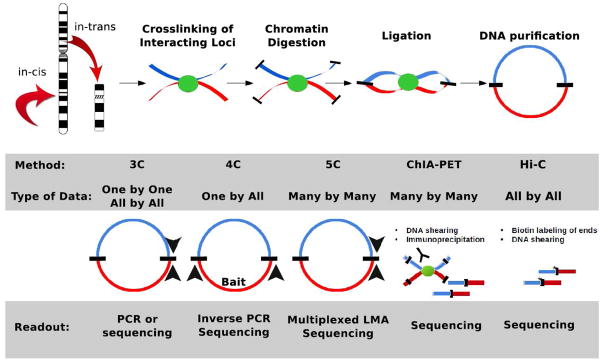
An overview of the 3C-based techniques for intra- and interchromosaomal interactions. They share a procedural front end that includes crosslinking, restriction-enzyme digestion, DNA ligation in dilute conditions, and DNA purification. Downstream, however, there are major differences in detection of these ligation products that yield significantly different types of data.
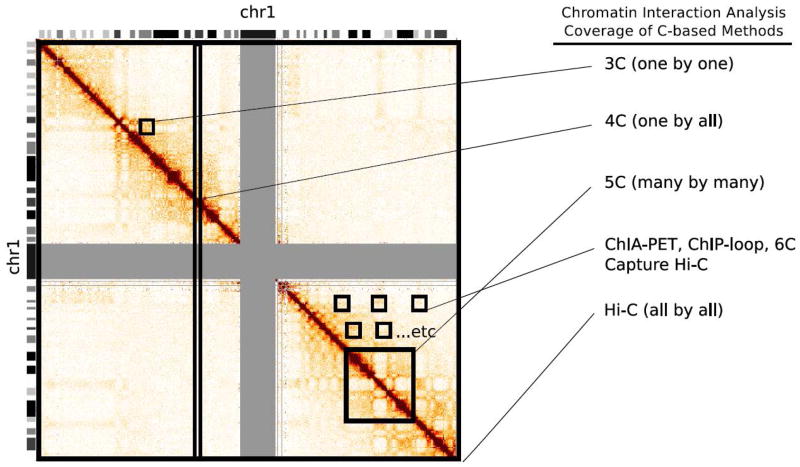
An example Hi-C heatmap depicting the types of data generated by 3C or 3C-based methods. 3C queries interactions on a one-by-one basis; 4C identifies interactions between a single region and the rest of the genome; 5C generates a high-resolution interaction matrix of a large genomic region; Capture Hi-C, ChIA-PET and other ChIP-based methods characterize chromatin-looping interactions over several different loci; and finally Hi-C queries genome-wide chromatin interactions at low or high resolution.
References
-
- Amano T, Sagai T, Tanabe H, Mizushina Y, Nakazawa H, Shiroishi T. Chromosomal dynamics at the Shh locus: limb bud-specific differential regulation of competence and active transcription. Developmental cell. 2009;16(1):47–57. - PubMed
-
- Cremer T, Cremer C, Baumann H, Luedtke EK, Sperling K, Teuber V, Zorn C. Rabl’s model of the interphase chromosome arrangement tested in Chinese hamster cells by premature chromosome condensation and laser-UV-microbeam experiments. Human genetics. 1982;60(1):46–56. - PubMed
Publication types
MeSH terms
Substances
Grants and funding
LinkOut - more resources
Full Text Sources
Other Literature Sources
